By Jayson · Updated July 2026 · 4-minute read
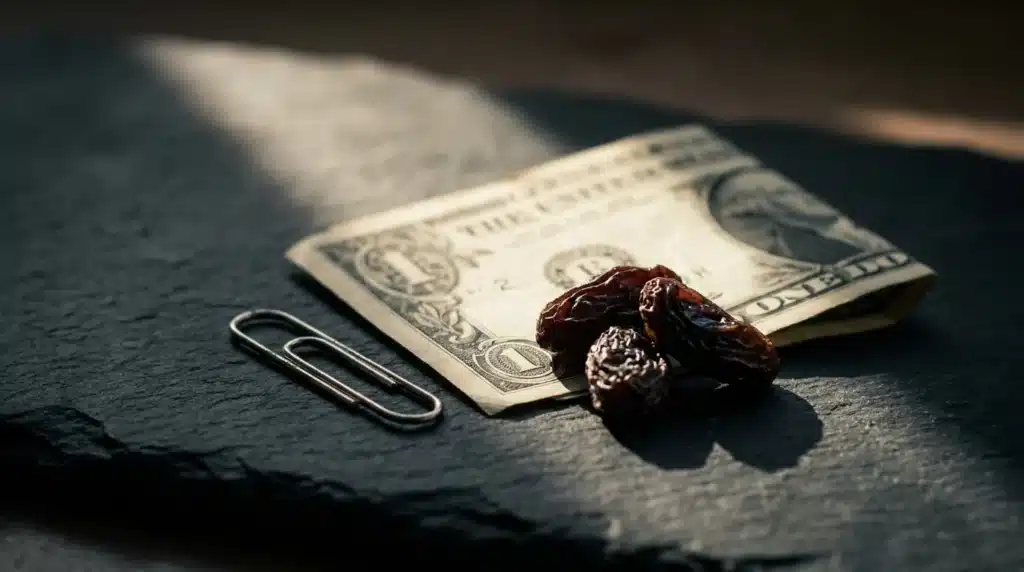
Quick answer: One gram is very light — about the weight of a single paperclip or a US dollar bill. It's one-thousandth of a kilogram. Below are 15 everyday things that weigh about a gram, and the kind of scale you need to actually measure one.
One gram is so light it's genuinely hard to feel. Put a paperclip in your palm and that's roughly it. Because a gram is this small, everyday comparisons are the only way most people can picture it — so here are 15 things that weigh about a gram.
A quick honesty note before the list: most of these are about a gram, not exact. A raisin's weight depends on its size; a paperclip depends on its gauge. Only a few, like a fresh dollar bill, land close to spot-on.
In this guide
- How light a gram is
- 15 things that weigh about a gram
- What weighs exactly 1 gram
- 1 gram vs. other tiny units
- The scale you need to measure a gram
- Common mistakes when weighing something this small
- FAQ
How light is 1 gram?
One gram is one-thousandth of a kilogram (0.001 kg). In imperial terms it's about 0.035 ounces — a tiny fraction of an ounce. The gram is defined from the kilogram, the SI base unit maintained by the BIPM.
That definition itself changed in 2019. For over a century, the kilogram — and by extension the gram — was defined by a single physical object: a platinum-iridium cylinder locked in a vault outside Paris, nicknamed "Le Grand K." The trouble was that even a carefully protected metal cylinder can gain or lose a few micrograms over decades, which meant the world's reference for a kilogram was, in principle, drifting. In 2019 the BIPM redefined the kilogram in terms of the Planck constant instead, a fixed physical value that doesn't degrade — so every gram weighed anywhere today ultimately traces back to a constant of nature, not a piece of metal in a French vault.
To put it in scale-calibration terms: a single US nickel weighs 5 grams, so a gram is one-fifth of a nickel. For that reference, see how much a nickel weighs.
Gram conversions at a glance
| A gram equals | Value |
|---|---|
| Kilograms | 0.001 kg |
| Milligrams | 1,000 mg |
| Ounces | 0.035 oz |
| Grams in an ounce | 28.35 |
| Grams in a nickel | 5 |
A gram sits between the milligram (a thousand of them make a gram) and the ounce (it takes 28 grams to make one). That in-between size is why it's the everyday unit for small kitchen and hobby measurements.
How to picture a gram
Hold a paperclip or lay a dollar bill flat on your palm — that's a gram. If you cook, a gram is about a quarter-teaspoon of sugar or salt. It's the smallest weight most people ever need to think about, and it's light enough that a breath of air or a fingerprint of oil can shift a reading.
15 things that weigh about a gram
All approximate — small objects vary by size and material.
| Object | Approx. weight |
|---|---|
| A US dollar bill | ~1 g |
| A small paperclip | ~1 g |
| A raisin | ~1 g |
| A thumbtack | ~1 g |
| A pen cap | ~1 g |
| A stick of gum | ~1 g |
| A jelly bean | ~1 g |
| A plastic bottle cap | ~1 g |
| A quarter-teaspoon of sugar | ~1 g |
| A coffee bean | ~1 g |
| Five grains of rice | ~1 g |
| A business card | ~1 g |
| A single sheet of paper | ~1 g |
| A grape | ~1 g |
| A birthday candle | ~1 g |
The theme: a gram is the weight of one small, light thing you'd barely notice picking up.
A few worth flagging:
- A dollar bill is the standout — it's manufactured to almost exactly 1 gram, so it's the most reliable everyday reference on the list.
- A paperclip varies by size: a small (No. 1) clip is about a gram, a jumbo clip is closer to 1.5 g.
- Rice is a useful one for tiny amounts — roughly five medium grains make a gram.
- A raisin depends entirely on size, from about 0.5 g for a small one to 1.5 g for a plump one.
Because a gram is so small, these are all rough — good for a mental picture, not for anything you need to be precise about.
It's also worth noticing what these examples have in common: they're all things you'd describe as "light" without a second thought, but none of them are so small you'd lose them in your palm. That's the practical range a gram occupies — small enough to be forgettable, large enough to still be a distinct, held object. Compare that to a milligram, which is genuinely invisible-feeling (a grain of table salt is roughly 1 mg), and the gram starts to feel almost substantial by comparison.
What weighs exactly 1 gram?
The closest everyday object to an exact gram is a US dollar bill — the Bureau of Engraving and Printing makes them at almost exactly 1 gram each. That makes a crisp, clean bill a surprisingly good pocket reference.
For anything that needs to be truly exact, though, a paper note or a raisin won't cut it — you'd want a certified 1-gram calibration weight.
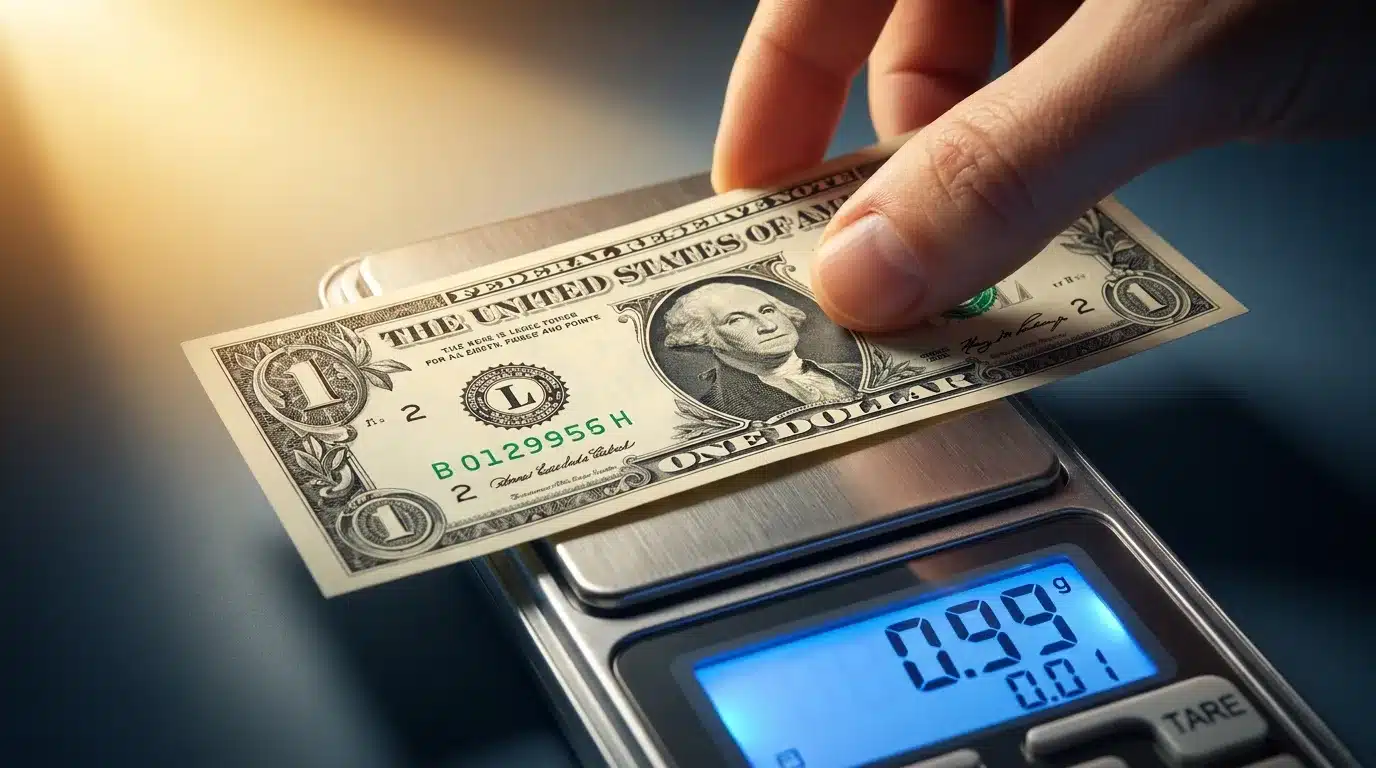 A crisp dollar bill is one of the few everyday items that lands close to exactly 1 gram.
1 Gram vs. Other Tiny Units
A gram doesn't sit in isolation — it's the anchor most other tiny-weight units are defined against or compared to. Knowing where it falls helps you pick the right scale for the job, not just the right object to picture.
| Unit | Relationship to 1 gram |
|---|---|
| Milligram (mg) | 1,000 mg = 1 gram |
| Grain (gn) | 1 gram ≈ 15.43 grains |
| Carat (ct) | 1 gram = 5 carats exactly |
| Pennyweight (dwt) | 1 gram ≈ 0.643 dwt |
| Troy ounce (ozt) | 1 gram ≈ 0.032 troy oz |
| Avoirdupois ounce (oz) | 1 gram ≈ 0.035 oz |
Two of these are worth calling out because people mix them up constantly. The carat, used for gemstones, is defined as exactly one-fifth of a gram — so a 1-carat diamond weighs 0.2 grams, and it takes five of them to make a single gram. The grain, used in reloading and pharmacy, is much smaller than a gram (roughly 15 grains per gram), which is why reloading scales usually read in tenths of a grain rather than whole grams.
If you're weighing anything in these adjacent units, a scale built for grams alone often can't switch cleanly — check that your scale's unit button actually includes the one you need before assuming "it does grams, so it does everything." A jewelry scale that toggles between grams, carats, and pennyweight at the touch of a button is a different tool than a kitchen scale that only ever reads in whole grams, even though both technically "measure grams."
Where grams actually matter
A gram is small, but it's the unit where precision counts most:
- Baking and coffee. Serious bakers and baristas weigh in grams because a few grams of flour or coffee changes the result. A standard espresso dose is 18-20 grams of coffee — a 1-2 gram miss is enough to noticeably change the shot. Whole-gram kitchen scales are common here, but precision baking (macarons, laminated dough) often calls for 0.1 g resolution.
- Jewelry and precious metals. Gold, silver, and gemstones trade by the gram (and fractions of a gram), so a 0.01 g jewelry scale is standard. At current gold prices, a 1-gram error on a piece of jewelry is a real dollar-value mistake, not a rounding error.
- Supplements and hobbies. Vitamins, spices, and reloading powders are measured in grams or fractions, where being off by a gram matters. A single gram of the wrong spice can throw off a recipe's balance; a gram of reloading powder is a meaningfully different charge.
- Mail. Lightweight items are often priced in grams internationally, so a small scale that reads grams accurately pays for itself the first time it saves you an overweight postage surcharge.
- Medication and dosing. Some over-the-counter and compounded medications are measured in gram or sub-gram amounts, where accuracy isn't optional — this is one of the few everyday uses where a scale reading a gram wrong has real consequences.
In all of these, the object usually weighs only a handful of grams — so the scale's accuracy at the low end is what matters. That's exactly where a quick check against a known 1-gram or 5-gram reference (a dollar bill, a nickel) earns its keep.
The scale you need to measure a gram
Here's the practical catch: most kitchen scales can't measure a single gram reliably. A scale that reads in whole grams (1 g steps) can be off by a gram just from rounding — useless when the whole thing weighs a gram.
To weigh grams accurately you need a digital pocket or jewelry scale that reads to 0.1 g, or 0.01 g for precise work like jewelry or reloading. If your scale reads to 0.01 g, test it with a dollar bill — it should show close to 1.0 g. When it drifts, our guide on how to calibrate a digital scale walks through the fix, and what weighs 100 grams covers the larger references.
At the gram level, small errors matter most, so scale calibration isn't optional — our complete guide explains why precision scales drift and how to keep them honest. A gram-scale reads its worst near the bottom of its range, which is exactly where you're working when a whole item weighs only a gram or two. Check it against a known reference often: a crisp dollar bill for 1 g, or a nickel for 5 g (see how much a nickel weighs). If those don't land, recalibrate before you weigh anything valuable — a fraction of a gram of gold, medication, or spice is worth getting right.
Common Mistakes When Weighing Something This Small
A single gram is small enough that small handling mistakes swing the reading by a meaningful percentage. A few worth knowing:
- Not letting the scale warm up. Precision scales stabilize their internal sensor over the first minute or two after power-on. Weighing a gram-sized item immediately can read low or high until the scale settles.
- Static and drafts. A light paper item like a dollar bill can pick up static and cling slightly to the platform, or shift in a draft — both throw off a reading this small. Weigh in a still room, away from air vents.
- Skipping the tare. If you're weighing a gram of something in a small dish or bag, forgetting to tare the container first means you're reading the container's weight, not the ingredient's — and most containers alone weigh more than a gram.
- Oily or dirty fingers on the platform. A fingerprint's worth of oil is a measurable fraction of a gram. Wipe the platform before weighing anything this light.
- Trusting a whole-gram display for fractional amounts. If your scale only shows whole grams, it's rounding — a true 0.6 g reading might display as "1 g" or "0" depending on which way it rounds. For anything under a gram, you need a scale with at least 0.1 g resolution.
Most of these are avoidable with a level, still surface and a clean platform — but they're worth checking first whenever a gram-level reading looks off, before assuming the scale itself is miscalibrated. If you've ruled out drafts, static, and a dirty platform and a 1-gram reference still reads wrong, that's the point to actually recalibrate rather than keep troubleshooting the environment.
Frequently asked questions
How much does 1 gram weigh? One gram is one-thousandth of a kilogram — very light. In everyday terms it's about the weight of a small paperclip, a US dollar bill, or a raisin.
What everyday object weighs about 1 gram? A US dollar bill weighs almost exactly 1 gram. A small paperclip, a raisin, a thumbtack, or a stick of gum are all about a gram too.
How can I measure 1 gram without a scale? Use a known 1-gram reference like a dollar bill for a rough sense. But a gram is too small to estimate reliably by hand — for anything that matters, use a scale that reads to 0.1 g or better.
What scale do I need to weigh 1 gram accurately? A digital pocket or jewelry scale with a readability of 0.1 g or finer (0.01 g for precise work). A kitchen scale that reads in whole grams can't resolve a single gram reliably.
How many grams are in an ounce? There are 28.35 grams in an ounce. So it takes about 28 of the objects on this list to add up to a single ounce.
Is a milligram the same as a gram? No. A milligram is one-thousandth of a gram, so 1,000 milligrams make 1 gram. Milligram amounts are far too small to weigh on a kitchen or pocket scale — they need a specialized milligram scale.
How many carats are in a gram? A carat is defined as exactly one-fifth of a gram, so 1 gram equals 5 carats. A 1-carat diamond weighs 0.2 grams.
Why did the definition of a gram change in 2019? The kilogram (and gram) used to be defined by a physical platinum-iridium cylinder in France, which could theoretically gain or lose tiny amounts of mass over time. In 2019 it was redefined using the Planck constant, a fixed value from physics, so the gram no longer depends on a single physical object anywhere in the world.
More weight references
- How Much Does a Nickel Weigh — scalecalibration.net/how-much-does-a-nickel-weigh/ — a nickel is exactly 5 grams.
- What Weighs an Ounce — scalecalibration.net/what-weighs-an-ounce/ — 28 grams of everyday objects.
- What Weighs 100 Grams — scalecalibration.net/what-weighs-100-grams/ — the classic metric reference.
- Calibration Weights: Which Class & Size — scalecalibration.net/calibration-weights/ — certified 1 g weights and up.