By Jayson · Updated August 2026 · 9-minute read
EN 45501 weighing instruments: are non-automatic weighing instruments (NAWIs) tested and classified according to EN 45501:2015, the EU harmonised standard that gives presumption of conformity with Directive 2014/31/EU's essential requirements. It defines four accuracy classes (I, II, III, IIII), sets the verification-scale-interval system those classes are built on, and specifies the type-examination tests — repeatability, eccentric loading, temperature and humidity — an instrument has to pass before it reaches the EU market.
Our NAWI Directive 2014/31/EU guide covers the legal framework EN 45501 weighing instruments sit inside. This one goes deep on the standard governing EN 45501 weighing instruments itself: what it actually requires, how its accuracy classes work, and where it comes from.
In this guide
- What EN 45501 weighing instruments actually means
- Relationship to OIML R76-1
- The four accuracy classes
- Type-examination tests it specifies
- Revision history: 1992 to 2015
- Who actually applies EN 45501
- Verify this yourself: official sources
- Common mistakes
- FAQ
What EN 45501 Weighing Instruments Actually Means
EN 45501 weighing instruments are governed by EN 45501:2015, "Metrological aspects of non-automatic weighing instruments" — the European harmonised standard listed under Directive 2014/31/EU for NAWIs. The European Commission's own harmonised-standards page confirms EN 45501:2015 as the current standard for this Directive, noted as "the first publication" with no earlier version superseded under 2014/31/EU specifically (the standard's own history goes back further, covered below).
Applying EN 45501 gives a manufacturer presumption of conformity with the Directive's Annex I essential requirements. That word "presumption" matters: using the standard is voluntary, not mandatory. A manufacturer could in principle demonstrate compliance another way, but in practice essentially every EN 45501 weighing instrument sold in the EU is designed and tested directly against this standard, because it's the accepted, unambiguous route to a type-examination certificate.
Relationship to OIML R76-1
The standard behind EN 45501 weighing instruments wasn't written from scratch. It was adapted from OIML R76-1 (the 2006 edition of the International Organization of Legal Metrology's recommendation on non-automatic weighing instruments) by a joint CEN/CENELEC working group. National adoptions of the standard state this directly, describing EN 45501:2015 as a revision of OIML R76-1:2006.
The two documents are substantively aligned — accuracy classes, maximum permissible errors, and test methods all follow the same underlying logic. WELMEC guidance has previously described EN 45501 and OIML R76 as "identical in substance" for their core metrological content. The practical difference is legal standing: OIML R76 is an international recommendation that individual countries can adopt, while EN 45501 is the version that actually carries legal weight for placing an instrument on the EU market under Directive 2014/31/EU.
The Four Accuracy Classes
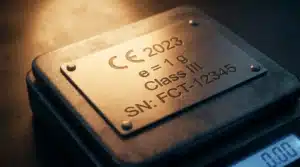
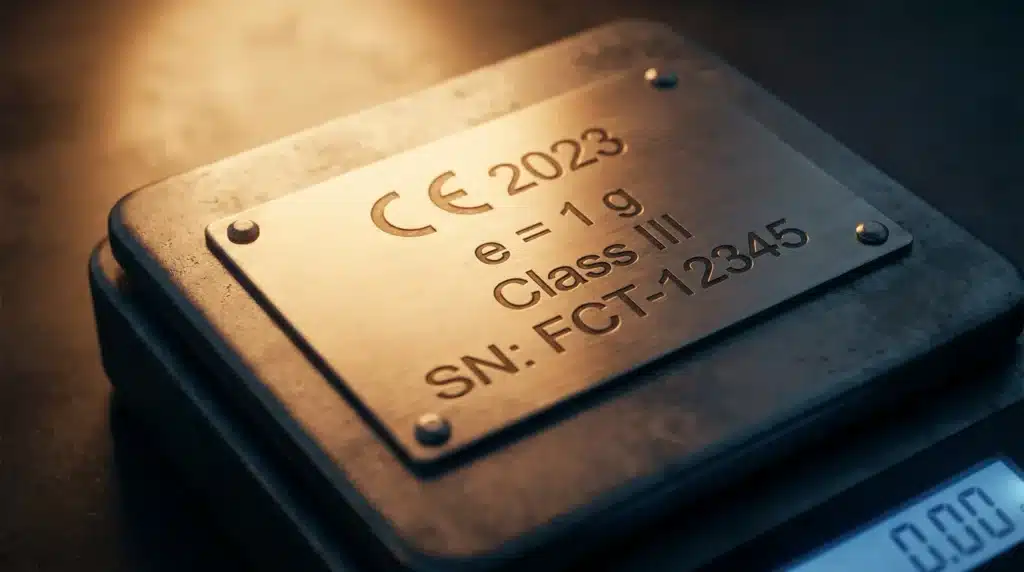
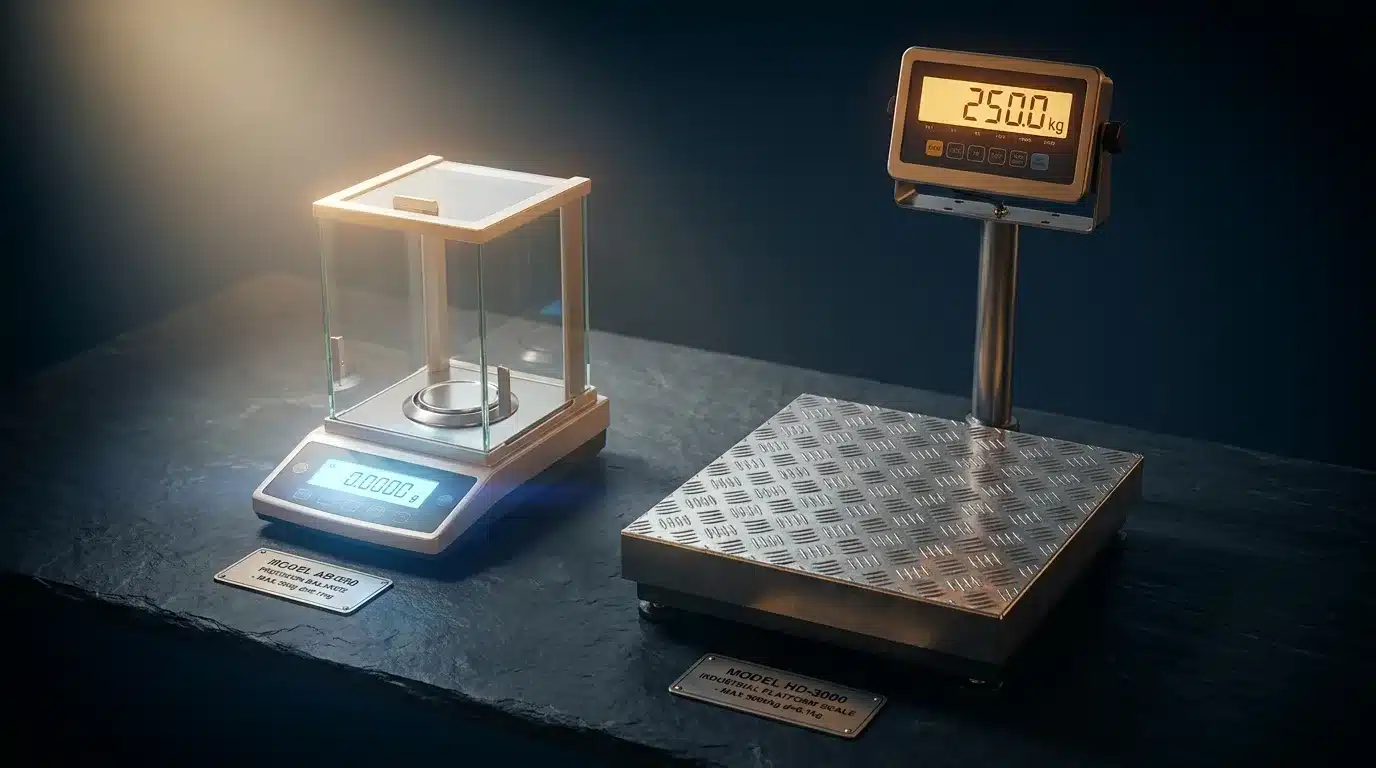 A Class I balance and a Class III trade scale meet completely different EN 45501 accuracy-class requirements, even though both are non-automatic weighing instruments.
All EN 45501 weighing instruments fall into one of four accuracy classes, built around two linked figures: the verification scale interval (e) — the smallest legally recognised division the instrument is verified against — and n, the number of verification scale intervals, calculated as n = Max ÷ e, where Max is the instrument's maximum capacity.
| Accuracy class | Typical verification interval (e) | Number of intervals (n = Max/e) | Minimum capacity |
|---|---|---|---|
| I — Special | e ≥ 0.001 g | up to 50,000 | 100e |
| II — Fine | 0.001 g ≤ e ≤ 0.05 g | 100 to 100,000 | 20e–50e |
| III — Medium | 0.1 g ≤ e ≤ 2 g | 100 to 10,000 (up to 3 × 10,000 for multi-interval instruments) | 20e |
| IIII — Ordinary | e ≥ 5 g | 100 to 1,000 | 10e–20e |
A real example of why this matters: a laboratory analytical balance weighing reagents down to 0.1 mg falls into Class I, because its verification scale interval has to be small enough to resolve that precision. A busy butcher's counter scale, by contrast, is almost always Class III — its verification interval might be 1 gram, and with a 15 kg maximum capacity that gives n = 15,000, comfortably inside the Class III band for a multi-interval instrument. The two scales are both EN 45501 weighing instruments, but they're built, tested, and marked to completely different technical bars.
Type-Examination Tests It Specifies
The standard governing EN 45501 weighing instruments doesn't just define accuracy classes on paper — it specifies the actual tests an instrument has to pass to earn a type-examination certificate. The main categories:
- Repeatability tests — the instrument is loaded and unloaded repeatedly, typically around 50% and close to 100% of its maximum capacity, and the spread of results has to stay within limits tied to the maximum permissible error for its class.
- Eccentric loading (corner-load) tests — a test load, often around one-third of maximum capacity, is applied to each corner or support point of the load receptor in turn, checking the instrument reads consistently regardless of where the load sits on the platform.
- Temperature tests — the instrument or its load cell is cycled through a defined temperature range (commonly around −10°C, +20°C, and +40°C), with accuracy and repeatability re-checked at each point.
- Humidity tests — electronic modules and load cells are tested at elevated relative humidity, again with repeatability re-checked afterward. A load cell can only carry certain humidity-related markings if it has actually been through this testing.
- Maximum permissible error (MPE) tests — a series of loads across the full weighing range, confirming the indication error stays within the class-specific tolerance at every point, not just at full scale.
A concrete example of what this catches in practice: a load cell that performs perfectly at room temperature but drifts once it's cycled through the −10°C to +40°C range would fail EN 45501's temperature testing before it ever reached a customer — which is exactly the point of testing environmental influence factors separately from basic accuracy.
Revision History: 1992 to 2015
The standard behind EN 45501 weighing instruments has one major revision behind it. EN 45501:1992 was the original version, linked to the earlier Directive 90/384/EEC, and was corrected once by an amendment in 1993. It remained the governing standard in most EU countries for over two decades.
EN 45501:2015, the version governing EN 45501 weighing instruments today, superseded the 1992 version, using it as a base but adding and amending content to account for technological developments since. It's explicitly tied to Directive 2014/31/EU, the recast Directive that replaced 90/384/EEC (via an intermediate 2009 recast) and took effect in April 2016. As of this guide's research in August 2026, EN 45501:2015 remains the current version — there's no published post-2015 revision on the European Commission's harmonised-standards listing.
Who Actually Applies EN 45501 Weighing Instruments Standards
Three groups use EN 45501 weighing instruments testing in practice, each for a different reason.
Manufacturers design EN 45501 weighing instruments against the standard's requirements from the start and use it as the technical basis when applying for an EU-type examination certificate — type-examination certificates commonly list the specific harmonised standard applied, by name and version.
Notified bodies — the organisations authorised to carry out conformity assessment for EN 45501 weighing instruments under Directive 2014/31/EU — use EN 45501 as their reference when running type-examination tests and issuing certificates, including for individual modules like load cells and indicators under the standard's modular approach, which allows components to be tested and certified separately rather than only as a complete assembled instrument.
National metrology institutes and market-surveillance authorities reference EN 45501 weighing instruments requirements when carrying out verification and in-service inspection of instruments already on the market, since it's the same technical baseline the instrument was originally tested against.
Verify This Yourself: Official Sources
Harmonised standards and their status can change, and this guide reflects research current as of August 2026. Before relying on this guide for an EN 45501 weighing instruments compliance decision, check directly with:
- European Commission — Harmonised standards for NAWI (Directive 2014/31/EU) — the official, current list of harmonised standards.
- CEN/CENELEC — EN 45501:2015 — the standard itself (a paid document; CEN does not publish full standard text for free).
- WELMEC — the European cooperation body publishing guidance on applying EN 45501 and the NAWI Directive in practice.
See our site disclaimer for how we handle regulatory and standards content generally.
Common EN 45501 Weighing Instruments Mistakes
- Assuming EN 45501 and OIML R76-1 are simply the same document under two names. They're substantively aligned, but EN 45501 is the version with actual legal standing for EU market access.
- Treating EN 45501 as mandatory for weighing instruments. It's voluntary — it just happens to be the practical route almost everyone uses, because it confers presumption of conformity automatically.
- Confusing accuracy class with precision in an absolute sense. A Class III scale isn't simply "less accurate" than a Class I balance — it's built and tested for a completely different weighing range and application.
- Assuming a type-examination certificate from 1998 still references the current standard. Older EN 45501 weighing instruments certificates were issued against EN 45501:1992; anything certified after 2015 should reference EN 45501:2015.
- Ignoring the modular approach. A load cell or indicator can carry its own EN 45501 test certificate independent of the complete instrument — worth checking when buying components rather than a whole assembled scale.
Frequently Asked Questions
What is EN 45501 and what does it mean for weighing instruments? EN 45501:2015, "Metrological aspects of non-automatic weighing instruments," is the EU harmonised standard under Directive 2014/31/EU. For EN 45501 weighing instruments, applying it gives presumption of conformity with the Directive's Annex I essential requirements, though use of the standard itself is voluntary.
How is EN 45501 related to OIML R76-1? EN 45501:2015 was adapted from OIML R76-1 (2006 edition) by a CEN/CENELEC joint working group. The two are substantively aligned on accuracy classes, maximum permissible errors, and test methods, though EN 45501 is the version that carries legal weight for EU market access.
What are the EN 45501 accuracy classes? Four classes: Class I (Special), Class II (Fine), Class III (Medium), and Class IIII (Ordinary), distinguished by the verification scale interval (e) and the number of verification scale intervals (n = Max/e).
How many verification scale intervals can a Class III scale have? Up to 10,000 for a single-interval instrument, or up to 3 x 10,000 across ranges for a multi-interval instrument meeting the relevant conditions.
Is EN 45501:2015 the current version? Yes. EN 45501:2015 supersedes the original EN 45501:1992 (which was linked to the earlier Directive 90/384/EEC) and is the version currently listed as harmonised under Directive 2014/31/EU.
Who actually applies EN 45501 weighing instruments requirements in practice? Manufacturers designing and type-testing instruments, notified bodies carrying out EU-type examination and issuing module test certificates, and national metrology institutes referencing it for verification procedures.
More Scale Calibration Guides
- NAWI Directive 2014/31/EU — scalecalibration.net/nawi-directive-2014-31-eu/ — the legal framework this standard operates under.
- EU Weighing Scale Regulations — scalecalibration.net/eu-weighing-scale-regulations/ — the broader EU compliance picture.
- CE and M Marking on Weighing Scales — scalecalibration.net/ce-and-m-marking-on-weighing-scales/ — the markings an EN 45501-tested instrument actually carries.
- NAWI Regulations UK — scalecalibration.net/nawi-regulations-uk/ — the UK's post-Brexit equivalent framework.
- Calibration Weights: Which Class & Size — scalecalibration.net/calibration-weights/ — certified weights for testing any accuracy class.