By Jayson · Updated August 2026 · 10-minute read
Quick answer: The NAWI Directive 2014/31/EU is the single EU law requiring every non-automatic weighing instrument to meet defined essential requirements, pass an independent conformity assessment, and carry CE and M marking before it can be placed on the market anywhere in the EU. The harmonised standard EN 45501 supplies the detailed technical testing regime behind it. What it doesn't cover is what happens after the sale — ongoing in-service verification is left entirely to each member state's own national law.
Our EU weighing scale regulations overview covers the whole EU compliance picture at a glance. This guide goes deeper into the single piece of legislation that whole picture actually rests on: the NAWI Directive 2014/31/EU itself — exactly which weighing tasks it regulates, what a manufacturer has to prove and to whom, and what the resulting paperwork is supposed to contain.
In this guide
- What the NAWI Directive actually is
- The seven categories of regulated use
- Essential requirements and EN 45501
- Conformity assessment: Modules B, D, F, and G explained
- The EU Declaration of Conformity: what it must contain
- What the NAWI Directive doesn't cover
- Verify this yourself: official sources
- Common mistakes
- FAQ
What the NAWI Directive Actually Is
The NAWI Directive 2014/31/EU — formally "Directive 2014/31/EU of the European Parliament and of the Council of 26 February 2014 on the harmonisation of the laws of the Member States relating to the making available on the market of non-automatic weighing instruments" — is a recast of the earlier Directive 2009/23/EC. It became applicable across the EU on 20 April 2016, and it remains the legal foundation every CE-marked commercial scale in the EU is built against, whether the buyer ever reads the directive text or not.
A non-automatic weighing instrument (NAWI) is defined by requiring human intervention during the weighing process — a person has to load the item and initiate or read the result. That definition covers the overwhelming majority of scales used in shops, pharmacies, warehouses, and laboratories. Fully automated checkweighers on a production line fall under separate EU legislation entirely, not the NAWI Directive.
The Seven Categories of Regulated Use
This is the part of the NAWI Directive 2014/31/EU that businesses most often skip past — but Article 1(2) is actually specific about exactly which weighing tasks are legally regulated, listing seven categories:
- (a) Determination of mass for commercial transactions.
- (b) Determination of mass for calculating a toll, tariff, tax, bonus, penalty, remuneration, indemnity, or similar payment.
- (c) Determination of mass for applying laws or regulations, or for expert opinion in court proceedings.
- (d) Determination of mass in medical practice, for weighing patients for monitoring, diagnosis, and treatment.
- (e) Determination of mass for making up medicines on prescription in a pharmacy, and for analyses in medical and pharmaceutical laboratories.
- (f) Determining price on the basis of mass for direct sales to the public and the making-up of prepackages.
- (g) All other applications not listed in (a) through (f).
Points (a) through (f) are the regulated uses the NAWI Directive 2014/31/EU actually governs in the legal-metrology sense — a scale used for any of these purposes needs to meet the directive's essential requirements and carry the CE and M marking. Point (g) covers everything else — a kitchen scale, a bathroom scale, an industrial process-control scale not used to price a sale — which sits outside the directive's regulated scope, even though many such scales are still built to the same accuracy standard voluntarily.
This distinction matters most for the two categories businesses tend to overlook: (e), pharmacy and medical-laboratory weighing, and (f), direct retail sales and prepackage weighing. Both are explicitly named, regulated uses under the NAWI Directive 2014/31/EU — a pharmacy compounding a prescription and a market stall pricing fruit by weight are, legally, doing the same category of regulated thing, even though the accuracy class each one actually needs differs sharply given what's at stake in a dosing error versus a small pricing discrepancy.
Essential Requirements and EN 45501
The NAWI Directive 2014/31/EU sets out essential requirements in Annex I — the legal minimum every regulated NAWI has to meet — but it deliberately doesn't spell out the detailed engineering test procedures in the directive text itself. That job belongs to the harmonised standard EN 45501:2015, "Metrological aspects of non-automatic weighing instruments," published by CENELEC and adapted from the international OIML R 76-1 recommendation.
A manufacturer who builds and tests to EN 45501 earns a presumption of conformity with the directive's essential requirements — which is why EN 45501 is the practical, working benchmark most manufacturers actually test against, rather than working from Annex I's legal language directly. EN 45501 is a genuinely thorough testing regime, not a short tolerance table:
- Performance and error-limit testing — verifying the instrument's readings stay within the applicable accuracy tolerances for its declared class.
- Environmental influence testing — including static temperature testing and damp-heat, steady-state humidity testing, confirming the instrument still performs accurately outside a controlled lab environment.
- Electromagnetic disturbance testing — the 2015 revision specifically expanded EMC immunity requirements to reflect the growing use of wireless technology in modern scales.
- Span stability testing — checking the instrument holds its calibration over repeated use rather than drifting.
That breadth is why EN 45501 testing is normally carried out in a proper test lab as part of the Module B type-examination process covered below, not something a manufacturer can meaningfully self-certify from a spec sheet alone. It's also why a buyer who sees "EN 45501 tested" on a spec sheet is looking at something more substantial than a marketing claim — under the NAWI Directive 2014/31/EU, that phrase implies the instrument actually passed environmental and electromagnetic testing in addition to a basic accuracy check, not just that someone weighed a reference mass on it once in a lab.
Conformity Assessment: Modules B, D, F, and G Explained
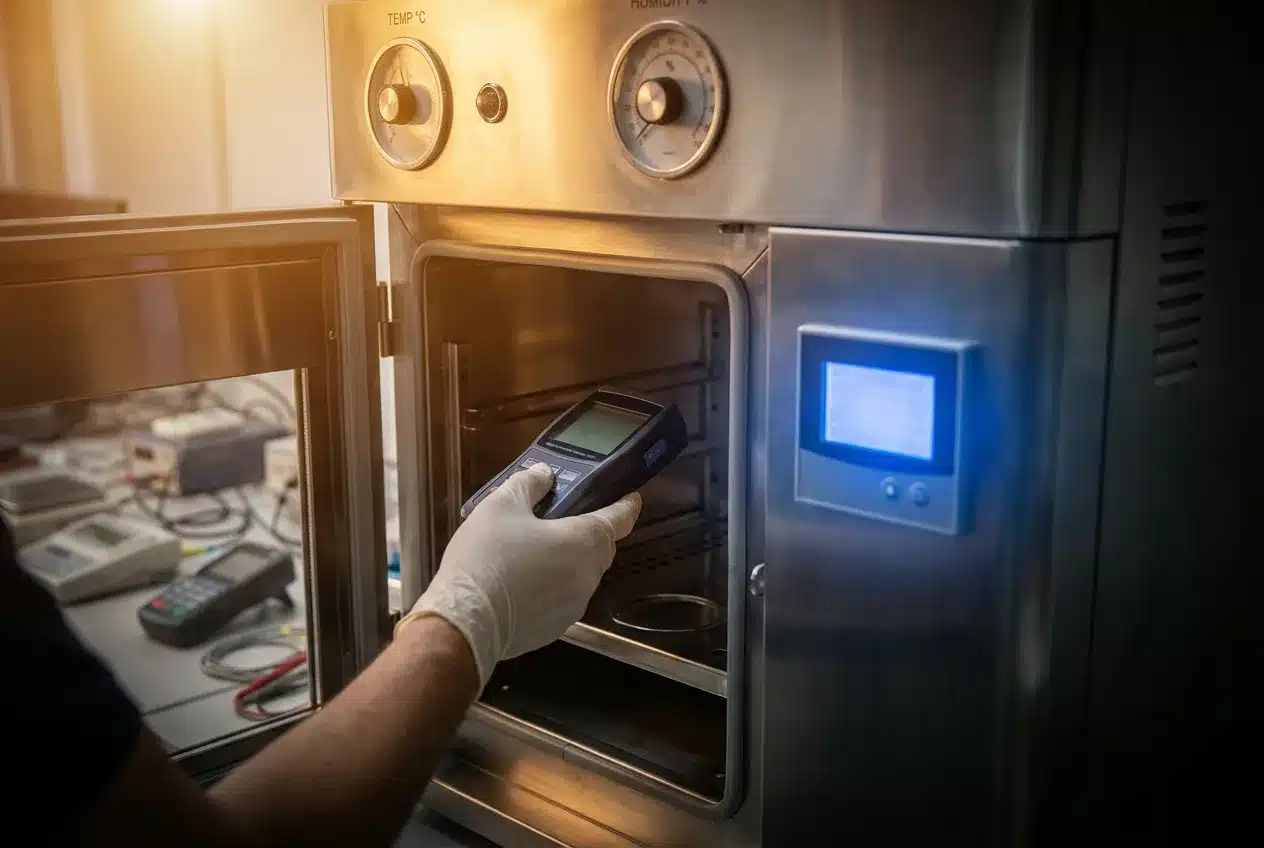 EN 45501 testing includes environmental and electromagnetic disturbance testing, not just a basic accuracy check — carried out as part of Module B type examination.
Before a NAWI can be placed on the market for a regulated use, its manufacturer has to prove conformity through one of several New Legislative Framework conformity assessment modules, each involving an independent notified body:
- Module B — EU-type examination. A notified body examines the manufacturer's technical documentation (design, drawings, risk analysis, EN 45501 test results) for a representative instrument type, and issues an EU-type examination certificate if it meets Annex I's essential requirements. Module B is always paired with a second module covering ongoing production.
- Module D — production quality assurance (used as B+D). The manufacturer operates a notified-body-approved quality management system covering production, ensuring every unit made continues to match the type approved under Module B. The notified body audits this system on an ongoing basis rather than checking every unit itself.
- Module F — product verification (used as B+F). Instead of auditing the manufacturer's production system, the notified body directly tests individual instruments or batches against the approved type — a stricter, more hands-on third-party check than Module D.
- Module G — unit verification. Used for one-off or very low-volume instruments, where a notified body examines and verifies each individual unit against the essential requirements directly, without a separate prior type-approval stage.
The manufacturer chooses the route, and that choice genuinely affects how much ongoing notified-body oversight continues after the instrument first clears type approval — B+D relies on audited production discipline, B+F relies on direct third-party testing of what actually gets made, and G verifies each individual unit on its own merits.
The EU Declaration of Conformity: What It Must Contain
Annex IV of the NAWI Directive 2014/31/EU sets the model structure for the EU Declaration of Conformity — the manufacturer's own formal written statement that a specific instrument meets the directive's requirements. A properly completed declaration should identify:
- The product — trade name, model, and type, described precisely enough to identify the exact instrument.
- The manufacturer — full legal name and address, and an authorised representative if applicable.
- A clear statement of conformity — issued under the manufacturer's sole responsibility, explicitly naming Directive 2014/31/EU and any other applicable EU legislation.
- The harmonised standards applied — typically EN 45501, cited by its full reference.
- The notified body and module involved — name, identification number, the specific module used (B+D, B+F, or G), and the relevant certificate number(s).
- Place, date, and signature — of the person authorised to sign on the manufacturer's behalf.
The manufacturer is required to keep the declaration and its supporting technical documentation on file for at least ten years after the instrument was placed on the market, and to make a copy available to national authorities on request. This is worth knowing if you're a buyer, too — a legitimate supplier should be able to produce a copy of the Declaration of Conformity for any regulated NAWI you buy, not just point to the CE mark on the box.
What the NAWI Directive Doesn't Cover
This is genuinely the most commonly misunderstood part of the NAWI Directive 2014/31/EU, and it's worth stating plainly: the directive governs placing an instrument on the market and putting it into service — not what happens to it afterward.
In-service, periodic re-verification of a NAWI already in use is not harmonised by the directive or by EN 45501. Neither document sets a re-verification interval. That responsibility belongs entirely to each EU member state's own national legal metrology law — which is why, in practice, a business running identical scales across two or three EU countries can find itself dealing with genuinely different re-inspection schedules and procedures for what is, on paper, the same certified instrument. The directive's job ends at the point of sale and initial use; everything about keeping that instrument compliant afterward is a national, not an EU-harmonised, question.
This is a deliberate design choice in the NAWI Directive 2014/31/EU, not an oversight — the directive exists to guarantee free movement of compliant goods across the single market, which only requires harmonising the point of manufacture and sale. Once an instrument is genuinely in a customer's hands and being used day to day, the practicalities of inspecting it — who does the inspecting, how often, and what happens if it fails — are left to whichever national metrology body already has the local infrastructure and legal authority to do that work.
Verify This Yourself: Official Sources
EU legislation and its implementing detail can change, and this guide reflects research current as of August 2026. Before relying on the NAWI Directive 2014/31/EU for a compliance decision, check directly with:
- EUR-Lex — full text of Directive 2014/31/EU — the complete legal text, including Article 1(2) and Annexes I, II, and IV.
- European Commission — Non-automatic weighing instruments (NAWI) — the Commission's own page on harmonised standards, including EN 45501.
- Your national legal metrology authority, for in-service verification rules specific to your country.
See our site disclaimer for how we handle regulatory and standards content generally.
Common Mistakes
- Assuming the NAWI Directive covers every scale, including non-commercial ones. Article 1(2)(g) explicitly places non-regulated uses — a kitchen scale, a personal bathroom scale — outside the directive's regulated scope.
- Treating EN 45501 as just an accuracy tolerance table. It's a full test regime covering environmental influence and electromagnetic disturbance testing too, not only basic error-limit checks.
- Assuming EN 45501 or the directive sets a re-verification schedule. Neither does — in-service verification intervals are set entirely at national level.
- Buying a regulated-use scale without asking for the EU Declaration of Conformity. A legitimate supplier should have one on file and be able to produce it, not just point to a CE sticker.
- Confusing Module B alone with full conformity. Module B only covers type examination — it must be paired with D, F, or used as G to actually authorise placing instruments on the market.
- Assuming pharmacy and market-stall scales are regulated the same way. Both fall under Article 1(2) as regulated uses, but they need very different accuracy classes given what's actually at stake in each case.
Frequently Asked Questions
What is the NAWI Directive 2014/31/EU? The EU law governing the placing on the market of non-automatic weighing instruments. It's a recast of Directive 2009/23/EC, applicable since 20 April 2016, and sets the essential requirements a weighing instrument must meet before being sold anywhere in the EU.
What is EN 45501 and how does it relate to the NAWI Directive? EN 45501:2015 is the harmonised European standard setting out detailed technical testing for NAWIs, adapted from OIML R 76-1. Building and testing to EN 45501 earns a presumption of conformity with the NAWI Directive's essential requirements.
Does EN 45501 set verification intervals for weighing instruments already in use? No. Both EN 45501 and the NAWI Directive govern design, testing, and initial placing on the market — not ongoing in-service verification. Re-verification intervals for instruments already in use are set by each EU member state's own national law.
Does the NAWI Directive cover pharmacy and pre-packaged goods weighing? Yes. Article 1(2) explicitly lists making up medicines on prescription in a pharmacy and medical/pharmaceutical laboratory analyses as regulated uses, alongside price determination for direct retail sales and prepackages.
What conformity assessment modules can a NAWI manufacturer use? Typically EU-type examination (Module B) combined with production quality-assurance surveillance (Module D) or product verification (Module F), or unit verification (Module G) for one-off instruments. Each requires notified-body involvement and a documented certificate.
What must an EU Declaration of Conformity for a weighing instrument include? Product and manufacturer identification, an explicit statement of conformity with Directive 2014/31/EU, the harmonised standards applied, the notified body and module used with certificate numbers, and a signature and date — kept on file for at least ten years.
More Scale Calibration Guides
- EU Weighing Scale Regulations — scalecalibration.net/eu-weighing-scale-regulations/ — the full compliance picture this directive sits inside.
- CE and M Marking on Weighing Scales — scalecalibration.net/ce-and-m-marking-on-weighing-scales/ — how to verify the marking a NAWI Directive-compliant instrument must carry.
- UK Weighing Scale Regulations — scalecalibration.net/uk-weighing-scale-regulations/ — the UK's own framework, originally derived from this same directive.
- Calibration Weights: Which Class & Size — scalecalibration.net/calibration-weights/ — certified weights for servicing any accuracy class of NAWI.
- Best Scales — scalecalibration.net/category/best-scales/ — buying guides across scale types.