By Jayson · Updated August 2026 · 9-minute read
CE and M Marking on Weighing Scales : A weighing scale legally approved for trade in the EU needs three things stamped together on its data plate: the CE mark, a supplementary M mark (a capital M plus the last two digits of the year, inside a rectangle matching the CE mark's height), and a notified body identification number. CE marking by itself is not enough — it's a general EU product-safety mark, not proof of metrological accuracy or trade approval.
Our EU weighing scale regulations overview and the NAWI Directive 2014/31/EU deep dive both mention CE and M marking briefly. This guide is the full, practical breakdown: what each mark actually proves, how to verify a notified body number is real rather than just printed, and the warning signs that a marking has been faked or misapplied.
In this guide
- CE marking on weighing scales: what it actually proves
- The M mark: what it adds on top of CE
- Why CE marking alone isn't enough
- What CE and M marking doesn't tell you
- How to verify a notified body number in NANDO
- The EU Declaration of Conformity: what to ask for
- Signs of a fake or misused CE mark
- Verify this yourself: official sources
- Common mistakes
- FAQ
CE Marking on Weighing Scales: What It Actually Proves
CE marking is the general EU conformity symbol used across a huge range of product categories — electrical equipment, machinery, toys, medical devices, and weighing scales among them. For a weighing scale specifically, CE marking typically indicates compliance with rules like the Low Voltage Directive (electrical safety) and the EMC Directive (electromagnetic compatibility), confirming the product is safe to plug in and won't interfere with or be disrupted by other equipment.
What CE marking on weighing scales does not inherently confirm is anything about measurement accuracy or suitability for legal-for-trade use. A scale can carry a completely genuine CE mark, be perfectly safe electrically, and still not be approved for pricing a customer's purchase — because that specific approval comes from a separate marking covered next.
The M Mark: What It Adds on Top of CE
The supplementary metrology marking — universally shortened to the M mark — is what actually signals a weighing scale has passed metrological conformity assessment under the NAWI Directive 2014/31/EU, for instruments intended for the regulated uses covered in that directive's Article 1(2): commercial transactions, pricing pre-packages, pharmacy dispensing, and similar.
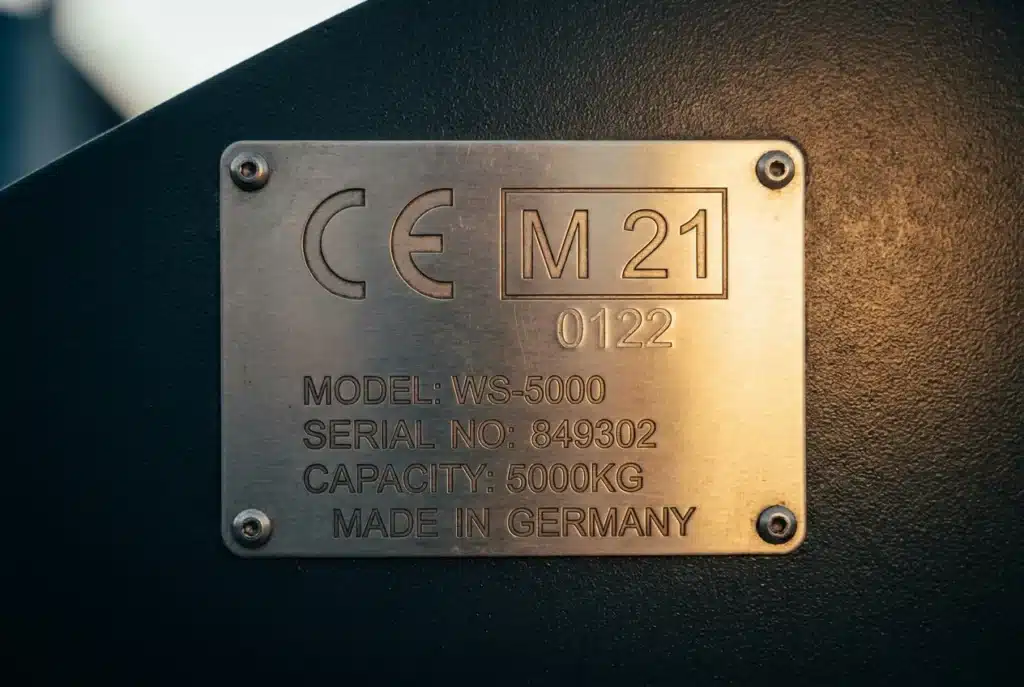
Per Article 16 of the directive, the M mark consists of:
- The capital letter M, plus the last two digits of the year it was affixed.
- Both enclosed in a rectangle, at least 5mm high, matching the height of the CE mark directly beside it.
- Immediately followed by the identification number of the notified body involved in production control.
CE and M marking on weighing scales work together, not separately — the M mark and notified body number are what turn a generally CE-compliant product into one specifically approved for regulated weighing. A scale showing only "CE" with no M rectangle and no notified body number next to it hasn't cleared that second, metrology-specific bar at all.
Why CE Marking Alone Isn't Enough
This is worth stating directly, because it's the single most common misunderstanding around CE and M marking on weighing scales: a genuinely CE-marked scale can still be completely unauthorised for trade use.
CE marking under the Low Voltage or EMC directives says nothing about a scale's weighing accuracy, its verification scale interval, or whether an independent notified body ever checked its metrological performance at all. A market-stall trader, a pharmacy, or a scrap yard relying on CE marking alone — without checking for the M mark and a genuine notified body number — could be using equipment that's electrically safe but has never actually been approved to set a customer's price.
The practical rule: for any weighing scale used for a regulated purpose under the NAWI Directive, check for CE, M, and a notified body number together. If any one of the three is missing, treat the equipment as unverified for trade use until you've confirmed otherwise directly with the supplier.
Consider a realistic version of how this goes wrong: a business imports a batch of price-computing scales from a manufacturer outside the EU. The scales carry a CE mark for electrical safety, genuinely earned, and the importer assumes that covers everything needed to put them straight onto a shop counter. Six months later a national market surveillance inspector checks the equipment, finds no M mark and no notified body number anywhere on the casing, and the business discovers — the hard way — that CE and M marking on weighing scales were never actually both present, only one of the two. The scales may weigh perfectly accurately in practice; that's not the point. Without the metrology-specific marking, there was never any independent confirmation of that accuracy in the first place, and the equipment was never legally authorised to set a customer's price regardless of how well it actually performed.
What CE and M Marking Doesn't Tell You
Even fully genuine CE and M marking on weighing scales has a real limit worth understanding: the marking reflects the instrument's condition at the moment it was placed on the market, not its condition today. A scale manufactured five years ago with completely legitimate CE and M marking, a real notified body number, and a clean paper trail can still have drifted out of tolerance since then through ordinary wear, an undocumented repair, or rough handling in transit.
Marking is a point-in-time compliance record, not an ongoing accuracy guarantee. That's precisely the gap that in-service calibration and, for regulated equipment, national in-service verification are designed to fill — a topic covered in full in our scale calibration services guide. A business that checks CE and M marking once at purchase and never revisits the equipment's actual accuracy afterward is only covering half of what genuine ongoing compliance actually requires.
How to Verify a Notified Body Number in NANDO
 Checking a notified body number against the official NANDO database takes a couple of minutes and is the single most reliable way to confirm CE and M marking on weighing scales is genuine.
NANDO is the European Commission's own public database of notified bodies, listing every organisation formally designated to carry out conformity assessment work under EU product legislation, including the NAWI Directive. Checking a notified body number is quick and doesn't require any special access:
- Note the notified body number printed immediately after the CE and M marking on the scale's data plate.
- Search that number in the European Commission's notified bodies database.
- Confirm the body is currently active, not withdrawn or expired.
- Confirm its listed scope actually covers non-automatic weighing instruments under Directive 2014/31/EU — a body notified for an entirely different product category doesn't count, even if the number itself is real.
If the number doesn't appear in NANDO at all, or appears but isn't notified for weighing instruments specifically, that's a genuine red flag worth raising directly with whoever sold you the equipment — not something to assume is a database glitch. The lookup itself takes only a couple of minutes and requires no account or paid access, which makes skipping it a genuinely avoidable risk rather than a reasonable time-saving shortcut, especially for equipment that's about to be used to price customer transactions.
The EU Declaration of Conformity: What to Ask For
Beyond the physical markings, a legitimate supplier of a regulated-use weighing scale should be able to produce an EU Declaration of Conformity on request — the manufacturer's own formal written statement, covered in more technical detail in our NAWI Directive guide, that the specific instrument meets the directive's requirements.
At minimum, a genuine declaration should name the instrument and manufacturer precisely, explicitly reference Directive 2014/31/EU, list the harmonised standard applied (normally EN 45501), and identify the notified body and certificate number behind the CE and M marking on the scale itself. If a supplier can't produce this document, or produces one that references a different directive entirely, that's worth treating with the same suspicion as a missing M mark.
Signs of a Fake or Misused CE Mark
CE and M marking on weighing scales can be misapplied in ways that aren't always obvious at a glance. Watch for:
- Distorted proportions or letter spacing in the CE logo itself — the design is legally defined, and a stretched, squashed, or oddly-spaced "CE" is a common tell.
- A missing or mismatched-height M rectangle — the rectangle around the M must match the CE mark's height exactly, not just be roughly similar.
- No notified body number at all, on a scale clearly intended for a regulated commercial use.
- A notified body number that doesn't check out in NANDO, or checks out for the wrong product category entirely.
- No EU Declaration of Conformity available, or one that vaguely references "applicable EU directives" without naming Directive 2014/31/EU specifically.
- CE marking presented as a general quality or safety endorsement rather than a specific legal conformity statement — genuine CE marking is never a marketing claim, it's a legal one.
None of these signs alone is definitive proof of fraud — printing errors happen even on legitimate equipment — but two or more together is a strong reason to verify directly with the manufacturer before relying on the scale for trade.
Genuinely fraudulent CE and M marking on weighing scales tends to show up most often in equipment sourced through unfamiliar overseas suppliers or resold second-hand without documentation, rather than from established, well-known manufacturers. That's not a reason to skip the check on equipment from a trusted brand — genuine mistakes and outdated stock happen everywhere — but it is a reason to apply extra scrutiny, including an actual NANDO lookup rather than a visual glance alone, whenever a supplier or price point looks unusually good for what's being offered.
Verify This Yourself: Official Sources
Marking requirements and notified body listings can change, and this guide reflects research current as of August 2026. Before relying on CE and M marking on a specific weighing scale, check directly with:
- European Commission — Notified bodies database (NANDO) — the official tool for verifying a notified body number.
- EUR-Lex — full text of Directive 2014/31/EU — Article 16 sets out the exact CE and M marking requirements.
- The manufacturer or supplier directly, for a copy of the EU Declaration of Conformity.
See our site disclaimer for how we handle regulatory and standards content generally.
Common Mistakes
- Assuming any CE logo means a scale is legal for trade. CE marking alone can reflect general product-safety compliance with no metrology assessment behind it at all.
- Not checking the M rectangle's height against the CE mark. A mismatched or undersized rectangle is a real compliance defect, not a cosmetic detail.
- Skipping the NANDO check because a number is present. A number existing and a number being genuinely notified for weighing instruments are two different things — only checking NANDO confirms the second.
- Never asking for the EU Declaration of Conformity. A legitimate supplier should have one on file; treat reluctance to produce it as a warning sign, not an inconvenience.
- Confusing CE and M marking on weighing scales with a calibration certificate. Marking shows the instrument was compliant when placed on the market — it says nothing about whether it's still accurate today after years of use.
- Assuming a notified body number valid for one directive is valid for all of them. Always confirm the specific scope listed in NANDO covers non-automatic weighing instruments, not just that the body is notified for something.
Frequently Asked Questions
What does CE marking mean on a weighing scale? CE marking shows a product complies with general EU legislation that applies to it — often electrical safety and electromagnetic compatibility rules, not metrology specifically. On its own, it doesn't prove a scale is accurate enough or approved for legal-for-trade use.
What does the M mark mean, and how is it different from CE? The M mark is a supplementary metrology marking under the NAWI Directive 2014/31/EU: a capital M plus the last two digits of the year, in a rectangle the same height as the CE mark. It specifically shows metrological conformity assessment for legal-for-trade weighing, which CE alone doesn't cover.
Is CE marking alone enough to prove a scale is legal for trade? No. For a regulated use under the NAWI Directive, both CE and M marking, plus a notified body number, are required together. CE marking alone can indicate general product safety without any metrology assessment at all.
How do I check if a notified body number is genuine? Search the number in NANDO, the European Commission's official database of notified bodies. Confirm the body is currently active and its listed scope covers non-automatic weighing instruments under Directive 2014/31/EU.
What is an EU Declaration of Conformity, and should I ask for one? The manufacturer's written statement that a specific instrument meets the NAWI Directive's requirements, naming the applicable legislation, standards, and notified body. Yes — a legitimate supplier should produce one on request.
What are signs of a fake or misused CE mark? Distorted logo proportions, a missing or mismatched-height M rectangle, a notified body number that doesn't check out in NANDO, and no Declaration of Conformity available are all warning signs.
More Scale Calibration Guides
- NAWI Directive 2014/31/EU — scalecalibration.net/nawi-directive-2014-31-eu/ — the full legal framework behind CE and M marking.
- EU Weighing Scale Regulations — scalecalibration.net/eu-weighing-scale-regulations/ — the complete EU compliance picture.
- UK Weighing Scale Regulations — scalecalibration.net/uk-weighing-scale-regulations/ — the equivalent CE/UKCA and M mark rules in the UK.
- Scale Calibration Services — scalecalibration.net/scale-calibration-services/ — verifying ongoing accuracy after marking is checked.
- Calibration Weights: Which Class & Size — scalecalibration.net/calibration-weights/ — certified weights for any accuracy class.
- Best Scales — scalecalibration.net/category/best-scales/ — buying guides across scale types.