By Jayson · Updated August 2026 · 9-minute read
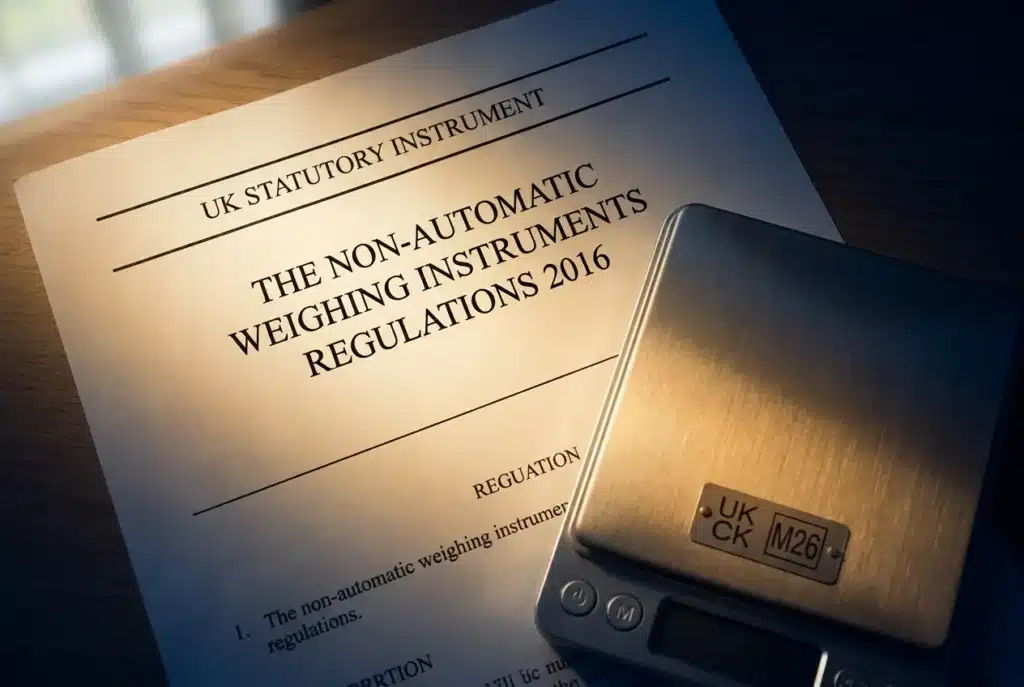
Quick answer: NAWI regulations UK refers to the Non-automatic Weighing Instruments Regulations 2016, SI 2016/1152, the statutory instrument that implements Directive 2014/31/EU into UK law. It's built from 10 Parts covering essential requirements, conformity assessment, economic operator obligations, market surveillance, and a dedicated offences section with its own criminal penalties, separate from the Weights and Measures Act 1985.
Our broader UK Weighing Scale Regulations guide covers the whole compliance picture. This one is a deep dive on the NAWI regulations UK specifically: the regulation text itself, its structure, what changed after Brexit, and exactly which offences it creates.
In this guide
- What the NAWI Regulations UK actually is
- The 10 Parts, in order
- Essential requirements: Schedule 6
- Conformity assessment: Schedule 7
- Who counts as an economic operator
- What changed after Brexit: the 2019 and 2021 amendments
- The offences Part 9 actually creates
- Verify this yourself: official sources
- Common mistakes
- FAQ
What the NAWI Regulations UK Actually Is
The NAWI Regulations UK is the Non-automatic Weighing Instruments Regulations 2016 (SI 2016/1152), and its own text is explicit about what it does: it implements Directive 2014/31/EU of the European Parliament and of the Council on the harmonisation of the laws of Member States relating to the making available on the market of non-automatic weighing instruments. It also replaces and revokes the earlier Non-automatic Weighing Instruments Regulations 2000 and the Non-automatic Weighing Instruments (Amendment) Regulations 2008.
That's worth being precise about, because a lot of general UK compliance content treats "NAWI regulations UK" as shorthand for the whole weighing-scale compliance picture. It isn't. It's a specific statutory instrument, with its own numbered Parts, its own Schedules, and, as covered further down, its own criminal offences distinct from the older Weights and Measures Act 1985 framework.
The 10 Parts, in Order
The NAWI regulations UK are structured into 10 Parts:
- Part 1 — Introductory. Citation, commencement, and territorial extent.
- Part 2 — Regulated non-automatic weighing instruments: obligations of economic operators. The core duties placed on manufacturers, importers, and distributors.
- Part 3 — Conformity of regulated non-automatic weighing instruments. How compliance is actually established and documented.
- Part 4 — Requirements for non-regulated non-automatic weighing instruments. A separate, lighter regime for instruments outside the regulated-use categories.
- Part 5 — Approval of conformity assessment bodies. How a body becomes authorised to assess instruments against the essential requirements.
- Part 6 — Putting into service of regulated non-automatic weighing instruments for the purposes listed in regulation 3(2). The specific regulated uses the whole framework hinges on.
- Part 7 — Use for trade of regulated non-automatic weighing instruments in Great Britain.
- Part 8 — Market surveillance and enforcement.
- Part 9 — Offences. The criminal offences created directly by this regulation.
- Part 10 — Miscellaneous and supplemental.
Regulation 3 itself, titled "Application of these Regulations," is what actually defines the purposes for which a regulated instrument's use triggers the whole framework — it's the hinge the rest of the Parts turn on, which is why Part 6's title references it directly.
Part 4 is worth pausing on specifically, because it's the part most general compliance content skips entirely. Not every non-automatic weighing instrument sold in the UK falls under the full "regulated" regime — a scale used purely for internal stock checks, personal use, or a purpose outside the list in regulation 3(2) doesn't trigger the same essential-requirements-and-conformity-assessment machinery. Part 4 sets out a separate, lighter requirement for these non-regulated instruments instead. A real example of the distinction: a warehouse's internal pallet-counting scale, never used to price anything sold to a customer, is a non-automatic weighing instrument but not a regulated one under SI 2016/1152 — the full Schedule 6/Schedule 7 machinery only switches on once regulation 3(2)'s purposes are actually in play.
Essential Requirements: Schedule 6
Under the NAWI regulations UK, the essential requirements a regulated instrument has to meet before it can be placed on the market or put into service aren't written out in the numbered regulations themselves — they're set out in full in Schedule 6, titled "Essential Requirements." This is the UK's domestic legal counterpart to Annex I of Directive 2014/31/EU, and Part 2's obligations on economic operators are built around ensuring an instrument actually meets what Schedule 6 requires.
In practice, this is the same structure used across UK product-safety law generally: the numbered Parts define who has to do what and by when, while a Schedule holds the detailed technical content those Parts point back to. Anyone comparing the NAWI regulations UK against other UK product-safety instruments will recognise the pattern immediately.
Conformity Assessment: Schedule 7
 Conformity assessment under Schedule 7 is what actually proves an instrument meets Schedule 6's essential requirements before it reaches the market.
Schedule 7, "Conformity Assessment Procedures," sets out the actual modules and procedures a manufacturer uses to demonstrate an instrument meets Schedule 6's essential requirements under the NAWI regulations UK: technical documentation, the involvement of an approved conformity assessment body, and the specific assessment route chosen. Part 3 of the Regulations governs how this process actually plays out, and Part 5 governs how a body becomes approved to carry it out in the first place.
Who Counts as an Economic Operator Under the NAWI Regulations UK
The NAWI Regulations UK places obligations on economic operators — a category that includes manufacturers, their authorised representatives, importers, and distributors. This mirrors the same structure Directive 2014/31/EU itself uses: legal responsibility isn't concentrated solely on the manufacturer, it's spread across the supply chain, so an importer bringing a non-compliant instrument into the UK carries real exposure of their own, not just the original manufacturer overseas.
Part 2 sets out what each of these operators actually has to do under the NAWI regulations UK — broadly, ensuring the instrument meets Schedule 6's essential requirements, that conformity assessment under Schedule 7 has genuinely happened, and that the instrument carries the correct markings and documentation before it changes hands further down the chain.
What Changed After Brexit: the 2019 and 2021 Amendments
The NAWI regulations UK haven't stayed static since 2016. Two amendment instruments are the ones that actually matter for a business checking compliance today.
The Product Safety and Metrology etc. (Amendment etc.) (EU Exit) Regulations 2019 amended the NAWI Regulations UK to domesticate it — shifting references away from the EU system as a live, ongoing framework and toward a UK-only regime. In practice this meant swapping EU "notified bodies" for UK "approved bodies," and introducing the UK-specific marking regime that would eventually sit alongside — and for a transitional period, substitute for — CE marking.
The Product Safety and Metrology etc. (Amendment) Regulations 2021 followed up on that, primarily to extend the transitional period during which CE marking could still be accepted on the Great Britain market while businesses had time to move to UKCA marking, plus a set of technical corrections to the 2019 changes. This is the same policy history that eventually led to the October 2024 decision — covered in our broader UK Weighing Scale Regulations guide — to let CE marking continue indefinitely for most products in Great Britain rather than forcing a hard UKCA cutover.
The post-amendment text of the Regulations reflects this directly: it now refers to the "UK marking" and the metrology "M marking" together, and prohibits economic operators from affixing any other marking that purports to attest compliance or that impairs the visibility of the genuine ones.
Worth being precise about what actually changed in the NAWI regulations UK versus what stayed the same: the essential requirements in Schedule 6 and the conformity assessment procedures in Schedule 7 weren't rewritten by either amendment. What changed was who checks compliance and what the resulting mark is called — a UK approved body doing broadly the same technical job an EU notified body used to do, and a UK marking sitting where a CE mark used to sit, rather than the underlying technical bar for what counts as a compliant instrument moving at all. A real, concrete example: a scale built to exactly the same technical specification in 2018 and in 2022 didn't suddenly become non-compliant when the amendments took effect — it just needed the right paperwork and marking to match the new regime, not a redesign.
The Offences Part 9 of the NAWI Regulations UK Actually Creates
This is the part of the NAWI Regulations UK that's genuinely distinct from the Weights and Measures Act 1985 — Part 9 creates its own criminal offences, not just a cross-reference to older weights-and-measures law.
- Regulation 71 — Unauthorised application of authorised marks. It's an offence to affix an authorised mark to an instrument other than in accordance with the Regulations, to alter or deface one, to remove one, or to affix any other marking likely to deceive someone as to the meaning of a genuine mark. It's a separate offence to place on the market, put into service, or use an instrument known to carry a removed, wrongly-affixed, altered, or deceptive mark. An instrument and any implement used to commit this offence are both liable to forfeiture.
- Regulation 72 — Offences by economic operators etc. Covers failures in the underlying obligations Part 2 and Part 3 impose: placing a non-compliant instrument on the market, failing to carry out proper conformity assessment, missing or wrong markings, and failing to maintain the required technical documentation.
- Regulation 73 — Penalties for offences. In England and Wales, a person guilty of an offence under any provision of the Regulations is liable, on summary conviction, to a fine. In Scotland or Northern Ireland, the maximum is a fine not exceeding level 5 on the standard scale.
- Regulation 74 — Defence of due diligence.
- Regulation 75 — Liability of persons other than the principal offender.
There's also a specific offence tied to requalification: using a regulated instrument that carries a disqualification mark is an offence unless a requalification mark has since been properly affixed — which is exactly the same event-based (not calendar-based) logic covered in our Weighing Scale Verification UK guide.
It's worth understanding why the NAWI regulations UK bother creating their own offences at all, rather than just leaning on the Weights and Measures Act 1985's existing enforcement machinery. The 1985 Act was written for a much broader, older weights-and-measures framework: general trading standards enforcement across a wide range of measuring practices. SI 2016/1152's offences are narrower and more specific to this one regime: unauthorised marking, economic-operator non-compliance, and the disqualification/requalification cycle particular to non-automatic weighing instruments. That specificity is also why Regulation 74's due-diligence defence and Regulation 75's provision on liability of persons other than the principal offender exist as their own numbered regulations rather than being left to general criminal-law principles — a business genuinely needs to know, in the text of the instrument itself, what counts as a valid defence and who else besides the immediately responsible person can end up liable for a breach.
Verify This Yourself: Official Sources
Legislation and its amendments can change, and this guide reflects research current as of August 2026. Before relying on the NAWI regulations UK for a compliance decision, check directly with the primary sources rather than any secondary summary, including this one:
- legislation.gov.uk — The Non-automatic Weighing Instruments Regulations 2016 — the full, current legal text, including all 10 Parts and Schedules 5 through 7.
- GOV.UK — Non-automatic weighing instruments guidance — official government guidance covering both the Great Britain and Northern Ireland versions of the Regulations.
- legislation.gov.uk — Product Safety and Metrology etc. (Amendment) Regulations 2021 — the most recent amending instrument.
See our site disclaimer for how we handle regulatory and standards content generally.
Common Mistakes About the NAWI Regulations UK
- Treating "NAWI regulations UK" as interchangeable with the whole UK weighing-scale compliance picture. It's one specific statutory instrument with its own Parts and Schedules, not a general label for UK weights and measures law.
- Assuming its criminal offences come from the Weights and Measures Act 1985. Part 9 of the NAWI regulations UK creates its own offences and penalties directly.
- Missing that economic operator obligations extend beyond the manufacturer. Importers and distributors carry real, independent legal exposure under Part 2.
- Assuming the 2019 and 2021 amendments only changed marking. They also restructured the underlying references from an EU-wide system to a UK-only one, including notified-body to approved-body terminology.
- Confusing Schedule 6 with Schedule 7. They cover genuinely different things — Schedule 6 is what an instrument must achieve, Schedule 7 is how that achievement gets verified.
Frequently Asked Questions
What is SI 2016/1152? The Non-automatic Weighing Instruments Regulations 2016 — the UK statutory instrument implementing Directive 2014/31/EU, replacing the earlier 2000 and 2008 Regulations.
How many Parts do the NAWI Regulations UK have? The NAWI regulations UK have ten Parts: Introductory; Obligations of Economic Operators; Conformity; Requirements for Non-Regulated Instruments; Approval of Conformity Assessment Bodies; Putting Into Service; Use for Trade; Market Surveillance and Enforcement; Offences; and Miscellaneous and Supplemental.
Where are the essential requirements set out? Schedule 6, which functions as the UK's domestic counterpart to Annex I of Directive 2014/31/EU.
What changed in the 2019 and 2021 amendments to the NAWI regulations UK? The 2019 EU Exit Regulations domesticated the framework — UK approved bodies replacing EU notified bodies, and the introduction of UK marking. The 2021 Regulations extended the transitional period for accepting CE marking and made technical corrections.
What penalties do the NAWI Regulations UK actually create? Regulation 73 sets a fine on summary conviction in England and Wales, and a fine up to level 5 on the standard scale in Scotland and Northern Ireland — separate from the Weights and Measures Act 1985's own penalty regime.
Who counts as an economic operator under these Regulations? Manufacturers, their authorised representatives, importers, and distributors — the same categories used in Directive 2014/31/EU itself.
More Scale Calibration Guides
- UK Weighing Scale Regulations — scalecalibration.net/uk-weighing-scale-regulations/ — the broader compliance picture this regulation sits inside.
- Legal for Trade Scales UK — scalecalibration.net/legal-for-trade-scales-uk/ — which businesses actually need trade-approved equipment.
- Scale Calibration Services — scalecalibration.net/scale-calibration-services/ — what professional calibration actually costs.
- Calibration Weights: Which Class & Size — scalecalibration.net/calibration-weights/ — certified weights for servicing any class of scale.
- Best Scales — scalecalibration.net/category/best-scales/ — buying guides across scale types.