Digital Balance Weight Classes: The Definitive Guide
Master the complexities of ASTM, OIML, and NIST standards to ensure your laboratory or industrial scale remains perfectly calibrated and accurate.
In the world of precision measurement, accuracy is not a suggestion—it is a requirement. Digital balance weight classes are standardized categories that define the maximum permissible error (tolerance) for a calibration weight. Whether you are working in a high-tech pharmaceutical lab or a small business, understanding these classes is the first step toward maintaining a reliable weighing system.
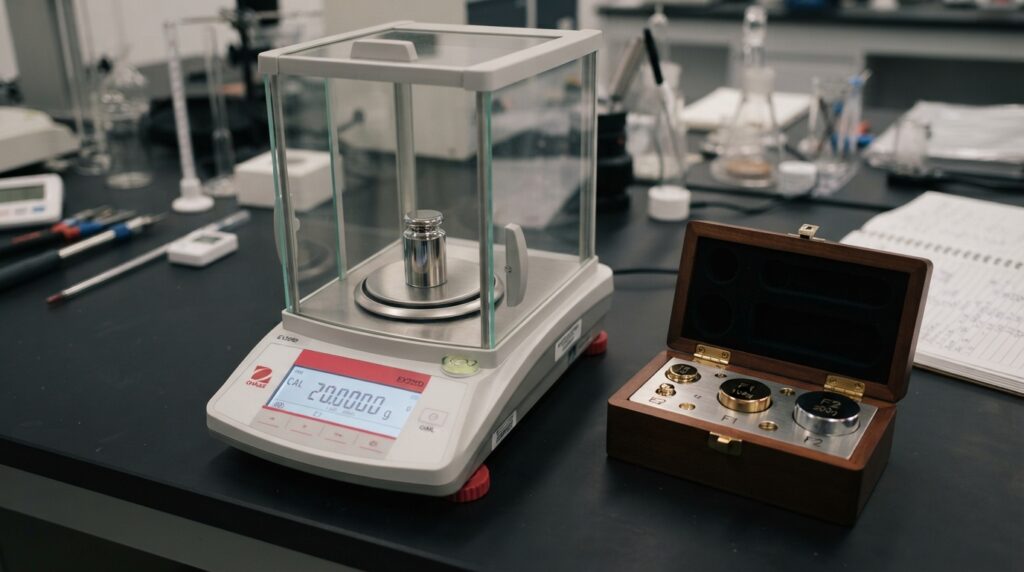
A calibration weight is not just a piece of metal; it is a reference standard. Because no manufacturing process is perfect, every weight has a “tolerance”—a tiny window of acceptable deviation from its nominal value. The “class” of the weight tells you exactly how small that window is. Higher precision balances require weights with much tighter tolerances (lower classes in ASTM, higher classes in OIML).
For a comprehensive look at how these weights are used, see our Scale Calibration: Your Complete Guide.
The Three Major Standards: ASTM, OIML, and NIST
Depending on your geographic location and industry, you will likely follow one of three major governing bodies. Each has its own naming convention for digital balance weight classes.
ASTM (U.S. Standard)
The American Society for Testing and Materials (ASTM E617) defines 10 classes ranging from 000 to 7. In this system, the lower the number, the higher the precision. Class 1 is the workhorse of laboratory settings.
OIML (Global Standard)
The International Organization of Legal Metrology (OIML R111) is used throughout Europe, Asia, and much of the world. Its classes use letters and numbers: E1, E2, F1, F2, M1, M2, and M3. Here, E1 is the most precise.
NIST (Industrial Standard)
The National Institute of Standards and Technology traditionally defined Class F weights for U.S. commercial scales. Note that as of 2020, NIST Class F is being phased out for new applications.
Weight Class Comparison Table
This table provides a high-level comparison of how different digital balance weight classes align across the major standards. Use this as a reference when selecting weights for your specific balance type.
| Scale Type | Standard Readability | Recommended ASTM Class | Recommended OIML Class |
|---|---|---|---|
| Ultra-Micro Balances | 0.0001 mg (0.1 µg) | Class 000 / 00 | E1 |
| Analytical Balances | 0.1 mg (0.0001 g) | Class 1 | E2 |
| Top-Loading Balances | 0.01 g to 0.001 g | Class 2 or 3 | F1 |
| Precision/Bench Scales | 0.1 g to 1.0 g | Class 4 | F2 or M1 |
| Industrial Platform Scales | 5.0 g + | Class 6 or 7 | M2 or M3 |
For more details on specific weights, visit our A Guide To Calibration Weights.
ASTM Classes: A Closer Look
In North American laboratories, ASTM E617 is the gold standard. Here is a breakdown of the most common digital balance weight classes used today:
- Class 000 & 00: These are the “Elite” classes. They are typically used as primary standards by national metrology institutes or high-end calibration laboratories to calibrate other weights.
- Class 1: This is the standard for analytical balances with a readability of 0.1 mg. If you are in a pharmaceutical or high-precision chemical lab, this is likely what you need.
- Class 2: Ideal for high-precision top-loading balances with a readability of 0.01 g.
- Class 3: Used for moderate precision balances (readability of 0.01 g to 0.1 g).
- Class 4: Common in educational settings or for industrial scales that require a higher degree of accuracy than standard commercial scales.
If you’re a student or researcher, you might find the usage of instrument for students and scientists helpful in understanding these applications.
How to Choose the Right Weight Class
The “Rule of 3” (or 4)
Industry experts follow a simple but critical rule: your calibration weight must be at least 3 to 4 times more accurate than the readability of the scale you are testing. For example, if your scale reads to 0.01g, your calibration weight should have a tolerance of 0.0025g or better.
Material Science Matters
The material of the weight often correlates with its class:
- High-Precision (ASTM 0-3 / OIML E-F1): These are almost always made of high-quality, non-magnetic stainless steel. This prevents environmental factors like magnetism or corrosion from affecting the weight.
- Industrial (ASTM 4-7 / OIML M-Classes): These may be made of plated brass, cast iron, or stainless steel. Cast iron is common for very large weights used for industrial floor scales.
Calibrating When You Don’t Have Standard Weights
What happens if you need to check your scale’s accuracy but don’t have a certified ASTM Class 1 weight on hand? While not suitable for ISO-certified environments, you can perform a “No-Weight Scale Calibration” using common objects of known mass.
Common household reference items include:
- A U.S. Nickel: Exactly 5.000 grams. See our guide: How Much Does a Nickel Weigh?
- 100 Gram Objects: Various household items can approximate this. See What Weighs 100 Grams? for ideas.
For a step-by-step procedure on this method, read our guide on steps to calibrate a digital pocket scale without weights.
Frequently Asked Questions
Most industrial and laboratory standards suggest a recalibration cycle of 12 to 24 months. However, if a weight is dropped or showing signs of corrosion, it should be serviced immediately.
While they are used for similar balances (analytical), OIML E2 generally has slightly tighter tolerances than ASTM Class 1 at certain mass points. They are often used interchangeably in non-regulated environments, but you should stick to the standard required by your local regulatory body.
As of January 1, 2020, NIST Class F weights are no longer manufactured for new “Legal for Trade” applications. They are being replaced by ASTM Class 6 or 7. Existing weights can still be used, but many businesses are transitioning to the ASTM standard.
This could be due to environmental factors like air drafts, static electricity, or an unlevel surface. It could also mean the scale’s internal sensors are damaged. Check out problems on the scale calibration process for troubleshooting tips.
Ready to Calibrate Your Scale?
Don’t let inaccuracy compromise your results. Whether you’re using professional weights or household objects, we have the resources to guide you through the process.
View Our Calibration Tutorials
Need more help? Explore how to calibrate measurements easily.