By Jayson · Updated August 2026 · 8-minute read
Quick answer: What is UKAS scale calibration? It means the work was done by a laboratory accredited by the United Kingdom Accreditation Service to ISO/IEC 17025 — the only body the UK government recognises to accredit calibration activities. That's a genuinely different, stronger guarantee than a merely "traceable" certificate: UKAS accreditation means an independent auditor has checked the lab's actual technical competence, not just its paperwork.
Two calibration certificates can look almost identical on the page — same numbers, same layout, same confident language — and still represent genuinely different levels of assurance. UKAS scale calibration is the distinction that actually matters, and it's one a surprising number of businesses never learn to check for until it's asked of them directly, often during an audit or a customer's own compliance review.
This guide covers what UKAS scale calibration actually means, how it's genuinely different from a basic "traceable" certificate, what to check on your own paperwork, and when your business actually needs to insist on it.
In this guide
- What UKAS scale calibration means
- UKAS vs. a merely traceable calibration
- Why ISO 9001 isn't the same thing
- What's on a genuine UKAS certificate
- How to find a UKAS-accredited laboratory
- When you actually need UKAS calibration
- What UKAS accreditation actually buys you
- Common mistakes
- Verify this yourself
- FAQ
What UKAS Scale Calibration Means
UKAS — the United Kingdom Accreditation Service — is the only organisation recognised by the UK government to accredit calibration activities, in both the private and public sectors, against the international standard ISO/IEC 17025. When a scale is calibrated by a UKAS-accredited laboratory, that laboratory's technical competence, equipment, and staff have already been independently audited against this standard before your scale was ever placed on their bench.
That's the core of UKAS scale calibration: it isn't just a claim the laboratory makes about itself. It's a status granted and actively maintained by an external accreditation body, with laboratories subject to ongoing audit to keep it.
UKAS vs. a Merely Traceable Calibration
This is the distinction most people genuinely don't know to ask about, and it's worth being precise here rather than vague.
Any legitimate calibration should be traceable — meaning the reference weights used can be linked, through an unbroken chain of comparisons, back to a national or international measurement standard. But "traceable" on its own is a description of the measurement chain, not an independent check on the laboratory doing the work. A company can print "traceable calibration" on a certificate without ever having been audited by anyone external.
UKAS scale calibration adds a layer traceability alone doesn't provide: independent verification that the specific laboratory has the demonstrated technical competence, trained personnel, and properly maintained equipment to actually deliver accurate results — not just a documented chain of custody for the reference weight. A joint communiqué from three international standards bodies — the International Organisation for Standardisation (ISO), the International Laboratory Accreditation Cooperation (ILAC), and the International Accreditation Forum (IAF) — puts it directly: fulfilling ISO/IEC 17025 "means the laboratory meets both the technical competence requirements and management system requirements... necessary for it to consistently deliver technically valid test results and calibrations."
In practice: if a calibration certificate says "traceable" but doesn't carry UKAS's own accreditation symbol, you have documentation of where the reference weight came from, but no independent confirmation that the laboratory itself was competent to use it correctly.
Why ISO 9001 Isn't the Same Thing
A specific, common confusion worth clearing up directly: a calibration provider being ISO 9001 certified is not the same guarantee as being UKAS accredited to ISO/IEC 17025, even though both sound like serious quality credentials.
ISO 9001 is a generic quality-management standard, applicable to virtually any organisation regardless of what it actually does. It establishes that a business has a documented quality management system — but according to UKAS's own guidance, "it does not contain technical requirements for personnel and operations. In other words, you do not have assurance that the calibrations are accurate."
ISO/IEC 17025, by contrast, was written specifically for testing and calibration laboratories, and covers both the technical competence of personnel and the equivalent management-system rigor of ISO 9001 built in. That's why the ISO/ILAC/IAF communiqué states plainly that "separate certification to ISO 9001 is therefore unnecessary for calibration activities" once a laboratory holds ISO/IEC 17025 accreditation — the technical standard already covers what ISO 9001 would add.
There's also a genuine terminology distinction worth knowing: organisations are certified to ISO 9001, but accredited to ISO/IEC 17025. Certification is third-party written assurance that something meets specified requirements; accreditation is formal recognition by an authoritative body that an organisation is competent to carry out specific technical tasks. For calibration work specifically, the right question to ask a supplier is whether they're accredited, not just whether they're certified to something.
What's on a Genuine UKAS Scale Calibration Certificate
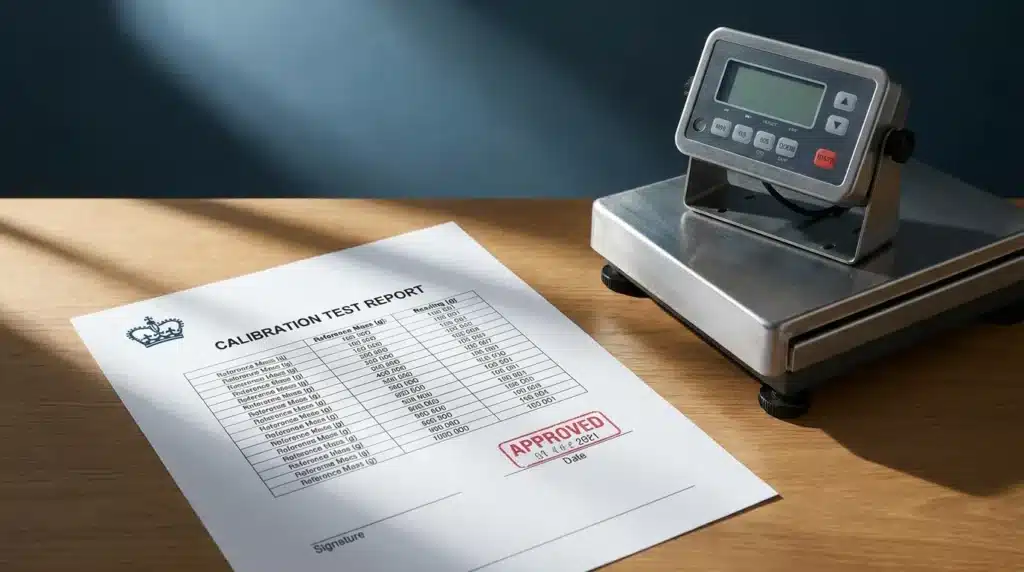
A real UKAS calibration certificate is recognisable by the UKAS accreditation symbol, featuring the Royal Crown, printed in the top corner of the front page. Beyond the symbol itself, the certificate should detail:
- The measurement results recorded during calibration.
- The measurement uncertainty associated with those results — a real UKAS certificate states a specific uncertainty figure, not just a pass/fail.
- A statement of conformance with the relevant metrological specification the scale was tested against.
If a certificate is missing the crown symbol, or only claims to be "traceable" without any reference to UKAS accreditation at all, that's worth a direct question to the supplier before assuming it carries the same weight.
How to Find a UKAS-Accredited Laboratory
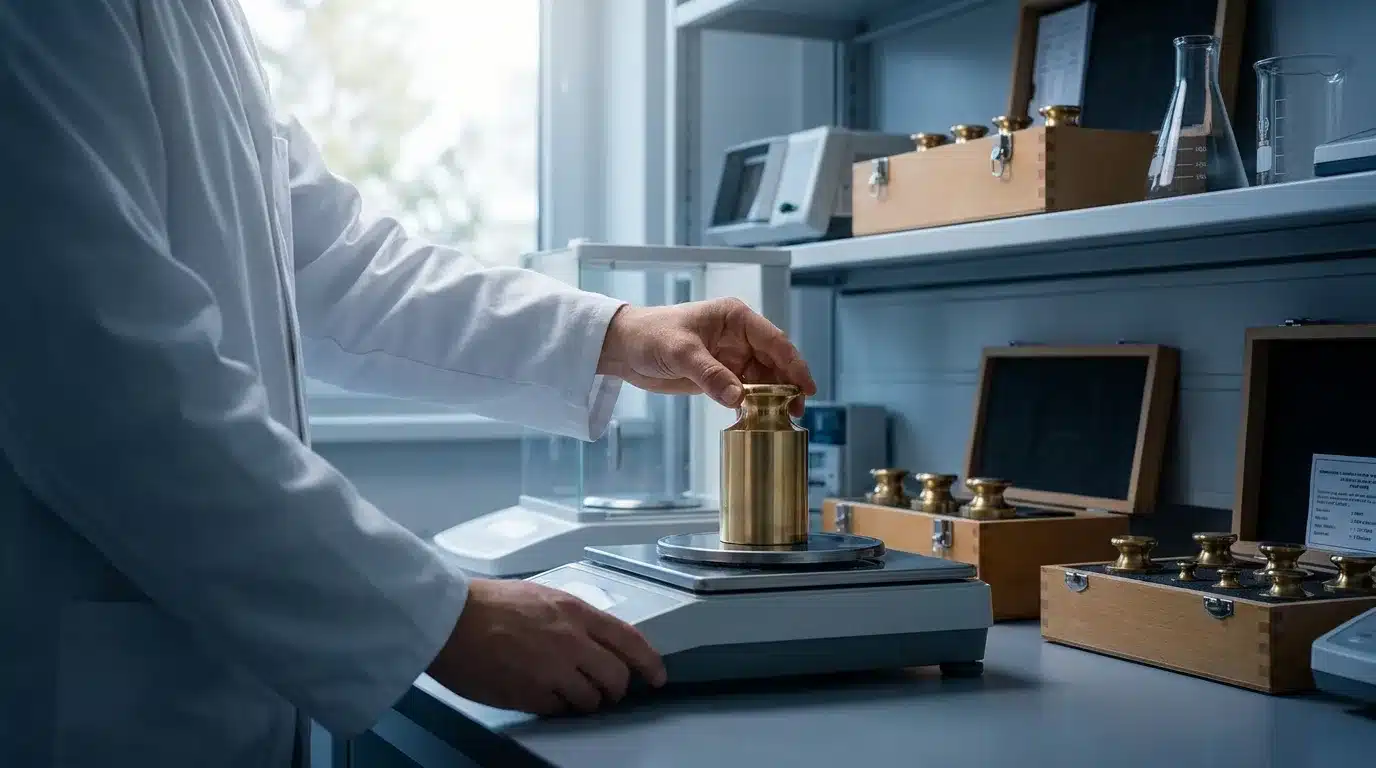 UKAS scale calibration is carried out with certified reference weights, traceable through an independently audited laboratory rather than just an unverified chain of paperwork.
UKAS currently accredits around 360 calibration laboratories to ISO/IEC 17025 across the UK. UKAS itself publishes a searchable directory at its own website showing exactly which laboratories hold accreditation and, critically, which specific types of calibration each one is accredited to perform — accreditation is granted for defined scopes of work, not as a blanket credential, so a lab accredited for temperature calibration isn't automatically accredited for mass/weighing calibration.
Before booking a UKAS calibration, it's worth confirming the specific laboratory's accreditation actually covers the type and capacity of scale you need calibrated, not just assuming any UKAS-accredited business covers everything.
This scope-specific structure exists for a good reason: accrediting a laboratory for mass and weighing calibration requires a genuinely different set of reference standards, environmental controls, and technician training than accrediting the same laboratory for, say, temperature or pressure calibration. A lab that's excellent at one discipline isn't automatically qualified for another just because it holds UKAS status somewhere in its portfolio — the accreditation follows the specific measurement discipline, capacity range, and uncertainty level the laboratory has actually demonstrated competence in, checked and re-checked through periodic UKAS surveillance visits rather than granted once and left unreviewed.
When You Actually Need UKAS Scale Calibration
UKAS scale calibration isn't a legal requirement for every scale in every business — but it becomes the practical standard in several genuinely common situations:
- Regulated industries — pharmaceuticals, food manufacturing, and other sectors where an auditor will specifically ask whether calibration was UKAS accredited, not just traceable.
- Quality management systems that reference it directly — many ISO 9001 and industry-specific quality systems require calibration evidence from an accredited source as a documented requirement.
- Export markets — UKAS accreditation is internationally recognised and can smooth access to markets that expect ISO/IEC 17025-backed documentation.
- Legal or insurance disputes — using an accredited body for calibration helps demonstrate due diligence if a measurement is ever challenged, since the independence of the accreditation is itself part of the evidence.
- High-value or high-risk weighing — anywhere a measurement error carries real financial or safety consequences, the extra assurance UKAS accreditation provides is worth the typically higher cost compared to a non-accredited provider.
For lower-stakes internal checks — routine verification where nothing downstream depends on a documented, independently-audited result — a standard traceable calibration from a reputable provider is often genuinely sufficient, and paying for UKAS accreditation on every single internal check isn't always a proportionate use of budget.
What UKAS Accreditation Actually Buys You
Beyond the certificate itself, UKAS accreditation carries real, practical business value that's worth understanding rather than treating as a compliance box to tick.
Accurate calibration backed by UKAS accreditation genuinely helps limit product failure and unplanned downtime, since a scale that's actually reading correctly — not just claimed to be — stops being a hidden source of manufacturing or quality errors. Using an accredited supplier can be a real time and cost saver in decision-making and risk management too: instead of independently vetting every calibration provider's internal competence yourself, UKAS has already done that verification work externally, on an ongoing basis, so you don't have to.
There's also a competitive and market-access angle that businesses sometimes overlook. Accreditation to internationally-recognised standards like ISO/IEC 17025 can genuinely smooth access to export markets, since UKAS accreditation is recognised internationally through mutual recognition arrangements between national accreditation bodies — a UKAS certificate carries weight beyond UK borders in a way a purely domestic "traceable" certificate doesn't automatically guarantee. And if a measurement is ever formally challenged — in a contract dispute, an insurance claim, or regulatory scrutiny — having used an independently accredited body for calibration is itself part of the evidence that a business exercised proper due diligence, rather than simply asserting it did.
Common Mistakes
- Assuming "traceable" and "UKAS accredited" mean the same thing. As covered above, they're genuinely different levels of assurance — check for the actual crown symbol, not just the word "traceable" on the certificate.
- Treating a supplier's ISO 9001 certificate as calibration proof. ISO 9001 says nothing about technical competence to calibrate accurately — ask specifically about ISO/IEC 17025 accreditation.
- Not checking the specific scope of accreditation. A UKAS-accredited laboratory isn't automatically accredited for every calibration type — confirm the scope actually covers your equipment.
- Paying for UKAS calibration where it isn't required. For low-stakes internal checks, a standard traceable calibration is often proportionate — reserve UKAS accreditation for situations where the extra assurance is genuinely needed.
- Not budgeting for the cost difference. UKAS-accredited calibration typically costs more than a basic traceable service, reflecting the laboratory's ongoing accreditation and audit costs — factor that in when comparing quotes.
Verify This Yourself
Accreditation scope, laboratory numbers, and requirements can change over time, and this guide reflects research current as of August 2026. Before making a decision based on UKAS scale calibration, check directly with:
- UKAS — Search accredited organisations — the official directory of accredited laboratories and their specific scopes.
- UKAS — Metrology sector information — further official detail on calibration accreditation.
- UKAS directly by phone (+44 (0)1784 429000) or email (info@ukas.com) for specific accreditation questions.
See our site disclaimer for how we handle regulatory and standards content generally.
Frequently Asked Questions
What is UKAS scale calibration? A calibration performed by a laboratory accredited by the United Kingdom Accreditation Service to ISO/IEC 17025 — the only organisation recognised by the UK government to accredit calibration activities against that standard.
What's the difference between UKAS calibration and traceable calibration? Any calibration should be traceable to a national standard, but "traceable" alone isn't independently verified. UKAS accreditation means an independent body has audited the laboratory's competence, equipment, and staff against ISO/IEC 17025.
Is ISO 9001 the same as UKAS accreditation for calibration? No. ISO 9001 is a generic quality-management certification that doesn't contain technical requirements for calibration personnel or operations. UKAS accreditation to ISO/IEC 17025 specifically tests technical competence, which ISO 9001 does not cover.
How do I check a calibration certificate is genuinely UKAS accredited? A genuine UKAS certificate carries the UKAS accreditation symbol, featuring the Royal Crown, in the top corner, along with measurement results, stated measurement uncertainty, and a statement of conformance.
How many UKAS-accredited calibration laboratories are there? UKAS currently accredits around 360 calibration laboratories to ISO/IEC 17025, with a searchable directory of which laboratory is accredited for which specific calibrations.
Does UKAS scale calibration cost more than a standard traceable calibration? Generally yes. A UKAS-accredited laboratory carries ongoing accreditation and audit costs that a non-accredited provider doesn't, and that's typically reflected in the price. For high-stakes or regulated weighing, the extra assurance is usually worth the difference; for routine internal checks, it may not be necessary.
Can any laboratory claim to offer UKAS scale calibration? No. UKAS accreditation is granted to specific laboratories for specific, defined scopes of calibration work, and it's independently verifiable through UKAS's own public directory — a laboratory can't simply assert UKAS status without it being checkable against the official record.
More Scale Calibration Guides
- UK Weighing Scale Regulations — scalecalibration.net/uk-weighing-scale-regulations/ — the full legal framework this sits inside.
- Legal-for-Trade Scales in the UK — scalecalibration.net/legal-for-trade-scales-uk/ — which businesses need approved equipment.
- Scale Calibration Services — scalecalibration.net/scale-calibration-services/ — real cost tiers for outsourced calibration work.
- Calibration Weights: Which Class & Size — scalecalibration.net/calibration-weights/ — the certified reference weights UKAS labs calibrate against.