By Jayson · Updated August 2026 · 9-minute read
Load cell replacement usually means one of two things — a conversion-kit upgrade that swaps just the sensing elements while reusing the existing foundation (fast, and a fraction of the cost of a new scale), or a full scale rebuild when the structure itself has failed. Real field data from METTLER TOLEDO shows analog load cell systems account for 76% of a truck scale's lifetime maintenance cost, which is why the upgrade path pays for itself quickly when the foundation is sound.
A single failed load cell doesn't just throw off a number on a display — it can throw off billing, inventory, and compliance all at once. That's why load cell replacement deserves more thought than "call whoever's cheapest": the real cost of accuracy includes labor, downtime, recalibration, and the certified weights needed to prove the system is reading correctly again, not just the price of the hardware itself.
This guide covers when a conversion-kit upgrade is the right call, when full scale replacement is actually necessary, what real manufacturer field data says about long-term reliability, and what calibration has to happen after either path.
In this guide
- What load cell replacement actually means
- When a load cell upgrade makes sense
- When full scale replacement is the real answer
- Real data: why analog load cells cost more over time
- What load cell replacement actually costs
- Calibration after load cell replacement
- Sourcing replacement load cells
- Do you need this for a small scale?
- How to decide: a quick checklist
- FAQ
Jump to: failure causes · warranty terms
What Load Cell Replacement Actually Means
"Load cell replacement" covers two genuinely different projects, and knowing which one you're budgeting for matters before you get a quote:
- A conversion-kit upgrade replaces the sensing elements of an existing scale — the load cells themselves, cabling, and sometimes the indicator — while keeping the foundation, pit, and structural steel intact.
- A full scale replacement rebuilds the structure itself: concrete, steel, and complete electronic instrumentation, because the foundation or structure can no longer be trusted.
Both are legitimately called "load cell replacement" depending on who you ask, which is exactly why this guide treats them as two separate decisions rather than one.
When a Load Cell Upgrade Makes Sense
A conversion-kit upgrade is the right call when the underlying structure is sound and only the electronic sensing components have aged or failed. Look for:
- Foundation and pit structurally sound, with no major cracking or settling.
- Existing junction boxes and cabling that can be reused or easily adapted.
- Downtime that needs to be minimized — upgrades can often be completed in a single day, since no concrete or structural work is involved.
- A facility that wants improved accuracy without a full capital-replacement budget.
Modern digital load cell upgrades — sealed, protected units designed to resist moisture, lightning, and physical damage — are a meaningfully different product than the analog systems many facilities are still running, not just a like-for-like swap.
What Actually Causes Load Cells to Fail
Understanding why load cell replacement becomes necessary in the first place helps explain why an upgrade, not just a repair, is often the right call. According to real field data on vehicle scale failures, three factors account for most load cell replacement decisions:
- Water — liquids that get inside junction boxes corrode hardware from the inside, often long before any external symptom appears.
- Lightning — a single strike can damage an entire string of load cells at once, since traditional analog systems share a signal path across the whole scale.
- Physical damage — rodents, debris, and overloading all cause damage that accumulates quietly until a reading finally drifts enough to notice.
This is exactly why a load cell replacement project should start with a root-cause conversation, not just a parts order — junction boxes are frequently the actual weak point rather than the load cells themselves, and moisture that gets in has nowhere to go. Sealed, junction-box-free digital designs address this specific failure mode directly, which is part of why they show up so heavily in the reliability data below.
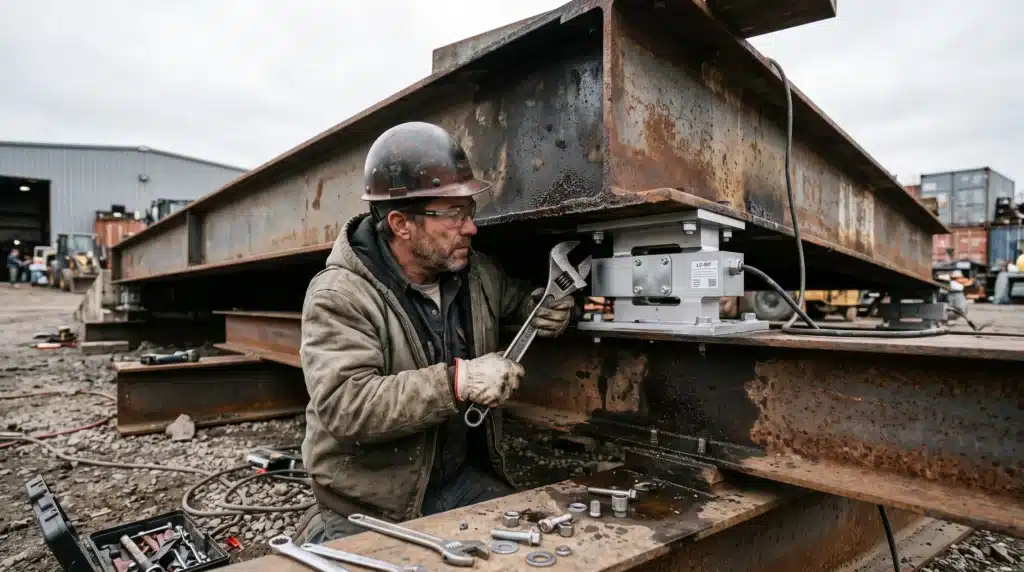
A load cell upgrade reuses the existing foundation and structure — only the sensing elements and cabling are replaced.
When Full Scale Replacement Is the Real Answer
Full replacement is the correct call when the foundation itself has failed, when the scale is decades past its designed capacity, or when the structure no longer meets current load requirements. If concrete is cracked through load-bearing sections, no amount of load cell replacement on top of it fixes that underlying problem — it just delays a more expensive failure.
Treat replacement as a structural decision first and an electronics decision second. Upgrading load cells on a failing foundation adds cost twice: once for the upgrade, and again when the structure eventually forces a full rebuild anyway.
Real Data: Why Analog Load Cells Cost More Over Time
According to METTLER TOLEDO's own published field data, analog load cell systems account for 76% of a truck scale's total lifetime maintenance cost — more than the weighbridge, software, accessories, and terminal combined. That figure includes parts, service repair, and profit lost to downtime, not just replacement hardware.
The same field data reports a failure rate under 0.02% for modern digital load cells, against a materially higher failure rate for analog systems over a comparable service life. On accuracy specifically, the real picture is more nuanced than a single number: field data shows the large majority of digital load cell readings fall within a tight 0-12 lb error band, while analog systems show a wider spread across multiple error bands, including a meaningful share exceeding 60 lb of error. The gap is real and well-documented — it just isn't a clean "all analog scales are this inaccurate" claim, and any resource that flattens it into one number is oversimplifying the manufacturer's own data.
What Load Cell Replacement Actually Costs
Exact numbers vary too much by scale capacity, site conditions, and region to state a single reliable price range here — a fact worth being upfront about, rather than repeating a specific dollar figure that can't be traced to a real source. What's consistently true across vendors and case studies: an upgrade that reuses the existing foundation costs meaningfully less than a full rebuild, because concrete and structural steel work is the most expensive line item in any scale project, not the load cells themselves.
One real, documented example: a steel manufacturer profiled by Brady Systems was losing roughly $18,000 each time an aging analog load cell failed — a cost driven mostly by production downtime, not the replacement part itself. After upgrading to digital load cells, the facility reported only one cell needing replacement over the following three years. That's the real shape of the cost argument for load cell replacement: the hardware price is rarely the biggest number in the equation — downtime and repeat failures are.
Get a scoped quote from a provider who's actually seen your foundation and scale capacity before budgeting a number. A vendor unwilling to inspect the site before quoting is a reason for caution, not a shortcut worth taking.
Warranty Terms Are Part of the Real Cost, Too
A warranty is a useful, if indirect, signal of how confident a manufacturer actually is in a load cell system's reliability — and it's worth comparing directly rather than treating as boilerplate. As a real published example, METTLER TOLEDO's own POWERCELL PDX warranty covers 100% of parts, labor, and travel/mileage for a full 10 years, plus lightning protection for the same period. By the manufacturer's own comparison, that's a meaningfully longer commitment than the industry-typical pattern of around 5 years of parts coverage with labor, travel, and mileage covered only in the first 90 days.
That gap matters for total cost of ownership: a load cell replacement quoted at a lower upfront price but backed by a short warranty can end up costing more once years 2 through 10 of service calls and part replacements are added in. When comparing quotes, ask each vendor to spell out exactly what's covered, for how long, and whether labor and travel are included — not just parts.
Calibration After Load Cell Replacement
Neither an upgrade nor a full replacement is complete without proper calibration. Even the most advanced digital load cell needs to be checked against known references before it can be trusted for billing or compliance work — see our how to calibrate a digital scale guide for the general process, scaled up considerably for industrial equipment.
A trustworthy provider will run this process using certified calibration weights, document every reading, and issue a certificate that satisfies auditors and customers alike — our NIST calibration certificate cost guide covers real pricing by capacity, and ISO 17025 accreditation explains what to check before trusting a provider's certificate. Large industrial scales, especially truck scales, usually can't be shipped to a lab — on-site calibration brings certified reference weights directly to the equipment instead.
Sourcing Replacement Load Cells
For load cell replacement projects specifically, sourcing components through established suppliers matters more than it might seem — compatibility with existing junction boxes, summing cards, and cabling isn't guaranteed across brands, and a mismatched component can introduce the exact accuracy problems you're trying to fix.
Every calibration weight used to verify the new system belongs to a specific calibration weight class, and that class determines how tight the tolerance must be — see our calibration weights guide for choosing the right one for your equipment's capacity.
Do You Need This for a Small Scale?
Load cell replacement in the sense covered here — conversion kits, foundation assessments, six-figure structural decisions — applies to industrial and truck scales, not a kitchen or postal scale. If a small digital scale is reading wrong, the fix is almost never a load cell swap; it's calibration. Our how to calibrate a digital scale guide covers that process, and a US nickel weighs exactly 5.000 grams — a genuine rough reference for a quick home check, see how much does a nickel weigh.
The underlying principle scales down the same way it scales up: a known reference mass verifies an unknown reading, whether that's an industrial load cell system or a kitchen scale.
How to Decide: A Quick Checklist
Before requesting quotes, walk the foundation and scale through these questions — they determine which kind of load cell replacement you're actually budgeting for:
- Is there visible cracking in load-bearing concrete, or has the structure settled unevenly? If yes, lean toward full replacement — no load cell, however advanced, fixes a structural problem.
- Are the existing junction boxes and cabling in serviceable condition? If they can be reused, that's a meaningful cost saving toward the upgrade path.
- How much downtime can the facility actually absorb? A single day favors an upgrade; if a week or more is tolerable, replacement stays on the table even for a marginal foundation.
- Has the scale's required capacity changed since it was built? A facility now weighing heavier loads than the original design may need replacement regardless of foundation condition.
- What's the failure history? Frequent, isolated load cell failures on a sound structure point toward an upgrade; recurring structural symptoms (uneven readings tied to specific corners, visible movement) point toward replacement.
Answering these honestly before calling a vendor puts you in a much stronger position to evaluate whether a quote is reasonable — or whether someone's recommending a full rebuild that a foundation inspection wouldn't actually require.
Conclusion
Load cell replacement, whether as a targeted upgrade or a full scale rebuild, comes down to one structural question: is the foundation still sound? When it is, a conversion-kit upgrade restores accuracy and reliability in a fraction of the time and cost of a rebuild, backed by real field data showing analog systems account for the bulk of a scale's lifetime maintenance burden. When the foundation itself has failed, no amount of load cell replacement changes that — full replacement is the only real answer.
Whichever path fits your facility, the work isn't finished until the system is calibrated against certified, traceable weights and documented for whoever needs to trust the number next — an auditor, a customer, or your own inventory records.
Frequently Asked Questions
What is load cell replacement?
Load cell replacement means swapping the sensing elements of a scale — the components that actually measure weight — either as a conversion-kit upgrade that reuses the existing foundation and structure, or as part of a full scale rebuild when the structure itself has failed.
Is a load cell upgrade cheaper than full scale replacement?
Yes, generally by a wide margin, since an upgrade reuses the existing foundation, pit, and structural steel and only replaces the sensing elements. Exact costs vary significantly by scale capacity, site conditions, and vendor, so get a facility-specific quote rather than assuming a fixed price.
How much of a scale's lifetime maintenance cost comes from the load cell system?
According to METTLER TOLEDO's own published field data, analog load cell systems account for 76% of a truck scale's ongoing lifetime maintenance cost — more than the weighbridge, software, accessories, and terminal combined.
Do I need scale calibration after load cell replacement?
Yes, always. Neither an upgrade nor a full replacement is complete without calibration against certified, traceable weights — the new or upgraded load cells need to be checked and documented before the scale can be trusted for billing or compliance work.
When does full scale replacement make more sense than a load cell upgrade?
When the foundation itself has failed — cracked concrete in load-bearing sections, a structure that no longer meets current capacity requirements, or settling that upgraded load cells can't compensate for. Replacing load cells on a failing foundation only delays the underlying problem.
What causes load cells to fail in the first place?
Field data points to three main causes: water intrusion corroding junction boxes and internal hardware, lightning strikes damaging an entire string of load cells at once, and physical damage from rodents, debris, or overloading. Sealed, junction-box-free digital designs address these failure modes more directly than older analog systems.
More Related Guides
- NIST Calibration Certificate Cost — scalecalibration.net/nist-calibration-certificate-cost/ — real pricing for the calibration that follows any load cell work.
- ISO 17025 Accreditation: A Buyer's Guide — scalecalibration.net/iso-17025-accreditation-a-buyers-guide/ — what to check before trusting a calibration provider.
- Calibration Weights: Which Class & Size — scalecalibration.net/calibration-weights/ — the reference standards behind every post-replacement calibration.
- Best Floor Scale for Warehouse — scalecalibration.net/best-floor-scale-for-warehouse/ — choosing new equipment when replacement is the right call.
- How to Calibrate a Digital Scale — scalecalibration.net/how-to-calibrate-a-digital-scale/ — the everyday process behind every scale, industrial or small.