By Jayson · Updated August 2026 · 8-minute read
Quick answer: OIML weight classes rank calibration weights by accuracy, from E1 (most precise) down to M3 (least). The class tells you the tolerance — how far the weight is allowed to be from its true value. Match the class to your scale: analytical balances need E2 or F1, everyday bench and retail scales are fine with F2 or M1.
Every calibration weight traces back to one document, and understanding the seven-class system it defines is the single most useful piece of background knowledge for buying the right reference weight the first time, instead of guessing and hoping.
In this guide
- What OIML R 111 is
- The seven classes, most to least precise
- How big is the difference, really?
- OIML vs. ASTM (for US readers)
- Which class do you need?
- How the class ladder actually works in practice
- How this connects to your scale
- Common mistakes
- FAQ
What OIML R 111 Is
Every calibration weight traces back to one document: OIML R 111.
OIML is the International Organization of Legal Metrology. Its recommendation R 111 sets the rules for calibration weights — the tolerances, the materials, the shape, even how they're marked. It covers weights from 1 milligram up to 5,000 kilograms, spanning nearly every practical weighing application that exists.
The point is consistency. When a lab in Ohio buys an F1 weight and a factory in Germany buys an F1 weight, R 111 guarantees both mean exactly the same thing. That shared definition is part of the wider system of weights and measures that keeps global trade honest, not just a manufacturer's internal quality spec.
R 111 is a recommendation, not a law by itself. But most countries adopt it directly into their own legal metrology rules, which is why it carries real practical weight even though it isn't legislation in the strict sense.
The Seven Classes, Most to Least Precise
There are seven main classes. Think of them as a ladder — each rung is tight enough to calibrate the rung directly below it.
| Class | Precision level | Typical use |
|---|---|---|
| E1 | Highest | National reference labs; links master standards to lower classes |
| E2 | Very high | Calibrating analytical balances; verifying F1 weights |
| F1 | High | Precision lab and analytical balances |
| F2 | Medium-high | Lab and quality-control scales; precision retail |
| M1 | Medium | Commercial and bench scales; general trade |
| M2 | Low | Coarser industrial weighing |
| M3 | Lowest | Rough industrial scales; heavy-duty weighing |
E-class weights are the aristocrats of this system. Most people who buy calibration weights will rarely, if ever, touch one unless they work directly in a calibration lab. The overwhelming majority of real-world calibration happens with F and M class weights instead.
The ladder isn't decorative structure — it's functional. An E1 weight is used to certify an E2 weight, which in turn certifies an F1 weight, and so on down the chain. That's literally how accuracy propagates from a national reference standard all the way down to the scale sitting on an ordinary lab bench, one certified step at a time.

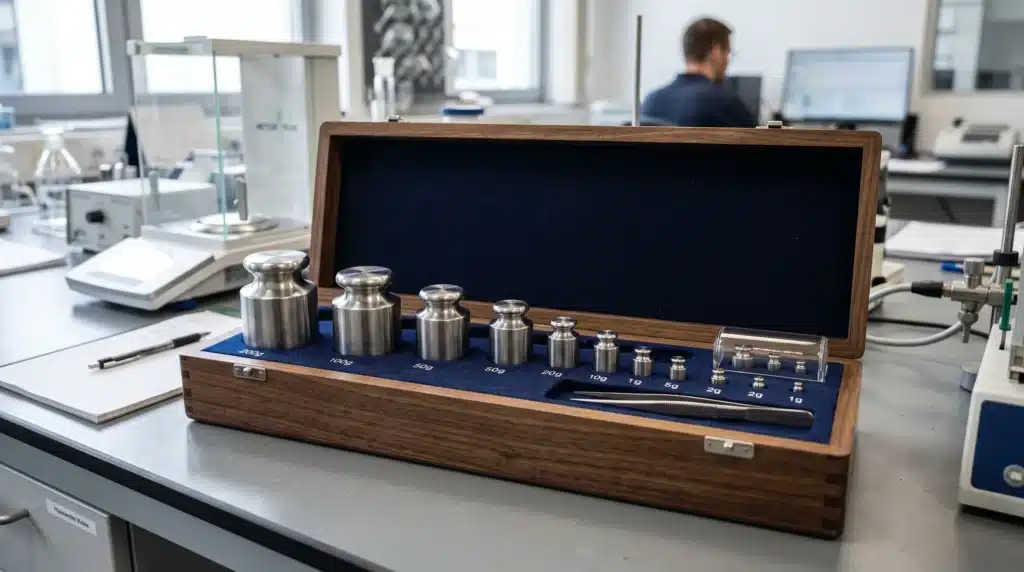
Handling technique matters as much as the class rating itself — bare-hand contact deposits oils and moisture that can shift even a properly-certified weight's mass over time.
How Big Is the Difference, Really?
The class names are abstract on their own. The actual tolerances are not.
Here is the maximum error allowed for a 1 gram weight in each class, straight from OIML R 111 — verified directly against two independent published sources of the standard:
| Class | Tolerance on a 1 g weight |
|---|---|
| E1 | ± 0.010 mg |
| E2 | ± 0.030 mg |
| F1 | ± 0.10 mg |
| F2 | ± 0.30 mg |
| M1 | ± 1.0 mg |
| M2 | ± 3.0 mg |
| M3 | ± 10 mg |
Look at the spread. An E1 gram is allowed to be off by ten-thousandths of a milligram. An M3 gram can be off by 10 milligrams — a thousand times looser than E1 on the exact same nominal 1 gram weight.
The tolerances scale with the weight itself — a 1 kg weight has a proportionally larger absolute tolerance than a 1 g weight in the same class, even though the relative precision requirement stays consistent. For the complete table across every nominal value OIML covers, the official R 111 document has the full breakdown. The general pattern, though, holds consistently across the whole range: each class up is roughly three times tighter than the one directly below it.
OIML vs. ASTM (for US Readers)
If you're in the United States, you've probably encountered ASTM classes as well. Here's how the two systems actually relate to each other.
OIML uses letters — E, F, M. ASTM uses numbers — Class 00 through Class 7. OIML is the global standard used in most of the world; ASTM is the system most US labs and suppliers grew up using and still reference by default.
They line up roughly, but not exactly:
| OIML class | Closest ASTM class |
|---|---|
| E1 | Class 00 |
| E2 | Class 0 |
| F1 | Class 1 |
| F2 | Class 2–3 |
| M1 | Class 4 |
| M2 | Class 5 |
| M3 | Class 6 |
Two of these correspondences are well established: OIML E1 matches ASTM Class 00 closely, and OIML F1 matches ASTM Class 1 closely. The rest are close approximations rather than exact equivalents. In some weight ranges an ASTM Class 1 weight is actually tighter than an OIML F1 weight at the same nominal value, and in other ranges that relationship flips the other way. So don't treat the mapping table as a literal, interchangeable swap — if a spec or a regulation calls for a specific named class, buy that exact class rather than substituting the "closest" equivalent from the other system. For the full US-side breakdown, see ASTM weight classes explained.
Which Class Do You Need?
There's a simple, genuinely useful rule for this decision: the one-third rule.
Your calibration weight's tolerance should be no more than one-third of your scale's readability. Readability is the smallest change your scale can actually display — 0.01 g on a good pocket scale, 0.0001 g on an analytical balance.
Run it through in practice:
- Analytical balance (0.1 mg readability) → E2 or F1
- Precision lab / jewelry scale (1–10 mg) → F1 or F2
- Bench, retail, or kitchen scale (0.1–1 g) → F2 or M1
- Industrial floor scale (10 g or coarser) → M1 or M2
Buying tighter than actually needed just wastes money without adding any usable benefit. An E1 set can cost many times what an equivalent M1 set costs, and a bench scale can't even resolve the difference between the two anyway — the extra precision is real, but it's invisible to an instrument that isn't fine enough to detect it. Match the class to the actual job at hand. If you're choosing a physical set to buy, our guide to calibration weights walks through materials, denominations, and what to actually buy for a given application.
Once a class is chosen, the next practical question is which denominations to actually buy, since a full set covering every possible value isn't necessary or standard. OIML weight sets are conventionally supplied in what's called a 5-2-2-1 series across each decade — meaning a set spanning 50g down to 1g typically includes one 50g, two 20g, one 10g, one 5g, two 2g, and one 1g weight. That specific mix of duplicated and single denominations lets a technician combine pieces to reach almost any intermediate value in that range without needing an individual weight for every single number, which keeps a working set both compact and genuinely useful across a wide range of calibration checks rather than needing a separate weight for every possible reading a scale might need verified against.
How the Class Ladder Actually Works in Practice
It's worth understanding what actually happens at each rung of the ladder, because it explains why the classes exist as a chain rather than as independent, unrelated tiers.
A calibration lab holding an E1 master weight uses it to verify E2 weights against their stated tolerance. Those E2 weights, once verified, get used to verify F1 weights. That process continues down through F2, M1, M2, and M3 — every class's accuracy is ultimately traceable back through this chain to the E1 reference at the top, and from there, back to the national standards body (NIST in the US) that maintains the actual master reference.
This is exactly what "traceability" means in a practical sense — not just a paperwork trail, but a real, unbroken sequence of physical verification, each link checked against the one above it. A weight that's changed hands or been recertified breaks that chain unless the recertification itself is documented and traceable back to an accredited source.
OIML R 111 doesn't mandate a fixed recertification schedule, but the accepted industry practice ties the interval to both accuracy class and how heavily a weight is actually used. A weight used infrequently or moderately is typically recertified annually; one in very frequent daily use is often recertified as often as every six months, since handling and environmental exposure accumulate faster under heavy use regardless of the weight's original class rating. E1 weights, which see relatively light, controlled use by their nature, are sometimes extended to a longer interval — occasionally as long as five years — precisely because they're rarely handled and kept under tightly controlled lab conditions the rest of the time.
Environmental conditions matter more as the class gets tighter, too. E and F class weights are typically calibrated and used in controlled-temperature, controlled-humidity lab environments specifically because air density, temperature-driven expansion, and even static charge can introduce measurable error at those tolerances — a genuinely negligible concern at M-class tolerances, but a real one once the allowed error drops into the microgram range. This is part of why E-class calibration work happens almost exclusively in accredited labs rather than in the field: the environment itself becomes part of the measurement, not just the instrument.
Density also plays a role that's easy to overlook. OIML defines a weight's "conventional mass" against a reference density of 8,000 kg/m³ in air of 1.2 kg/m³ — and because air buoyancy affects a weight's apparent mass differently depending on how close its actual density sits to that reference, a buoyancy correction becomes mandatory at the tightest tolerances. OIML R 111 specifically requires this correction for E1 and E2 class weights. Stainless steel, the material used almost universally at E and F class, has a density that sits very close to 8,000 kg/m³ by design, which keeps the required correction small. A cast iron weight, with a meaningfully lower density, would need a larger buoyancy correction to hit the same real-world accuracy — a real part of why cheaper materials top out at the lower M classes rather than being offered at E or F class at all.
How This Connects to Your Scale
You don't need to memorize the entire class ladder to calibrate a scale at home. But it does explain something genuinely useful about calibration guidance in general.
When a guide says "use a proper calibration weight," the class is what actually separates a real, trustworthy reference from a rough approximation. A stack of clean nickels gets you reasonably close — a US nickel weighs 5.000 g by mint specification — but coins carry no class rating at all and wear down with handling over time. That's a perfectly fine approach for a kitchen scale, but it's not remotely adequate for lab or commercial work.
The full picture of where these weights sit within the broader legal system is covered in the weights and measures overview. And if the goal is just checking whether a scale is currently reading true, the accuracy tester on our pocket scale guide gives an instant verdict against any known weight without needing to think about class ratings at all.
The overall takeaway is short: higher class means tighter tolerance, higher cost, and a job that genuinely demands real precision to justify the expense. For most people and most scales, F2 or M1 is all they'll ever actually need.
Common Mistakes
- Buying the highest class available "to be safe." Beyond what the one-third rule actually requires, extra class precision is wasted money that the scale itself can't even register.
- Treating the OIML-to-ASTM mapping as exact. The correspondences are close approximations except at E1/Class 00 and F1/Class 1 — buy the specific class a requirement calls for, not the nearest-sounding equivalent.
- Handling weights with bare hands. Skin oils and moisture transfer onto the weight's surface and can measurably shift its mass over time, especially at E and F class tolerances where the margin for contamination is genuinely tiny.
- Assuming a weight stays in-class forever. Certified weights drift too, from wear, contamination, and mechanical damage — periodic recertification against a traceable reference is what keeps a weight's class rating actually valid, not just its original certificate.
- Mixing up nominal-value tolerance with absolute tolerance across sizes. A class's tolerance in mg changes with the weight's nominal size — a 1g and a 1kg weight in the same class do not share the same absolute tolerance number.
Frequently Asked Questions
What are the OIML weight classes?
OIML R 111 defines seven main classes: E1, E2, F1, F2, M1, M2, and M3. E1 is the most accurate and M3 the least. Each has a tolerance matched to a level of weighing precision, from national reference labs down to rough industrial scales.
Which OIML class do I need for my scale?
Use the one-third rule — the weight's tolerance should be no more than a third of your scale's readability. Analytical balances need E2 or F1. Bench and retail scales are fine with F2 or M1. Coarse industrial scales use M2 or M3.
What is the difference between OIML and ASTM weight classes?
OIML uses letters and is the global standard. ASTM uses numbers (Class 00 to 7) and is most common in the US. They roughly correspond — E1 to Class 00, F1 to Class 1 — but the tolerances aren't identical, so match the exact class a spec requires.
What does OIML R 111 cover?
R 111 sets the tolerances, materials, shape, and marking rules for calibration weights from 1 mg to 5,000 kg. It's the document that makes an F1 weight mean the same thing in any country.
Why is a higher-class weight more expensive?
Tighter tolerance costs more to make and certify. An E1 weight is polished non-magnetic stainless steel, accurate to thousandths of a milligram, and individually documented. An M-class weight has a far looser tolerance, so it's cheaper.
What is the actual tolerance for a 1 gram E1 weight versus an M3 weight?
A 1 gram E1 weight must be accurate to within ±0.010 mg. A 1 gram M3 weight only needs to be accurate to within ±10 mg — a thousand times looser, and the clearest illustration of how wide the spread between the top and bottom OIML classes really is.
More Scale Calibration Guides
- Weights and Measures: What They Are and Why Your Scale Depends on Them — scalecalibration.net/weights-and-measures/ — the pillar overview this article supports; start here for the big picture.
- ASTM Weight Classes Explained — scalecalibration.net/astm-weight-classes-explained/ — the US numbered-class system compared directly to OIML.
- Calibration Weights — scalecalibration.net/calibration-weights/ — how to choose and buy the physical weights in each class.
- Legal for Trade Scales — scalecalibration.net/legal-for-trade-scales/ — what NTEP certification actually requires.
- E2 Class Weights — scalecalibration.net/e2-class-weights/ — a real-world deep dive into one specific class from this ladder.