By Jayson · Updated August 2026 · 9-minute read
Quick answer: NIST NIST Handbook 44 is the US rulebook for commercial weighing devices. It defines how scales must be built, marked, tested, and how accurate they have to be. NIST publishes it every year; states adopt it into law. It's the technical foundation for NTEP approval and for every legal-for-trade scale — and its five accuracy classes, not four, determine exactly which tolerance table applies to any given scale.
Behind every honest commercial scale sits one document, and understanding its structure explains more about why a scale is built, marked, and tested the way it is than almost any other single piece of background knowledge in this field — including why two nearly identical-looking scales can be governed by genuinely different rules.
In this guide
- What NIST Handbook 44 is
- Who writes it and how often it changes
- What it actually covers
- How it becomes law
- Its link to NTEP and legal-for-trade
- Accuracy classes I, II, III, III L, and IIII
- Why the class marking matters more than most people realize
- Common mistakes
- FAQ
What NIST Handbook 44 Is
Its full title is Specifications, Tolerances, and Other Technical Requirements for Weighing and Measuring Devices. Everyone just calls it NIST Handbook 44, or HB 44.
It's the national rulebook that governs how a commercial scale must be built, installed, marked, tested, and used. The underlying point is fairness — accurate, repeatable measurements that don't mislead a customer on either side of a transaction. It's the technical engine of the whole weights and measures system, not just one component sitting alongside it.
If a scale is used to buy or sell by weight anywhere in the US, NIST Handbook 44 is the standard it ultimately answers to, whether the person using it realizes that or not.
Who Writes It and How Often It Changes
Two organizations share the work, and the split between them matters for understanding how the document actually gets updated.
- The NCWM — the National Conference on Weights and Measures — develops and votes on the technical content. Manufacturers, state officials, and industry representatives meet each year and agree on changes together.
- NIST's Office of Weights and Measures (OWM) — provides technical guidance and formally publishes the official handbook.
In plain terms: the NCWM decides the rules through its committee process, NIST provides technical support and prints the result. The handbook is updated every year, released after the NCWM's annual meeting. Each edition rolls in the prior year's adopted changes and formally replaces the one before it.
The current edition is HB 44-2026, whose amendments were adopted at the NCWM's 110th Annual Meeting in July 2025. When a state law references "the current edition," this annual publication cycle is exactly what it's tracking.
The handbook itself isn't a recent invention — NIST Handbook 44 as a formally named publication was first issued in 1949, but it was preceded by similar weights-and-measures handbooks going back to 1918, according to NIST's own publication history. What's changed most over that century-plus isn't the underlying goal — fair, accurate commercial measurement — but the annual revision cycle that keeps the document current against new device types, from the earliest mechanical scales to today's networked digital and IoT-connected weighing systems.
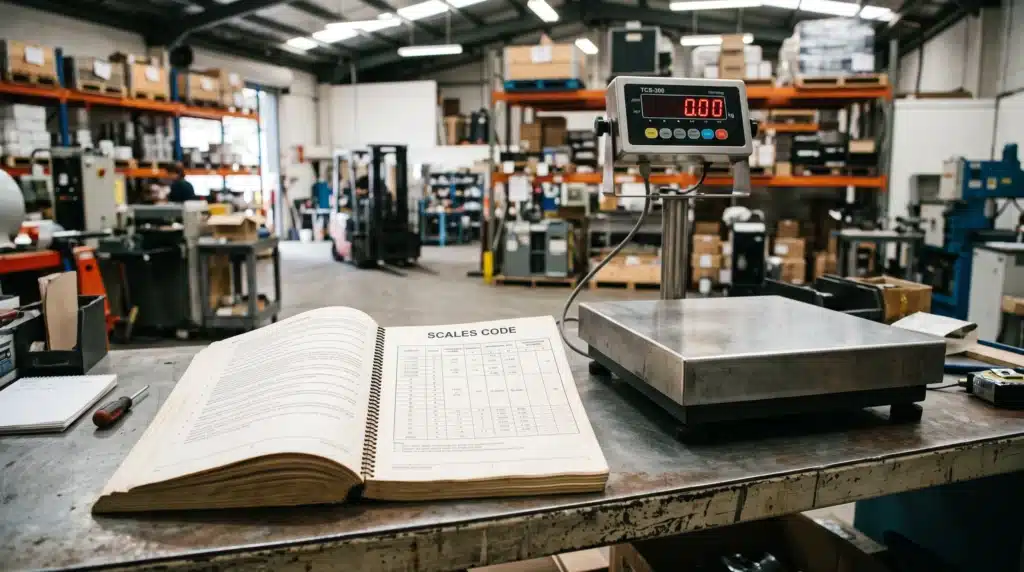
The Scales Code section is what a technician actually reaches for in the field — it's a small fraction of the full handbook, but the part that governs the vast majority of real-world scale inspections.
What It Actually Covers
NIST Handbook 44 isn't only about scales. It also covers gas pumps, water meters, taximeters, and a range of other measuring devices. But its internal structure is worth understanding, because it explains exactly how the rules apply to a given scale in practice.
It's built in two layers:
- The General Code — baseline rules that apply to every device type: indications, sealing, labeling, and a blanket rule that a device must not facilitate fraud in any transaction.
- Specific device codes — detailed rules for each individual device type. For scales specifically, that's the Scales Code, found in Section 2.20 of the handbook.
When the two layers conflict on a specific point, the specific device code wins. So the Scales Code overrides the General Code for anything scale-related, while the General Code still governs whatever the Scales Code doesn't specifically address.
The Scales Code, in plain terms, covers:
- Definitions — capacity, scale division, accuracy class, and the other technical terms the rest of the code depends on.
- Design and construction — how a scale must be built to stay accurate over time and resist tampering or unauthorized adjustment.
- Marking — model, capacity, and accuracy class must all be clearly and permanently shown on the device.
- Tolerances — how close to true the scale must read, both in ongoing service and at initial type evaluation.
- Test procedures — how officials actually test a scale, and at which specific load points during that test.
The tolerances section deserves a closer look, because it's not a single fixed number the way many people assume. NIST Handbook 44 actually specifies two distinct tolerance levels for the same scale: acceptance tolerance, the tighter standard a brand-new scale must meet before entering service, and maintenance tolerance, a looser standard — roughly twice as wide — applied to scales already in the field. That gap deliberately accounts for the normal mechanical wear and environmental drift a scale accumulates over real-world use, so a scale that's been in service for a year isn't held to the exact same razor-thin standard as one fresh off the assembly line. This maintenance-vs-acceptance structure is one of the more practically important details in the entire Scales Code, since it's what actually determines whether a specific out-of-tolerance reading during a routine inspection is a minor, expected finding or a genuine failure.
How It Becomes Law
Here's the part that genuinely surprises a lot of people encountering this for the first time: NIST Handbook 44 is not a law on its own, no matter how authoritative it sounds.
It only carries legal force when a jurisdiction formally adopts it. Most states have a Weights and Measures Act that adopts NIST Handbook 44 by reference — sometimes naming a specific edition explicitly, sometimes simply pointing to whatever the latest published edition happens to be at any given time.
Once a state adopts it, HB 44's specifications and tolerances become the actual legal standard for commercial devices operating in that state. That's why a scale used to sell goods by weight is only genuinely legal for trade if it complies with the specific edition your state has adopted — not necessarily the newest edition NIST has published, if a state hasn't formally updated its own reference yet. The rulebook itself is national in scope; the enforcement of it is handled state by state.
Its Link to NTEP and Legal-for-Trade
NIST Handbook 44 and NTEP work as a pair, functioning at two different levels of the same overall system. One sets the rules; the other tests devices against them.
NTEP — the National Type Evaluation Program — evaluates a scale model before it ever reaches the commercial market. It tests the model's design against NIST Handbook 44's requirements directly. A model that passes earns a Certificate of Conformance.
Then essentially the same verification happens again in the field, but at the individual unit level rather than the model level:
- Type level (NTEP) — does this model design meet NIST Handbook 44's requirements? If yes, the model earns a CoC.
- Field level (state inspection) — does this specific installed scale still meet NIST Handbook 44's tolerances in actual use? A state or county official checks it directly before it's approved and sealed.
Only a scale that clears both levels is genuinely legal for trade under NIST Handbook 44. The practical difference between that field-level check and routine servicing in between checks is covered in inspection vs. calibration.
Accuracy Classes I, II, III, III L, and IIII
NIST Handbook 44 sorts scales into five accuracy classes, not four — a detail that's easy to miss because two of the classes look deceptively similar in their Roman-numeral naming. The class controls how fine a scale's resolution needs to be and where it can legally be used; we cover this in even more depth in scale accuracy classes explained.
| Class | Typical scales |
|---|---|
| I | Precision laboratory weighing applications |
| II | Laboratory weighing, grain test scales, precious metal and gem weighing |
| III | General commercial weighing not otherwise specified, verification scale division (e) under 2 kg |
| III L | Large-capacity commercial weighing, verification scale division (e) 2 kg or larger — vehicle, axle-load, rail, and crane scales |
| IIII | Wheel-load and axle-load weighers used in highway weight enforcement |
The class is set primarily by the scale's resolution (how small a division it can display) combined with, for the III/III L split specifically, the scale's rated capacity. A Class I balance can resolve differences far finer than any Class III retail scale ever needs to. A Class IIII wheel-load weigher, by contrast, is built for a completely different job — roadside enforcement — and its tolerance structure reflects that entirely different use case rather than simply being "less accurate" in a generic sense.
Two practical takeaways worth remembering:
- Most everyday trade scales are Class III. Grocery, deli, shipping, and bench scales fall here. It's accurate enough for fair commerce without being lab-grade precision.
- Class III and Class III L are easy to confuse, but the split matters. Truck scales and rail scales specifically fall under Class III L because of their verification scale division, not Class III — a division (e) of 2 kg or larger is the actual dividing line, not the type of business using the scale or a flat capacity number.
Why the Class Marking Matters More Than Most People Realize
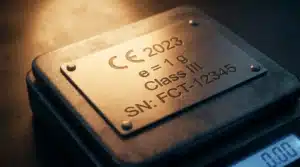
The class marking on a scale's nameplate isn't decorative — it's functionally the scale's job description, and it tells an inspector exactly which tolerance table in NIST Handbook 44 to reference during a test. Two scales that look nearly identical in size and capacity can be governed by entirely different tolerance requirements if their class differs, which is why the marking itself, not just the scale's apparent build quality, is what an inspector actually checks first.
This marking requirement has applied to scales manufactured since 1988 — scales built before that date may lack a class marking entirely, which inspectors handle through separate tolerance-table guidance rather than treating the absence of a marking as an automatic failure. For any scale built since, a missing or incorrect class marking is itself a compliance problem independent of how accurately the scale actually reads.
The certified weights used to test each class are graded on their own separate accuracy scale entirely; see OIML weight classes explained for that side of the system.
Common Mistakes
- Assuming Class III covers every commercial scale. Anything with a verification scale division of 2 kg or larger — including most truck scales and rail scales — actually falls under Class III L, a genuinely separate class with its own tolerance table.
- Treating "the current edition" as automatically applicable. A state's legal requirement is whatever edition that state has formally adopted, which isn't always the newest one NIST has published.
- Confusing NTEP model approval with individual unit compliance. A scale model holding a valid Certificate of Conformance still needs its specific installed unit verified and sealed by a field inspector before it's actually legal for trade.
- Ignoring the General Code in favor of the Scales Code alone. The Scales Code overrides the General Code only where the two actually conflict — General Code provisions still apply wherever the Scales Code is silent.
- Assuming a missing class marking on an older scale is automatically a violation. The marking requirement applies to scales manufactured since 1988; older unmarked scales are handled under separate guidance, not treated as automatically non-compliant.
- Treating acceptance and maintenance tolerance as the same number. A scale failing a routine inspection against the tighter acceptance tolerance, when the correct standard for an in-service unit is the wider maintenance tolerance, is a common and entirely avoidable misreading of the requirement.
- Assuming the newest handbook edition applies everywhere immediately. Because adoption happens state by state, a business operating across multiple states can genuinely be subject to different editions simultaneously, depending on how quickly each state updates its own referenced version.
Frequently Asked Questions
What is NIST NIST Handbook 44?
It's the national rulebook titled Specifications, Tolerances, and Other Technical Requirements for Weighing and Measuring Devices. It sets how commercial scales and meters must be built, marked, tested, and used. NIST publishes it; the NCWM develops the technical content.
How often is NIST NIST Handbook 44 updated?
Annually, published after the yearly NCWM meeting. Each edition folds in the prior year's adopted changes and supersedes the last. The current edition, HB 44-2026, was adopted at the NCWM's 110th Annual Meeting in July 2025.
Is NIST NIST Handbook 44 a law?
Not by itself. It becomes binding when a state adopts it by reference, usually through a Weights and Measures Act naming an edition. Most states adopt it, making its specs and tolerances the legal standard for commercial devices there.
What do scale accuracy classes I, II, III, III L, and IIII mean?
Class I covers precision laboratory weighing. Class II covers laboratory weighing, grain test scales, and precious metal/gem weighing. Class III covers general commercial weighing with a verification scale division under 2 kg. Class III L covers larger-capacity commercial weighing with a verification scale division of 2 kg or more — vehicle, axle-load, rail, and crane scales. Class IIII covers wheel-load and axle-load weighers used in highway weight enforcement.
How does NIST Handbook 44 relate to NTEP?
NIST Handbook 44 is the technical basis for NTEP. A model is evaluated against it, and if it passes it earns a Certificate of Conformance. State officials then verify each installed unit against NIST Handbook 44 tolerances in the field.
What's the difference between Class III and Class III L?
Both cover general commercial weighing, but the split is the verification scale division (e): Class III applies when e is under 2 kg (most retail, deli, and bench scales), while Class III L applies when e is 2 kg or larger — truck scales, rail scales, and crane scales fall under III L because their divisions are large enough to cross that threshold.
More Scale Calibration Guides
- Weights and Measures: What They Are and Why Your Scale Depends on Them — scalecalibration.net/weights-and-measures/ — the pillar overview this article supports.
- Legal for Trade Scales — scalecalibration.net/legal-for-trade-scales/ — how NTEP and NIST Handbook 44 make a scale approved for commerce.
- Weights and Measures Inspection vs. Calibration — scalecalibration.net/weights-and-measures-inspection-vs-calibration/ — how acceptance and maintenance tolerances actually get applied.
- OIML Weight Classes Explained — scalecalibration.net/oiml-weight-classes/ — the international grading of the test weights used to check each accuracy class.
- Truck Scales — scalecalibration.net/truck-scales/ — a real-world example of Class III L equipment, with real cost tiers.