By Jayson · Updated August 2026 · 9-minute read
Quick answer: Weights and measures are the official standard units — the pound, the gram, the gallon — that governments define and enforce so every scale reads the same. In the US, NIST sets the standards and your county's weights and measures office checks that commercial scales obey them. Your home scale isn't regulated, but it relies on the exact same reference weights.
A gram in your kitchen has to equal a gram at the grocery store. Otherwise trade falls apart. That single requirement — that a unit means the same thing no matter who's measuring it or what they're selling — is the entire reason weights and measures exist as a body of law rather than just a set of physics definitions.
In this guide
- What "weights and measures" actually means
- A short history of the standards
- Who governs weights and measures in the US
- How other countries handle it
- "Legal for trade": what it means for scales
- Acceptance vs. maintenance tolerance
- Weights and measures vs. calibration
- What this means for your own scale
- Common misunderstandings
- FAQ
What "Weights and Measures" Actually Means
Weights and measures are the agreed standard units for quantities like weight, length, volume, and area. Someone has to define exactly how heavy a kilogram is, then make sure everyone's equipment matches that definition — a scale, a fuel pump, a fabric yardstick, a taxi meter.
Most of the world uses the International System of Units, or SI. Its base units are the metre for length, the kilogram for mass, and the second for time. The United States runs a dual system — it uses SI alongside the older US Customary units like the pound and the ounce, which is why a US grocery scale can legally display both pounds and, on request, kilograms.
Without a shared reference, "one pound of coffee" would mean whatever the seller wanted it to mean. Weights and measures law removes that argument entirely. It ties every commercial scale back to a physical (or, since 2019, a physically-derived) standard that nobody gets to quietly redefine in their own favor.
A Short History of the Standards
Standardized weights are older than most governments. Ancient traders used stone and metal reference weights to settle disputes long before anyone wrote formal rules down — archaeological weight sets from Mesopotamia and the Indus Valley predate written law codes by centuries.
In the United States, the authority is built directly into the Constitution. Article I gives Congress the power to "fix the standard of weights and measures." That authority eventually landed with the federal standards body, now called the National Institute of Standards and Technology (NIST).
For most of history, a physical object defined each unit. The kilogram, for well over a century, was a literal platinum-iridium cylinder kept in a vault outside Paris — the International Prototype Kilogram. That changed in 2019, when the international scientific community redefined the SI base units around fixed constants of nature instead of physical artifacts. The kilogram is now tied to the Planck constant, a definition that can't be lost, scratched, or worn down by handling, the way the old physical cylinder theoretically could.
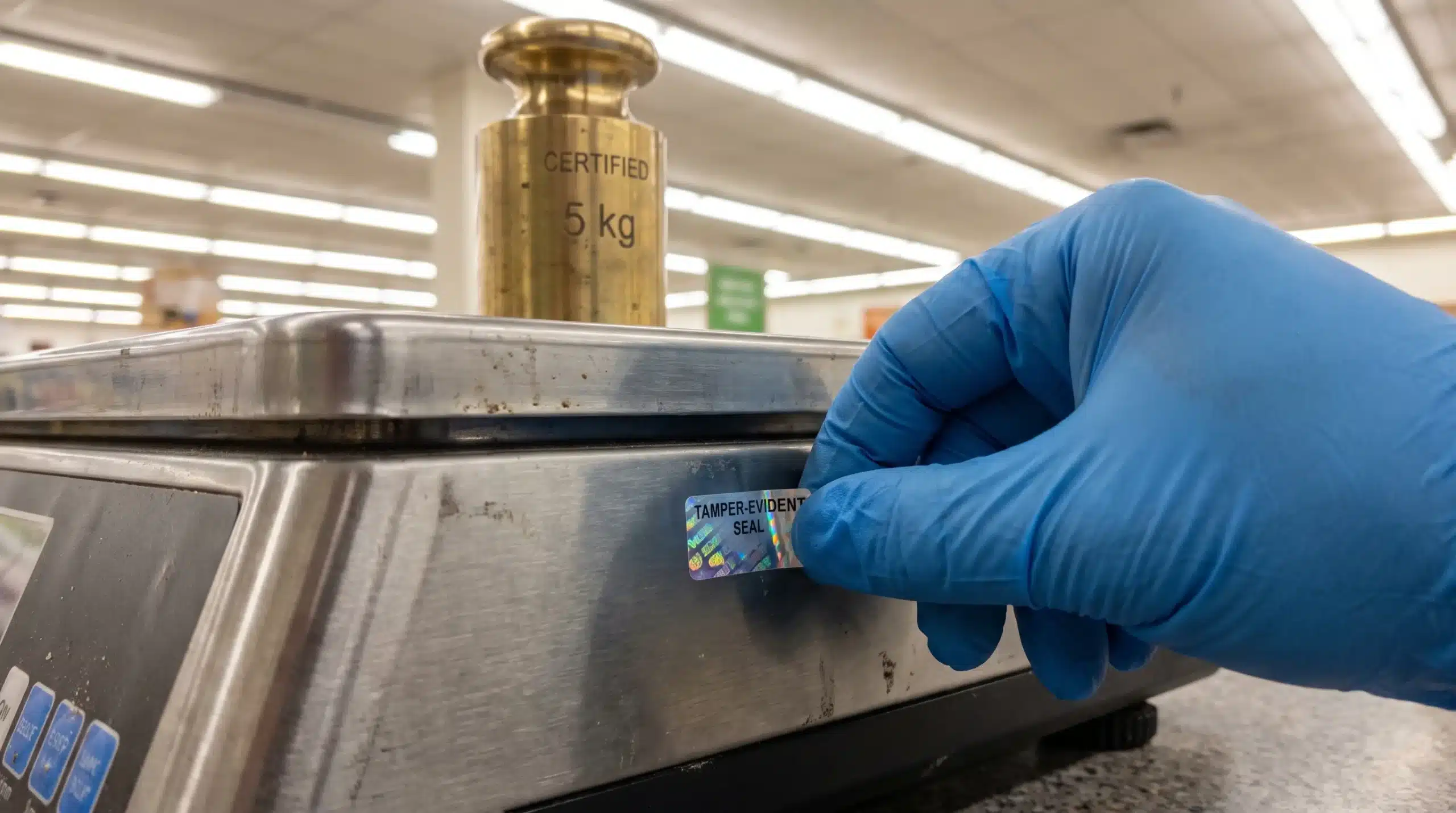
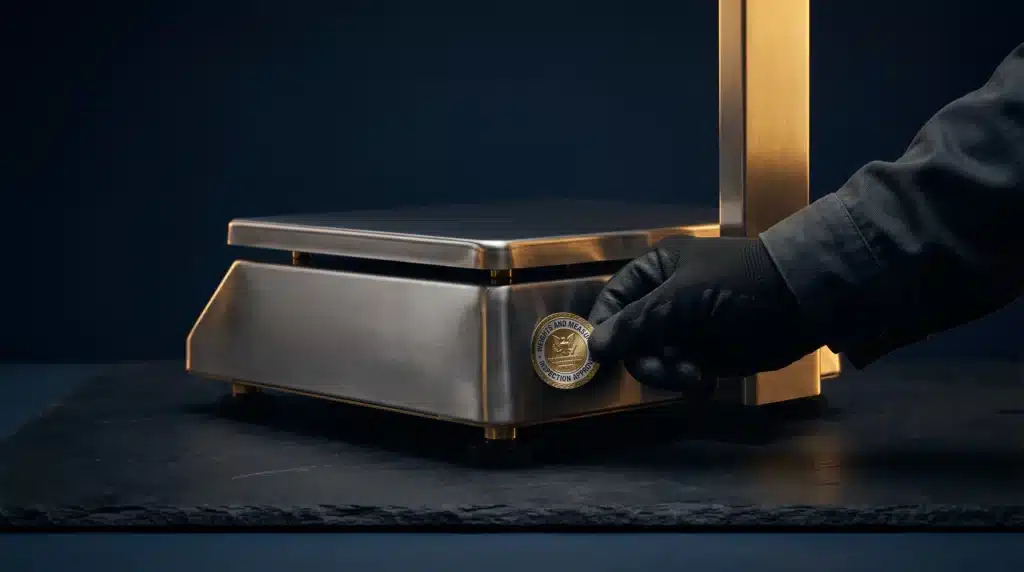
The seal is the visible end of a very long chain — from a defined physical constant, through NIST's master standards, to the certified weight in the inspector's case, to the sticker on this scale.
The everyday enforcement side is older and more local than the constant-based physics behind it. For centuries, towns and counties appointed a "sealer of weights and measures" to test merchants' scales and stamp the honest ones with a mark of approval. That role still exists today, almost unchanged in function, usually organized at the county or state level rather than the town level.
Who Governs Weights and Measures in the US
Three layers do the actual work, and they rarely overlap in responsibility.
- NIST — the National Institute of Standards and Technology writes the national rules and maintains the master reference standards. Its key document for scales is Handbook 44, the full title of which is Specifications, Tolerances, and Other Technical Requirements for Weighing and Measuring Devices.
- NTEP — the National Type Evaluation Program tests specific scale models before they're allowed to be sold for commercial use in the US. A scale model that passes earns a Certificate of Conformance, which is a prerequisite for legal-for-trade use anywhere in the country.
- State and county officials — the field inspectors, still called sealers in many jurisdictions. They physically visit stores, test the scales already in service against certified weights, and apply a tamper-evident seal to the ones that pass.
Internationally, the base units themselves are maintained by the International Bureau of Weights and Measures (BIPM), headquartered near Paris. NIST's own standards trace back to BIPM's definitions. That unbroken chain — from BIPM, to NIST's master weights, to a state metrology lab's working standards, to your county inspector's field weights, to the deli scale being tested — is exactly what the term "traceability" means in a calibration context. See our measurement traceability guide for how that chain is documented in practice.
How Other Countries Handle It
The US system isn't unique in structure, even though the specific agency names differ. The United Kingdom's Office for Product Safety and Standards sets national policy, while local Trading Standards authorities handle field enforcement — functionally the same NIST-plus-county-sealer split, under different names. Canada centralizes the equivalent function under Measurement Canada, a federal agency that both sets standards and runs field inspections directly, without the state/county layer the US uses.
The common thread across every developed economy's system is the same three-part structure seen in the US: a national body that defines the standard, a certification process that vets scale models before sale, and a field-inspection layer that verifies individual scales in actual commercial use. The names change; the underlying logic — definition, approval, verification — doesn't.
"Legal for Trade": What It Means for Scales
If a business weighs something and charges for it based on that weight, the scale used has to be legal for trade.
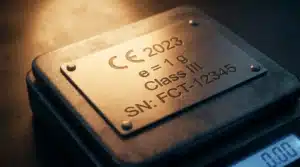
A legal-for-trade scale is one that meets NIST Handbook 44 requirements and has passed NTEP approval as a model. You'll see this in practice at grocery deli counters, at the post office, on truck weighbridges, at recycling depots, and anywhere a customer pays based on a number the scale produces. It isn't a marketing badge or an optional quality tier — it's a legal requirement, and using a non-approved scale for commercial weighing can bring real fines from the state or county enforcing it.
Most US states require an annual weights and measures inspection of every legal-for-trade scale in active commercial use, with high-volume sites sometimes requiring more frequent checks. The inspector tests the scale against a set of certified reference weights and confirms the reading falls within the Handbook 44 tolerance defined for that scale's accuracy class.
Acceptance vs. Maintenance Tolerance
One detail that trips up a lot of scale owners: the tolerance a scale has to meet isn't a single fixed number — it depends on whether the scale is brand new or already in service.
Acceptance tolerance is the tighter standard. A scale has to meet it before it's approved for initial commercial use — essentially, the bar for a scale entering the field for the first time.
Maintenance tolerance applies to scales already in service, and it's genuinely looser — Handbook 44 sets it at roughly twice the acceptance tolerance. That extra margin exists deliberately, to account for the normal mechanical wear and environmental drift a scale accumulates over months or years of real use, without forcing a scale out of service the moment it drifts even slightly from its brand-new baseline.
In practice, this means a scale that would have failed its very first inspection can still legally pass a routine annual re-inspection, provided the drift stays inside that wider maintenance window. It's a deliberately built-in, forgiving tolerance for age — not a loophole, and not a sign the inspection is being done loosely.
Weights and Measures vs. Calibration
People often use these two terms as if they mean the same thing. They don't, and the distinction actually matters for anyone running a commercial scale.
Calibration is the technical process of testing a scale and adjusting it to read correctly. A technician — or you, at home, on a non-commercial scale — does it using known reference weights. It's the process that fixes the scale.
A weights and measures inspection is the official government verification that a commercial scale already meets legal tolerances. A state or county official does it, using their own certified field weights. It's the process that certifies the scale, not the process that fixes it.
Calibration comes first, in practice. A shop keeps its scales properly calibrated all year specifically so they pass the annual inspection cleanly rather than failing it and losing the ability to legally weigh and sell by weight until it's fixed. We break this exact relationship down further in weights and measures inspection vs. calibration, and for the full technical side of the calibration process itself, see our complete guide to scale calibration.
The reference weights themselves sit at the center of both processes. Certified weights carry an accuracy class under the OIML E1-to-M3 system, and picking the right class for a given job is its own real decision. See what calibration weights you need to choose a set matched to your actual accuracy requirements.
What This Means for Your Own Scale
Here's the honest part. If your scale lives in a kitchen or bathroom, none of the legal machinery described above applies to you directly. There's no inspector coming, no seal required, and no fine for a scale that reads slightly wrong.
But the underlying accuracy problem is identical. Your scale still drifts, still loses its zero point over time, and still needs a known weight to check it against if you want to actually trust the number it shows you. The only real thing you lose at home, compared to a commercial scale, is the paperwork and the legal stakes.
You can run essentially the same basic verification test the professionals run, just without the certified equipment:
- Zero the scale with nothing on it.
- Place an object of known weight in the center of the platform.
- Compare the displayed reading to the object's true, known weight.
No certified weights on hand? Household objects work for a rough, informal check — a stack of coins is the classic trick, since a US nickel weighs exactly 5.000g by mint specification. See what weighs 100 grams for more household reference objects, or use the built-in accuracy tester on our pocket scale calibration guide for an instant pass/fail check.
Worn coins can genuinely be off by 0.1g or more each from handling wear, so they won't match a certified weight closely enough for anything that actually matters. For any use where accuracy has real financial or safety consequences, buy a proper certified calibration weight instead. But for keeping a kitchen scale honestly close to accurate for everyday cooking, the coin method is good enough.
Common Misunderstandings
A few points cause genuine, recurring confusion even among people who deal with scales regularly:
- "NTEP-approved" and "legal for trade" aren't quite the same claim. NTEP approval certifies the scale model was tested and meets the standard. Legal-for-trade status also requires that the specific scale in use has been installed correctly and passed its local field inspection — a genuinely NTEP-approved model can still be non-compliant if it hasn't been inspected and sealed.
- A calibrated scale isn't automatically a legal-for-trade scale. Calibration only confirms the reading is accurate right now. Legal-for-trade status additionally requires the underlying scale model to carry NTEP approval and the individual unit to carry a current inspection seal — a perfectly calibrated but non-NTEP scale still can't legally be used to bill customers by weight.
- Weights and measures law covers the transaction, not the location. A scale in a home kitchen used to weigh ingredients for a hobby is unregulated; the exact same physical scale, used to weigh and price homemade goods for sale, falls under weights and measures law the moment money changes hands based on its reading.
- The 2019 SI redefinition changed the definition, not the day-to-day number. A kilogram measured today weighs the same as a kilogram measured in 2018 — the redefinition changed what physically anchors the unit, not its practical size, so nothing about existing calibration weights or scale readings actually shifted because of it.
Frequently Asked Questions
What does "weights and measures" mean?
Weights and measures are the official standard units for quantities like weight, length, and volume. They exist so a pound or a gram means the same thing everywhere. Governments define and enforce them to keep trade fair and honest.
Who is in charge of weights and measures in the United States?
NIST sets the national standards and publishes Handbook 44. State and county officials — often called sealers — inspect and certify commercial scales in the field. Internationally, the BIPM maintains the base SI units that everything traces back to.
What does "legal for trade" mean on a scale?
A legal-for-trade scale meets NIST Handbook 44 and is approved through the NTEP. Any business that buys or sells goods by weight must use one. Most US states re-inspect these scales every year.
Is a weights and measures inspection the same as calibration?
No. Calibration is the technical process of testing and adjusting a scale, done by a technician. A weights and measures inspection is the government check that verifies the scale meets legal tolerances. Calibration fixes the scale; inspection certifies it.
Do I need to worry about weights and measures for a home scale?
No. These laws only cover scales used in commerce. Your kitchen or bathroom scale has no legal requirement. The same accuracy principles apply, though, so calibrating it against a known weight is still worth doing.
What's the difference between acceptance tolerance and maintenance tolerance?
Acceptance tolerance is the tighter standard a brand-new scale must meet before it can enter service. Maintenance tolerance, used on scales already in use, is roughly twice as wide — NIST Handbook 44 allows this extra margin to account for normal wear between inspections.
More Scale Calibration Guides
- Scale Calibration: The Complete Guide — scalecalibration.net — the full technical companion to this standards overview.
- Calibration Weights — scalecalibration.net/calibration-weights/ — how accuracy classes work and which certified weights you actually need.
- OIML Weight Classes Explained — scalecalibration.net/oiml-weight-classes/ — the international accuracy classes (E1 to M3) behind every certified weight.
- Legal-for-Trade Scales — scalecalibration.net/legal-for-trade-scales/ — what NTEP certification actually requires.
- Weights and Measures Inspection vs. Calibration — scalecalibration.net/weights-and-measures-inspection-vs-calibration/ — the two processes compared in full detail.