By Jayson · Updated August 2026 · 8-minute read
Quick answer: A legal-for-trade scale is one approved for buying and selling by weight. It has passed NTEP evaluation, meets NIST Handbook 44, and is checked by a state weights and measures official. If your business sets a customer's price by weight — a deli, a dispensary, a scrap yard — you need one. If the scale is only for internal use, you don't.
If a scale's reading decides what a customer pays, the law cares about that scale. That single fact separates a legal-for-trade scale from an ordinary one, and it's a distinction a lot of business owners only discover the hard way — when an inspector rejects the scale they've been using for months, sometimes right in the middle of a busy trading day.
In this guide
- What "legal for trade" actually means
- Which businesses need one
- Who doesn't need one
- How to tell if a scale is legal for trade
- The penalties for getting it wrong
- Buying a legal-for-trade scale
- How this connects to calibration
- Common mistakes
- FAQ
What "Legal for Trade" Actually Means
A legal-for-trade scale is one approved for commercial transactions — any sale, purchase, or payment where weight sets the price or quantity. It isn't a marketing badge or a quality tier a manufacturer can claim informally. It's a legal status, and it rests on three separate things all being true at once.
First, the scale model passed NTEP evaluation. NTEP is the National Type Evaluation Program, run by the National Conference on Weights and Measures. It tests a specific scale model against the technical rules before that model can legally be sold for commercial use anywhere in the country.
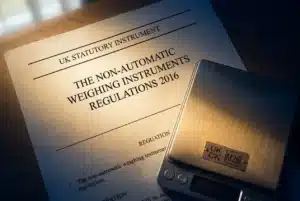
Second, the model meets NIST Handbook 44 — the national rulebook for weighing and measuring devices. See our NIST Handbook 44 explainer for the full breakdown of what that document actually specifies.
Third, a state or county official verifies the individual physical unit in the field before it goes into commercial service, and periodically afterward. All three pieces sit inside the wider system of weights and measures that keeps commerce honest — model approval, national standards, and local verification, working together.
Which Businesses Need One
The rule isn't really about your industry category. It's about one specific question: does the weight this scale produces set the price a customer pays?
If it does, you need a legal-for-trade scale. In practice, that covers a genuinely wide range of businesses:
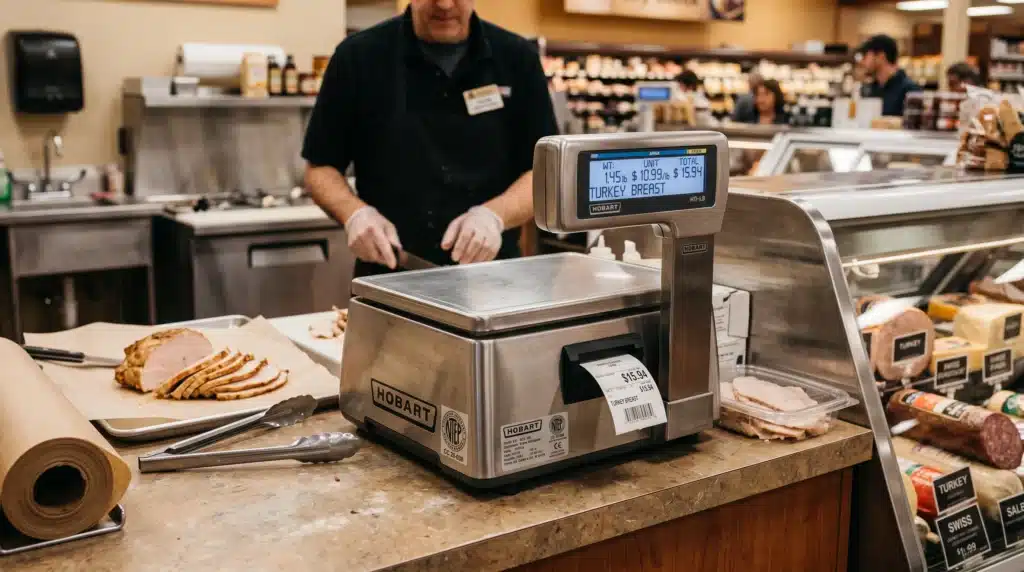
- Grocery counters — deli, meat, seafood, and bakery scales that print price labels directly from a weight reading.
- Cannabis dispensaries — anywhere product is sold by weight and that weight sets the sale price.
- Shipping and freight — anywhere the customer's charge is calculated from package or pallet weight.
- Recycling and scrap yards — paying customers by the pound for metal or other materials is a commercial trade use, no different legally from a grocery scale.
- Farmers markets and livestock sales — anything sold by weight directly to a buyer.
- Industrial bulk sales — grain, aggregate, and similar commodities weighed on truck scales or rail scales where the weight determines an invoice amount.
The reading you sell against is the reading the law watches. A deli selling turkey by the pound and a scrap yard paying by the ton face exactly the same basic requirement, even though almost nothing else about those two businesses looks alike.
One important caveat: state law controls the exact rules. There's no single federal list dictating who must comply nationwide. Most states adopt Handbook 44 as their baseline and enforce it their own way, so a dispensary in California and a grocer in Texas can answer to meaningfully different local requirements even though both trace back to the same national standard. When in doubt, the right move is calling your state's weights and measures office directly rather than assuming another state's rule applies.
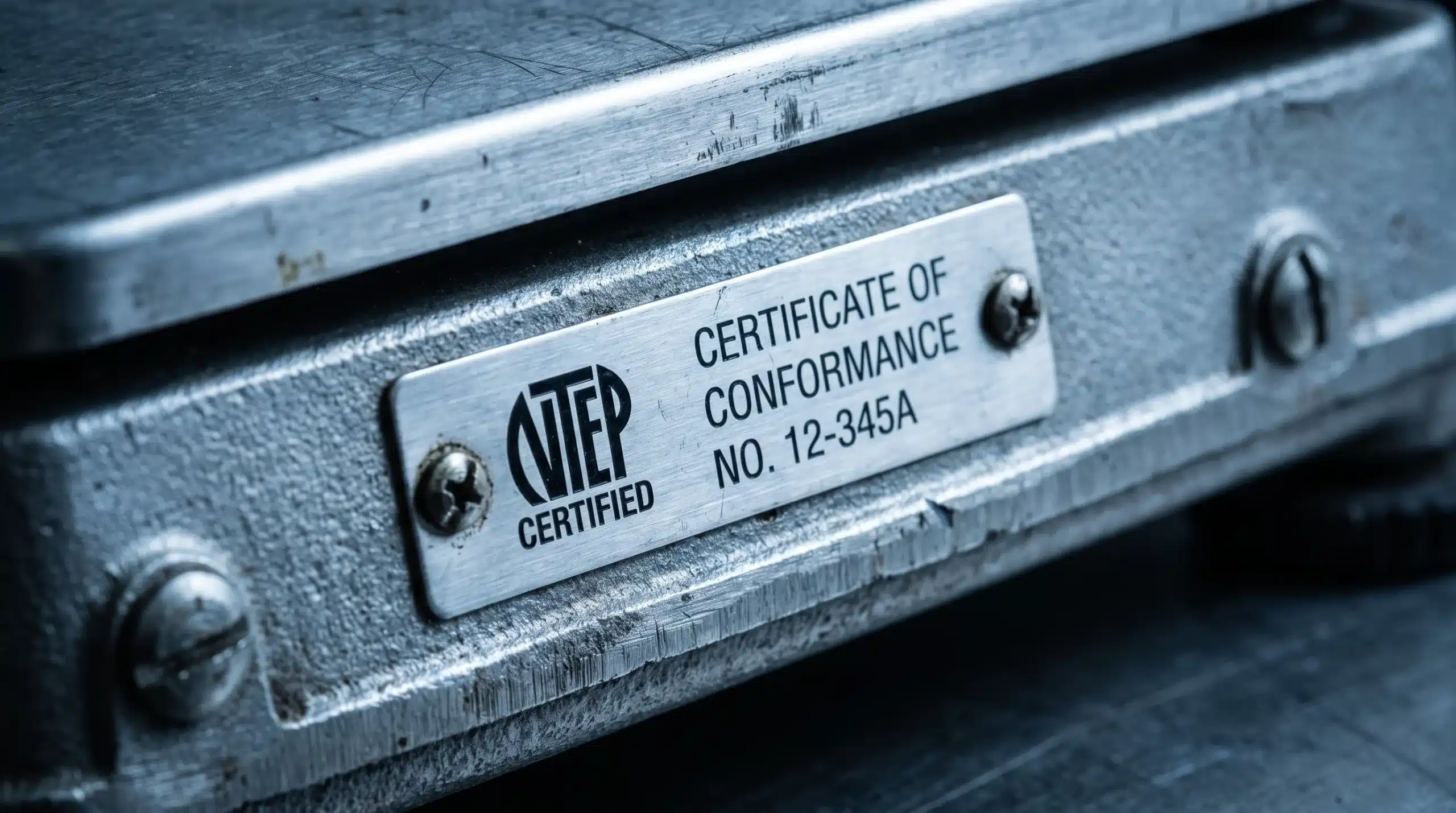
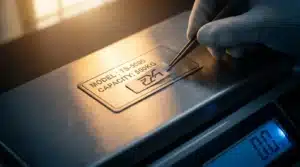
The Certificate of Conformance number on the nameplate is the actual proof — an inspector can look that exact number up rather than taking a scale's accuracy on faith.
Who Doesn't Need One
Plenty of scales never touch a commercial transaction at all. Those don't need NTEP approval, and buying a certified legal-for-trade model for one would be an unnecessary expense.
- Internal inventory — counting stock a business already owns, with no sale happening at the point of weighing.
- Process control and portioning — weighing an ingredient inside a company's own production line, before anything reaches a customer.
- Personal, lab, or educational use — no sale involved at any point.
The dividing line is simple in principle, even when the specifics get complicated in practice: if the number a scale produces never sets a price a customer actually pays, legal-for-trade approval usually isn't required. A factory floor scale tracking how much flour goes into a production batch is fine unregulated. The retail scale at the counter that prices the finished bag for sale is not — even if it's sitting twenty feet away in the same building.
How to Tell If a Scale Is Legal for Trade
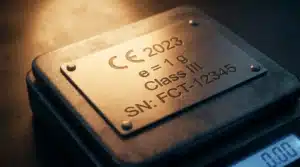
Nobody has to guess at this. The proof is physically printed on the scale itself.
Look at the nameplate or serial plate for two specific things:
- An NTEP mark or logo, usually a small stamped or printed symbol.
- A Certificate of Conformance (CoC) number — often written as "CC No." followed by an alphanumeric code.
That CoC number functions as a receipt. It confirms the exact model passed NTEP evaluation, and it's specific enough that an inspector — or anyone else — can look it up against NTEP's public records to verify it's real and current. If a scale is printed with the phrase "Not legal for trade," that's a direct, unambiguous answer: it cannot legally be used in commerce, regardless of how accurate its readings actually are in practice.
A cheap kitchen or shipping scale bought from a general retailer almost never carries an NTEP number — that absence is usually the fastest, most reliable tell that a scale isn't built or certified for commercial use.
The Penalties for Getting It Wrong
Using the wrong scale in commerce is a state enforcement matter, and the real consequences can stack up quickly beyond just a warning.
When an inspector finds a non-approved scale being used in a commercial setting, they can:
- Reject and tag the scale, voiding any prior approval seal it may have carried.
- Order it out of service — the business legally can't sell against that scale's reading until the problem is fixed.
- Issue fines or citations under the relevant state's weights and measures law.
- Pursue civil or criminal penalties in more serious cases, particularly where customers were demonstrably overcharged as a result.
There's no single nationwide penalty figure to point to — the actual consequence depends heavily on the state and on whether the violation looks accidental or deliberate to the inspector. But enforcement is genuinely taken seriously, because a non-compliant scale in active commercial use is treated as a consumer-protection problem first and a paperwork issue second. Cutting the corner on scale approval rarely stays the cheaper option once an inspection actually happens.
Buying a Legal-for-Trade Scale
The practical fix is straightforward once the requirement is clear: buy a model that already carries NTEP approval rather than trying to retrofit or certify a non-approved scale after the fact — retrofitting an existing non-approved unit into legal-for-trade status generally isn't a realistic option at all, since the approval attaches to a specific manufactured model, not to an individual unit after purchase.
When shopping, confirm the NTEP mark and CoC number are visible on the specific listing or spec sheet before buying, not just implied by the seller's marketing language. Reputable industrial scale suppliers list NTEP status explicitly as a spec — our guides on pallet scales, industrial scales, counting scales, and forklift scales each note where NTEP-certified versions are available within that specific scale category, since not every model in a given product line necessarily carries it.
It's worth budgeting for the fact that NTEP-certified models generally cost more than their non-certified counterparts at the same nominal capacity — the certification process itself, and the tighter manufacturing tolerances needed to reliably pass it, add real cost that shows up in the price. Buyers sometimes try to save money by purchasing a non-certified model and assuming they can upgrade it later; in practice, that upgrade path usually doesn't exist, because NTEP approval is tied to how a specific model was designed and manufactured, not something a field technician can add after the fact. The only reliable fix for a non-certified scale in a business that needs one is replacement, not retrofit — which makes getting this decision right at purchase time considerably cheaper than getting it wrong.
For businesses operating in multiple states, it's also worth checking whether every relevant state has actually adopted the same edition of Handbook 44 currently in force nationally. Most states stay current, but adoption isn't always instantaneous, and a multi-location business can occasionally find itself needing to track a small lag between states rather than assuming uniform national timing.
How This Connects to Calibration
Buying an NTEP-approved scale is step one. Keeping it accurate for as long as it stays in commercial use is the ongoing job that comes after.
An approved scale still drifts over time, the same as any other precision instrument. It still needs regular service against certified weights to stay inside its Handbook 44 tolerance. That's exactly where the distinction between calibration and inspection matters most in practice — calibration is the technical work that keeps a scale accurate, while inspection is the separate government process that certifies it's currently meeting the legal standard. We break that relationship down fully in weights and measures inspection vs. calibration.
Most retail commercial scales fall under Handbook 44 accuracy Class III, though higher-precision commercial applications can require Class II. The certified weights used to service any of these scales carry their own separate accuracy grading under the OIML system — see OIML weight classes explained for how that classification works and which class is appropriate for servicing a Class III retail scale.
The short version worth remembering: the NTEP mark is what gets a scale legal in the first place. Regular calibration, backed by scale calibration services if you're outsourcing the work, is what keeps it legal for as long as it stays in service.
Common Mistakes
- Assuming "accurate" and "legal for trade" mean the same thing. A scale can read perfectly accurately in a spot check and still be non-compliant if it lacks NTEP approval or a current inspection seal.
- Buying a non-NTEP scale for a business that will grow into needing one. It's cheaper to buy the right scale from the start than to replace a non-compliant unit once the business starts selling by weight.
- Assuming one state's rules apply everywhere. Handbook 44 is a national baseline, but state-level enforcement specifics genuinely differ — confirm locally rather than assuming.
- Letting calibration lapse on an already-approved scale. NTEP approval and a current inspection seal don't mean a scale is exempt from ongoing drift — ignoring calibration is exactly how an approved scale ends up failing its next inspection.
- Not checking NTEP status before buying online. Marketing copy that says "commercial grade" or "professional" isn't the same claim as NTEP-approved — confirm the actual CoC number is listed before assuming a scale qualifies.
- Treating internal and commercial use as interchangeable on the same device. A scale bought and approved for internal process control doesn't become legal for trade just because a business later starts using its reading to price a sale — the approval has to match the actual current use, not the original purchase intent.
Most of these mistakes share a common root: treating "legal for trade" as a one-time purchase decision rather than an ongoing status that depends on the scale's continued approval, its continued accuracy, and how it's actually being used in practice at any given moment. A scale that was fully compliant on the day it was installed can quietly fall out of compliance months later through drift, a lapsed inspection, or a change in how the business uses it — none of which show up as an obvious red flag until an inspector happens to check.
Frequently Asked Questions
What is a legal for trade scale?
It's a scale approved for commercial transactions where weight sets the price, quantity, or payment. It has passed NTEP evaluation, meets NIST Handbook 44, and is verified by a state official before use.
Which businesses need a legal for trade scale?
Any business that buys or sells by weight — grocery delis, cannabis dispensaries, shipping and freight, recycling yards, farmers markets, livestock. If the weight decides what a customer pays, the scale must be legal for trade.
How do I know if my scale is legal for trade?
Check the nameplate for an NTEP mark and a Certificate of Conformance number. That confirms the model passed evaluation. A scale marked "Not legal for trade" cannot be used in commerce.
What happens if I use a non-approved scale in commerce?
An inspector can reject and tag it, order it out of service, and issue fines or citations. Serious overcharging cases can bring civil or criminal penalties. Enforcement is by state, not a single federal rule.
Do I need a legal for trade scale to sell online by weight?
If the weight you record sets the customer's price, most states require an approved device. If you only estimate shipping and the carrier reweighs for the real charge, the rules are looser. Confirm with your state weights and measures office.
What accuracy class do most legal-for-trade retail scales use?
Most retail commercial scales — deli counters, general merchandise scales — fall under NIST Handbook 44 accuracy Class III. Higher-precision commercial applications may require Class II, while the certified weights used to service any of these scales carry their own separate OIML accuracy rating.
More Scale Calibration Guides
- Weights and Measures: What They Are and Why Your Scale Depends on Them — scalecalibration.net/weights-and-measures/ — the pillar overview this article supports.
- NIST Handbook 44 Explained — scalecalibration.net/nist-handbook-44-explained/ — the rulebook behind NTEP and legal-for-trade status.
- Weights and Measures Inspection vs. Calibration — scalecalibration.net/weights-and-measures-inspection-vs-calibration/ — who keeps your scale legal, and how.
- OIML Weight Classes Explained — scalecalibration.net/oiml-weight-classes/ — the accuracy classes behind certified test weights.
- Scale Calibration Services — scalecalibration.net/scale-calibration-services/ — real cost tiers for the ongoing calibration work.