By Jayson · Updated August 2026 · 10-minute read
Industrial scales covers three genuinely different product types — floor scales (low-profile, high-capacity, 5,000-100,000+ lb), platform scales (raised 2-6 inches, up to roughly 10,000-20,000 lb), and bench scales (tabletop, precision-focused, 5-150 kg). A real NTEP-certified floor scale like Rice Lake's RoughDeck HP lists at $1,735.50 for 10,000 lb capacity — the right type and capacity depend entirely on what you're weighing and how it moves through your facility.
"Industrial scales" gets used as a catch-all term, but it isn't one product — it's a category spanning three genuinely different designs, each built for a different job. An industrial scale is also a different instrument entirely from a large commercial scale: it's built with structural platforms that resist deflection under dynamic fork-truck loading, load cells rated for millions of cycles, and IP-rated housings that survive washdown conditions that would destroy a lighter-duty instrument in weeks.
In this guide
- Floor scales vs. platform scales vs. bench scales
- A real industrial floor scale, specced and priced
- What NTEP and legal-for-trade actually mean
- Load cell types explained
- IP ratings and environmental protection
- How to size an industrial scale correctly
- What to check before you buy
- Calibration and maintenance
- Suppliers and where prices actually come from
- Common industrial scale buying mistakes
- Where industrial scales get used
- FAQ
Floor Scales vs. Platform Scales vs. Bench Scales
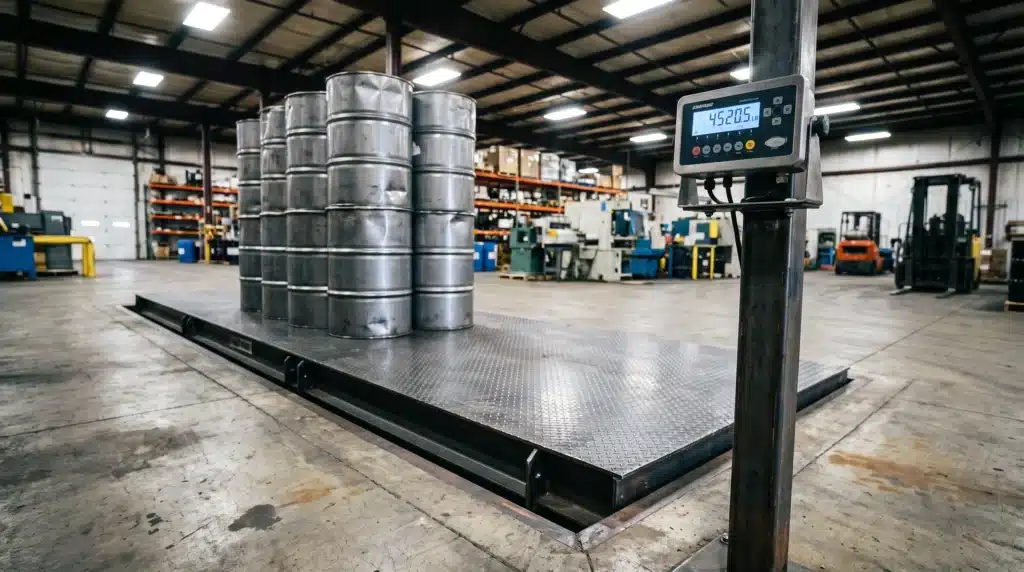
Floor scales sit flush or nearly flush with the ground, built for high-capacity loads — drums, crates, IBCs, and pallets — with a low-profile deck that makes loading straightforward. Capacities commonly run from 5,000 lb up to 100,000 lb or more for truck- and vehicle-rated systems, and larger units are often custom-installed in concrete pits for stability.
Platform scales have a raised deck, typically 2 to 6 inches high, so loads are lifted or rolled onto them rather than simply pushed across. They usually cap out around 10,000 to 20,000 lb, though some models go higher, and many are portable with built-in wheels for moving between weighing points.
Bench scales are compact, tabletop units built for precision rather than raw capacity — portion control, parts counting, checkweighing, and quality-control tasks. Standard capacities run roughly 5 to 150 kg, with heavier-duty industrial bench models reaching 300 to 500 kg.
None of these three categories is inherently "better" than the others — they answer different questions. A floor scale answers "how much does this pallet weigh." A platform scale answers the same question at a smaller scale, often with the portability to move between stations. A bench scale answers a different question entirely: "is this individual part or batch within tolerance," which calls for precision measured in grams rather than raw capacity measured in tons.

The load cell hidden under the deck — not the platform itself — is what actually determines an industrial scale's accuracy and lifespan.
A Real Industrial Floor Scale, Specced and Priced
Real numbers beat vague capacity ranges. Rice Lake's RoughDeck HP is a 4' x 4' steel low-profile floor scale, 3.5 inches tall, rated for 10,000 lb capacity, built on a structural steel channel frame with a diamond treadplate safety deck. It uses four NTEP-certified alloy steel shear beam load cells, carries NTEP CC 92-001, Class III at 5,000 divisions, and is FM Approved for hazardous-location use. Real price: $1,735.50, base unit only (before an indicator).
That single example illustrates the category well: genuinely industrial-grade scales are structural products, not just a bathroom scale scaled up — the frame, the load cell rating, and the certification all matter as much as the capacity number on the spec sheet.
What NTEP and Legal-for-Trade Actually Mean
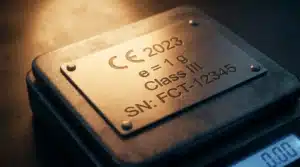
NTEP (National Type Evaluation Program) certification means a specific scale-and-indicator combination has been independently tested and approved for legal-for-trade use anywhere in the US, without needing separate state-by-state approval. It's required for any industrial scale used to buy, sell, or bill a customer or supplier by weight — internally-used scales for inventory or process control don't carry the same legal requirement, though the underlying accuracy standard is worth applying anyway.
Internationally, the equivalent body is OIML (International Organization of Legal Metrology). A load cell or complete scale system can carry NTEP certification, OIML certification, or both, depending on the markets it's sold into — see Hogentogler's guide to choosing an NTEP-certified scale and our own legal for trade scales guide for the full requirements.
Load Cell Types Explained
A load cell is the actual sensor — a machined elastic body with bonded strain gauges, wiring, and environmental sealing — that converts mechanical force into the electrical signal a scale's indicator displays as a weight. Common industrial types include:
- Shear beam load cells — used in the RoughDeck HP example above; well suited to platform and floor scale designs.
- Single-ended beam cells — common in lower-capacity bench and platform scales.
- Double-ended beam cells — used where a platform needs support from both ends of a load cell.
- Bending beam cells — often found in smaller platform and bench-scale applications.
The load cell — not the platform steel — is what actually determines an industrial scale's accuracy, repeatability, and service life. Two visually similar platforms can perform very differently depending on which load cell type and rating sit underneath.
IP Ratings and Environmental Protection
Industrial scales operating outdoors, in washdown areas, or in dusty environments need IP-rated enclosures to resist water and dust intrusion. Stainless steel construction and hermetically sealed load cells matter specifically in wet or heavily washed-down environments — a scale rated for a clean, climate-controlled facility will fail early if installed somewhere it has to survive daily hose-downs or outdoor weather.
Matching the environmental rating to the actual installation site, not just the load capacity, is one of the most commonly overlooked factors when businesses shop for industrial scales.
How to Size an Industrial Scale Correctly
Sizing industrial scales correctly means starting with the heaviest realistic load they'll see, not the average one. A floor scale rated exactly at a facility's heaviest pallet leaves no margin for double-stacked loads, forklift impact, or future growth in shipment size. Running industrial scales near their rated maximum on a regular basis also shortens load-cell lifespan and increases the chance of a reading drifting out of tolerance between calibration visits.
A reasonable rule of thumb: size industrial scales for roughly 20-30% more than the heaviest load actually expected, rather than the exact figure — the RoughDeck HP's 10,000 lb rating, for example, comfortably covers a fully loaded standard pallet with real headroom to spare. Under-sizing to save a small amount up front is one of the most common regrets businesses have after living with industrial scales for a year or two of real, heavier-than-planned use.
What to Check Before You Buy
Beyond the headline capacity number, a few things are worth confirming on any industrial scale before ordering:
- NTEP certification, if legal-for-trade use is required. Confirm the specific model and indicator combination is certified, not just "accurate."
- Load cell type and rated cycle life. A scale weighing hundreds of loads a day needs load cells rated for that duty cycle, not a light-use rating.
- IP rating matched to the actual installation environment. Indoor, climate-controlled facilities have very different needs than outdoor or washdown locations.
- Platform material and deck design. Diamond treadplate steel decks resist slipping and wear better than smooth surfaces in high-traffic industrial settings.
- Indicator compatibility and data output. Confirm whether the scale ships with an indicator or requires one purchased separately, and whether it supports the data logging or printer output your operation needs.
Calibration and Maintenance
Industrial scales are only as good as their last calibration. Most facilities calibrate industrial scales at least annually against certified weights, with more frequent checks for legal-for-trade use, heavy daily cycling, or harsh environments. Preventive maintenance — checking load cell mounts, cable condition, and platform level — matters as much as the calibration reading itself, since a mechanically compromised scale can fail even with a technically accurate load cell underneath.
For large or fixed installations that can't easily be moved, on-site and heavy-duty calibration is the practical option — ask any provider directly what calibration weight class and NIST-traceable documentation they use before signing a service contract.
Common Industrial Scale Buying Mistakes
A handful of mistakes show up repeatedly when businesses shop for industrial scales without a clear sense of their actual environment and workflow first:
- Sizing to the average load instead of the heaviest one. Industrial scales rated exactly to a typical load leave no margin for the heaviest realistic case, forklift impact, or future growth.
- Ignoring the installation environment. A scale built for a clean, indoor facility fails early outdoors or under washdown conditions — the IP rating has to match the real site, not the easiest assumption.
- Treating capacity as the only spec that matters. Two industrial scales with identical capacity ratings can have very different load cell quality, cycle-life ratings, and long-term accuracy.
- Skipping NTEP certification, then needing it later. Retrofitting an uncertified scale for legal-for-trade use is often more expensive than buying the right model up front.
- Assuming factory calibration is permanent. Every one of these industrial scales still needs a real ongoing calibration schedule — accuracy on delivery day is a starting point, not a guarantee.
Where Industrial Scales Get Used
Industrial scales show up anywhere raw materials, finished goods, or vehicles need an accurate weight: manufacturing floors tracking material input and output, warehouses and distribution centers handling pallets and freight, recycling and scrap operations weighing incoming and outgoing loads, and agricultural or food-processing facilities weighing bulk product. The specific type — floor, platform, or bench — changes with the application, but the underlying need for a structurally rated, properly certified, regularly calibrated instrument doesn't.
Even within a single facility, it's common to see all three categories deployed side by side: a floor scale at the receiving dock, platform scales scattered through a production area for in-process checks, and bench scales at a quality-control station verifying individual parts or samples. Treating the purchase as one decision instead of matching each instrument to its specific station is a common source of both overspending and underperformance.
Suppliers and Where Prices Actually Come From
The major manufacturers behind most industrial scales sold in North America include Rice Lake Weighing Systems, Cardinal Scale, and Mettler Toledo, each offering overlapping product lines across floor, platform, and bench-scale categories — Rice Lake even publishes a direct cross-reference guide mapping its own models against Mettler Toledo equivalents, which is a useful way to compare specs across brands without guessing at rough equivalencies.
Pricing for industrial scales varies by far more than capacity alone. The same nominal capacity can carry a very different price depending on load cell quality and cycle-life rating, NTEP certification status, deck material (mild steel vs. stainless), IP rating for washdown or outdoor use, and whether an indicator ships with the base unit or has to be purchased separately. The $1,735.50 RoughDeck HP example above is a base unit only — a full working system with an indicator, cabling, and any washdown upgrades will run higher, which is worth budgeting for rather than being surprised by at checkout.
Buying through an authorized dealer or distributor rather than an unfamiliar third-party listing also matters more for industrial scales than for most equipment purchases, since warranty coverage, calibration support, and access to genuine replacement load cells often depend on the equipment having been sold through a manufacturer's approved channel.
Lead time is worth asking about directly too. Standard floor and platform scale models are often stocked and ship quickly, but larger custom installations — pit-mounted floor scales, high-capacity truck scale systems, or anything requiring site-specific engineering — can carry lead times measured in weeks rather than days. Factoring that into a project timeline up front avoids the common mistake of ordering equipment too late relative to a facility opening or a compliance deadline.
Conclusion
"Industrial scales" isn't a single product to shop for — it's a category spanning floor scales built for raw capacity, platform scales built for versatility, and bench scales built for precision. A real, verified example like Rice Lake's RoughDeck HP ($1,735.50, 10,000 lb, NTEP Class III) shows what a genuinely industrial-grade instrument actually looks like on paper: structural steel construction, rated load cells, and real certification, not just a bigger number on a spec sheet. Match the type to how loads actually move through your facility, size with real headroom above the heaviest expected load, and keep whichever scale you choose on a real calibration schedule — the certification on delivery day only matters if it still holds a year later, long after the invoice has been paid and the equipment is quietly doing its job.
Frequently Asked Questions
What's the difference between a floor scale, platform scale, and bench scale?
Floor scales sit low and flush with the ground for high-capacity loads like pallets and drums (often 5,000-100,000+ lb). Platform scales sit 2-6 inches off the floor and typically cap around 10,000-20,000 lb. Bench scales sit on a tabletop for smaller, precision loads, usually 5-150 kg.
What does NTEP certification actually mean?
NTEP (National Type Evaluation Program) certification means a scale model has been independently tested and approved for legal-for-trade use anywhere in the US without state-by-state re-certification. It's required for any scale used to buy, sell, or bill by weight.
How much does an industrial floor scale cost?
A real example: Rice Lake's RoughDeck HP, a 4'x4' NTEP-certified 10,000 lb floor scale, lists at $1,735.50. Prices scale up with capacity, platform size, and environmental protection (washdown/IP rating).
What is a load cell, and what types exist?
A load cell is the sensor that converts mechanical force into an electrical signal a scale's indicator can read. Common industrial types include shear beam, single-ended beam, double-ended beam, and bending beam cells, each suited to different platform designs and capacities.
How often do industrial scales need calibration?
Most industrial scales are calibrated at least annually, with more frequent checks for legal-for-trade use or harsh operating environments. Heavy daily use, temperature swings, and washdown conditions all justify shorter intervals.
More Related Guides
- Pallet Scales vs. Pallet Jack Scales — scalecalibration.net/pallet-scales/ — real specs and prices for pallet-specific weighing equipment.
- Best Floor Scale for Warehouse — scalecalibration.net/best-floor-scale-for-warehouse/ — extreme-temperature floor scale models compared.
- Heavy-Duty Calibration Services — scalecalibration.net/heavy-duty-calibration-services/ — real fee data for on-site industrial calibration.
- Legal for Trade Scales — scalecalibration.net/legal-for-trade-scales/ — what NTEP approval actually requires.
- Preventive Maintenance for Scales — scalecalibration.net/preventive-maintenance-for-scales/ — the real financial cost of skipping scheduled calibration.