By Jayson · Updated August 2026 · 9-minute read
Quick answer — forklift scales: forklift scales weigh a load during the normal lift, using either hydraulic lift-cylinder pressure or strain gauge load cells built into the carriage. A real example, Prime USA's Wireless Bluetooth 4.0 model, lists at $5,599 for a 5,000 lb capacity unit with 0.1% accuracy. Load cell systems are meaningfully more precise than hydraulic ones and are the only type that can carry NTEP legal-for-trade certification — a distinction that matters far more than price when choosing between them.
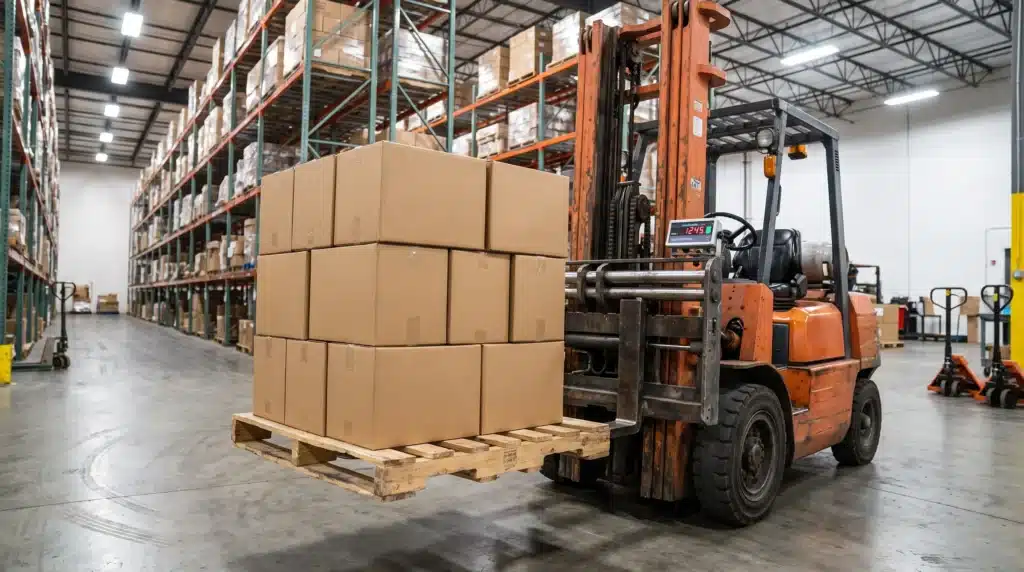
A warehouse that weighs pallets on a separate floor scale is adding a step that forklift scales eliminate entirely. The weight gets captured the instant the load leaves the ground — no detour, no queue at a fixed scale, no operator remembering to make a second stop. The two technologies behind that capability work very differently, though, and picking the wrong one for the job is a common, expensive mistake.
In this guide
- How forklift scales actually work
- A real forklift scale, specced and priced
- Hydraulic vs. load cell: accuracy and legal-for-trade
- Wireless data and warehouse integration
- Installation: what actually happens
- Sizing a forklift scale for your truck
- Common forklift scale mistakes
- Calibration and why it still matters
- Where forklift scales get used
- What to check before you buy
- FAQ
How Forklift Scales Actually Work
Forklift scales fall into two core technologies, and the difference between them explains almost everything else about how they're priced, installed, and used.
Hydraulic pressure scales tap directly into the forklift's existing hydraulic lift circuit. As a load is lifted, hydraulic pressure in the lift cylinder rises in proportion to the load's weight — a pressure transducer reads that rise and converts it to a weight display. Nothing about the truck's carriage or forks changes, which makes hydraulic forklift scales fast and non-invasive to install.
Load cell carriage scales work differently: strain gauge load cells are built into a steel carriage plate that sits between the mast and the forks, so the forks attach to the carriage plate rather than directly to the mast. The load cells measure the actual force of the lifted weight directly, rather than inferring it from hydraulic pressure — which is the core reason load cell systems are considerably more precise than hydraulic ones.
Both approaches capture weight automatically during a normal lift. Neither requires the operator to do anything differently — the load is weighed the moment it's picked up, and on wireless models that reading is transmitted immediately to a display, handheld device, or warehouse system.
A Real Forklift Scale, Specced and Priced
Real numbers beat vague capability claims. Prime USA's Wireless Bluetooth 4.0 forklift scale is a load cell carriage system with a 5,000 lb capacity (6,000 lb and 10,000 lb configurations are also available), readability of 2 lb up to 2,000 lb and 5 lb from 2,000-5,000 lb, and a rated 0.1% accuracy. It ships with a standard 42" fork length (48", 60", 72", and custom lengths available), runs on a Lithium Ion battery with a low-battery indicator, and pairs over Bluetooth 4.0 to iOS and Android devices for wireless weight transmission. Both NTEP-certified (legal-for-trade) and non-NTEP versions are offered. Real price: $5,599 (listed regular price $7,498).
For comparison, Rice Lake's CLS NextGen is a similarly-built load cell carriage scale — NTEP certified, rated 5,000 x 5 lb (or 4,500 x 5 lb on some configurations), available with fork lengths up to 42" or 72", and built around two 5,000 lb stainless steel load cells. Rice Lake doesn't publish pricing directly; like most industrial-scale manufacturers selling through dealer networks, it's a quote-only purchase rather than a listed price.
Hydraulic systems sit at the other end of the spectrum. American Forklift Scale's hydraulic system handles up to 100,000 lbs with no derating and a minimum load of 400 lbs, at roughly 98-99% accuracy — slightly less precise than a load cell system, but installed without any carriage modification at all. Pricing here is also quote-only; the manufacturer directs buyers to request a quote rather than listing a price on the product page.
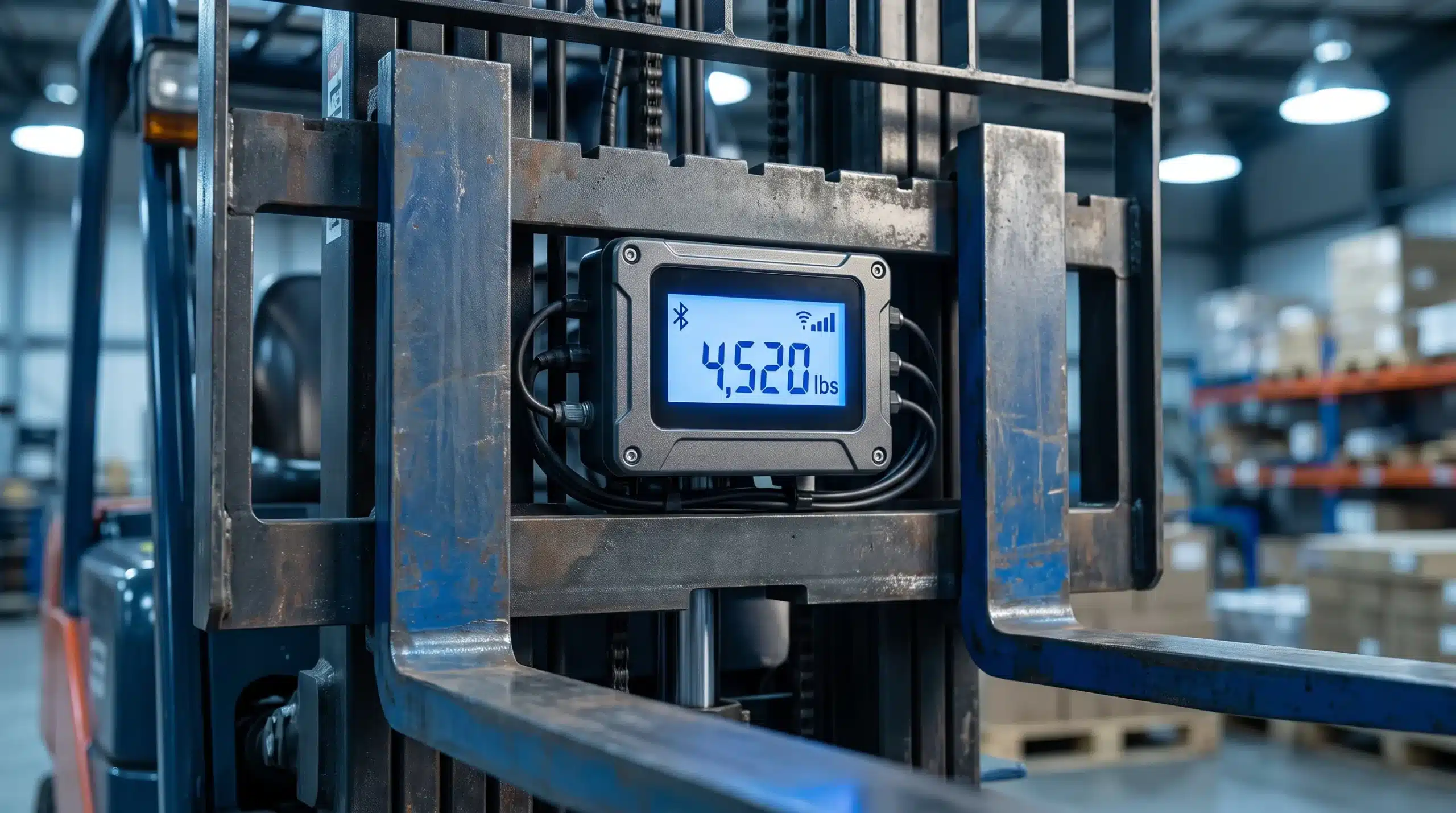
The carriage-mounted display is the whole point of forklift scales — the weight reading happens in the same motion as the lift, with no separate step for the operator.
Hydraulic vs. Load Cell: Accuracy and Legal-for-Trade
The accuracy gap between the two technologies is the single most important factor in choosing between forklift scales, because it determines what the numbers can actually be used for.
| Factor | Hydraulic | Load Cell |
|---|---|---|
| Typical accuracy | ±1-2% of rated capacity (≈98-99%) | ±1 lb or better (0.1% on the Prime USA example) |
| NTEP / legal-for-trade | Not available | Available on certified models |
| Installation | Fast, non-invasive; no carriage changes | More involved; carriage plate replacement, capacity plate update |
| Capacity impact | None | Slightly reduced by carriage plate weight |
| Best fit | Internal operational weighing | Billing, invoicing, any legal-for-trade use |
Hydraulic forklift scales are genuinely good enough for internal use — checking that a pallet isn't overloaded, spot-verifying a shipment before it leaves the dock, or tracking approximate inventory movement. What they can't do is stand in for a certified scale in any transaction where the weight determines what a customer is billed. Only NTEP-certified load cell forklift scales carry that legal-for-trade eligibility, the same certification standard covered in our legal-for-trade scales guide.
Wireless Data and Warehouse Integration
Most current forklift scales transmit weight data wirelessly the moment a load is captured, over Bluetooth, RF, or Wi-Fi depending on the model, with effective range varying from roughly 20 meters to over 100 meters. That data can feed a handheld display in the cab, a tablet, or a warehouse management system (WMS) directly — automatically updating inventory records, supporting billing workflows, or triggering downstream processes without manual entry.
This is the feature that turns forklift scales from a weighing convenience into an actual data-capture tool. Every pallet moved becomes a logged weight event tied to whatever pallet ID or job the operator enters, without adding a single extra motion to a task the operator was already doing.
Installation: What Actually Happens
Installation differs sharply between the two technologies. A wireless load cell system like the Prime USA model above is designed for the user to install directly — the manufacturer cites roughly ten minutes for a straightforward carriage swap. A hydraulic system requires a technician to depressurize the lift circuit by lowering the forks to the ground, locate the hydraulic lift line, install a tee fitting, and connect an accumulator hose and pressure transducer — then calibrate the system by lifting an object of known weight and entering that value into the indicator.
Neither installation is especially disruptive, but the hydraulic route generally needs a technician on-site, while a wireless carriage scale can often be swapped in by warehouse staff without scheduling an install visit at all.
Sizing a Forklift Scale for Your Truck
Forklift scales need to be matched to the truck's rated capacity, not just the heaviest load expected day to day. A carriage-style load cell scale adds a small amount of its own weight to the truck's front end, which slightly reduces the truck's usable lift capacity — a detail that matters most on trucks already operating near their rated limit.
The other sizing question is readability versus typical load weight. A scale with 5 lb readability is more than adequate for pallets running into the hundreds or thousands of pounds, but the same scale would be a poor fit for lighter, more precision-sensitive loads — in which case a finer-readability model, even at a lower total capacity, is the better match.
Fleets running more than one truck class shouldn't assume a single scale spec fits every truck in the yard. A 5,000 lb class II truck lifting pallets all day has very different sizing needs than a heavier class III truck moving bulk material, and matching forklift scales to the specific truck each one mounts on avoids both an underpowered scale and unnecessary cost from buying more capacity than any single truck will ever use.
Common Forklift Scale Mistakes
- Choosing hydraulic for legal-for-trade use. Hydraulic systems cannot be NTEP certified — using one for billing or invoicing weights is a compliance problem waiting to surface.
- Ignoring the capacity reduction from a carriage plate. A load cell carriage scale slightly reduces a truck's rated lift capacity; skipping that check can put a truck over its safe limit without anyone noticing.
- Skipping calibration after installation. Both technologies require a proper calibration step at install — a hydraulic system calibrated against the wrong reference weight will be wrong from day one.
- Assuming all wireless models have the same range. Effective wireless range varies significantly by technology and environment; a system rated for 100 meters in an open yard may perform far worse inside a steel-frame warehouse with heavy interference.
- Buying on price alone. The gap between a $5,599 wireless load cell scale and a quote-only hydraulic system isn't just price — it's a real difference in accuracy and legal-for-trade eligibility that should drive the decision first.
Calibration and Why It Still Matters
Forklift scales are still weighing instruments, and both hydraulic and load cell versions drift out of tolerance over time the same way any other scale does — through mechanical wear, environmental exposure, and the simple accumulation of thousands of lift cycles. A hydraulic system calibrated once at installation and never rechecked will quietly diverge from the actual pressure-to-weight relationship it was tuned against; a load cell system can develop the same kind of drift in its strain gauges.
Regular calibration against certified weights keeps that relationship accurate, and it's a non-negotiable requirement for any NTEP-certified load cell scale used in legal-for-trade transactions. See our scale calibration services guide for real cost tiers — forklift scales generally fall into the on-site/mobile-equipment pricing tier rather than the smaller bench-scale range, given the technician time involved in accessing and testing equipment mounted on a moving truck.
Where Forklift Scales Get Used
Forklift scales show up wherever pallets or loose loads move through a facility on a forklift and someone downstream needs an accurate weight: distribution centers verifying outbound shipment weights before loading a truck, manufacturers tracking raw material or finished-goods weight as it moves through production, scrap and recycling operations weighing material by the load rather than running everything across a separate truck scale, and agricultural operations weighing grain, feed, or produce during handling. The common thread is eliminating a separate weighing step that would otherwise slow down material handling that's already happening.
Facilities that also operate a fixed floor scale or a truck scale often use forklift scales as a fast internal check between full weighments — catching an obviously overloaded pallet or a shipment that looks short before it ever reaches the certified scale that produces the number on the invoice.
Cold storage and outdoor yard operations are a good example of where the technology choice really shows up in practice. A hydraulic system's sealed, non-electronic sensing has an edge in extreme cold or wet conditions where a display unit and battery pack face a harder environment. A load cell system, properly rated for the environment, can handle the same conditions, but it's worth confirming the display and battery enclosure's environmental rating before assuming a wireless model will hold up outdoors or in a freezer aisle the way it does on an indoor warehouse floor.
What to Check Before You Buy
A few things worth confirming beyond the headline capacity and price when comparing forklift scales:
- NTEP certification, if the reading needs to be legal-for-trade. Only certified load cell models qualify — confirm this before assuming any given scale can be used for billing.
- Capacity reduction from the carriage plate. Ask specifically how much of the truck's rated lift capacity a carriage-style scale consumes.
- Fork length compatibility. Standard lengths like 42" cover many trucks, but confirm against the actual forks in use before ordering.
- Wireless range in your actual facility. A manufacturer's range spec is a best-case figure; steel racking and structural interference can reduce it meaningfully indoors.
- Battery life across a full shift. Confirm the runtime is enough to cover the longest shift the truck runs without a mid-shift charge.
- Installation method and who performs it. A wireless carriage swap can often be done in-house; a hydraulic tap-in typically needs a technician — factor that into total cost and downtime.
None of these show up in a simple capacity-and-price comparison, but any one of them can be the actual reason a specific forklift scale does or doesn't work for a given fleet. Reading the full spec sheet before ordering is worth the extra few minutes.
Conclusion
Forklift scales solve a real, specific problem: getting an accurate weight without adding a step to material handling that's already happening. The choice between hydraulic and load cell technology comes down to one question more than any other — does the weight need to be legal-for-trade? If yes, only an NTEP-certified load cell system like the Rice Lake CLS NextGen or a certified version of the Prime USA Bluetooth 4.0 model ($5,599, 5,000 lb capacity, 0.1% accuracy) will work. If the weight is for internal use only, a hydraulic system's 98-99% accuracy and non-invasive installation may be the more practical and often more affordable route. Either way, keep the scale on a real calibration schedule — the accuracy numbers on a spec sheet only hold if the instrument itself hasn't drifted.
Frequently Asked Questions
How do forklift scales work?
Forklift scales weigh a load during the normal lift, either by reading pressure in the truck's existing hydraulic lift cylinder or by using strain gauge load cells built into a carriage plate mounted between the mast and the forks. Either way, weight is captured automatically with no separate trip to a floor scale.
How accurate are forklift scales?
Hydraulic forklift scales typically run about 98-99% accuracy, or roughly plus-or-minus 1-2% of the truck's rated capacity. Load cell carriage scales are considerably more precise, often accurate to within 1 lb or better, and are the only type available with NTEP legal-for-trade certification.
How much do forklift scales cost?
A real example: Prime USA's Wireless Bluetooth 4.0 forklift scale lists at $5,599 for a 5,000 lb capacity model with 0.1% accuracy and NTEP and non-NTEP versions available. Hydraulic systems and heavier-capacity load cell carriages are typically quote-only.
What's the difference between a hydraulic and a load cell forklift scale?
A hydraulic forklift scale taps into the truck's existing lift cylinder pressure and installs without modifying the carriage. A load cell forklift scale replaces the standard carriage plate with one containing strain gauge load cells, which is more precise and can be NTEP certified, but is a more involved installation.
Can a forklift scale be used for legal-for-trade transactions?
Only load cell forklift scales carrying NTEP certification qualify for legal-for-trade use. Hydraulic pressure scales are not available with NTEP certification and are intended for internal operational weighing, not billing or commercial transactions.
More Related Guides
- Industrial Scales — scalecalibration.net/industrial-scales/ — types, capacities, and what to actually buy across the broader category.
- Pallet Scales vs. Pallet Jack Scales — scalecalibration.net/pallet-scales/ — real specs and prices for a related but distinct weighing category.
- Scale Calibration Services — scalecalibration.net/scale-calibration-services/ — real cost tiers and what a certified technician checks.
- Legal-for-Trade Scales — scalecalibration.net/legal-for-trade-scales/ — what NTEP certification actually requires.
- Preventive Maintenance for Scales — scalecalibration.net/preventive-maintenance-for-scales/ — the real financial cost of skipping scheduled calibration.