By Jayson · Updated August 2026 · 8-minute read
Quick answer — Counting scales: a counting scale doesn't actually count — it weighs a small sample of identical parts, calculates an Average Piece Weight (APW), then divides any larger batch's total weight by that APW to estimate a piece count. A real example, Ohaus's EC15, lists at $544.44 for a 15,000g capacity unit with 1:600,000 internal counting resolution — the resolution number, not the price, is what actually determines counting accuracy.
Most people assume counting scales literally count items one by one, the way a person would. They don't — they're doing math, not counting, and understanding that distinction is the key to buying the right one and trusting the number it gives you.
In this guide
- How a counting scale actually works
- A real counting scale, specced and priced
- Sample size and why it matters more than most people think
- Resolution: the number that actually determines accuracy
- How to size a counting scale correctly
- Common counting scale mistakes
- Calibration and why it still matters here
- Where counting scales get used
- What to check before you buy
- FAQ
How Counting Scales Actually Work
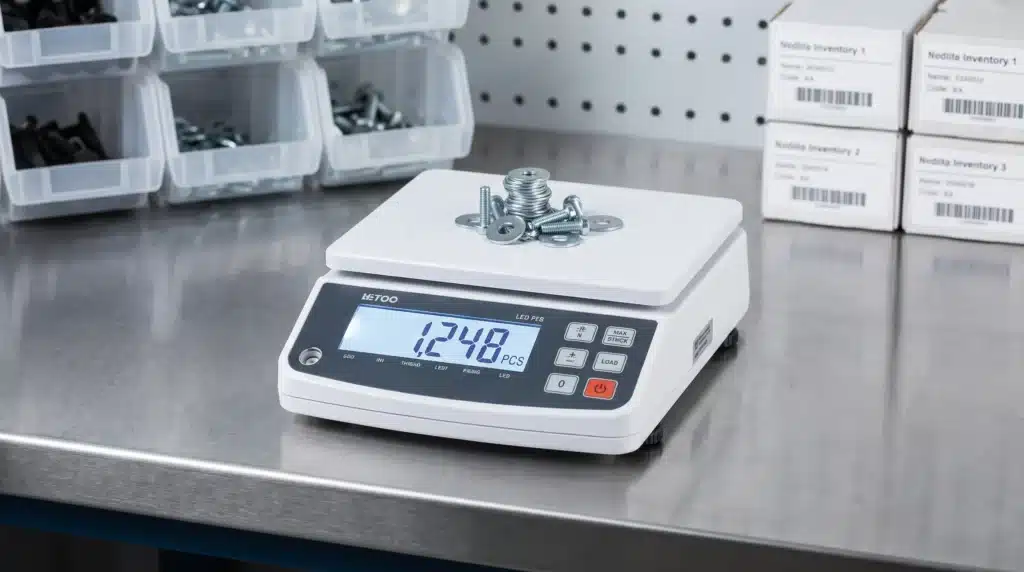
Counting scales weigh a small sample of identical parts, then divide that total weight by the number of pieces entered to calculate the Average Piece Weight (APW) — the estimated weight of a single item. From that point on, the scale simply weighs a larger batch and divides by the APW to produce a piece count.
That means the accuracy of counting scales has nothing to do with actually detecting individual items — it's entirely a function of how consistent the parts' real weights are, how large and representative the original sample was, and how fine the scale's own resolution is. Counting scales can be mechanically flawless and still produce a wrong count if any of those three factors is off.
This is also why counting scales are sometimes called "counting balances" or "parts counters" interchangeably in catalogs — the underlying hardware is a precision bench scale, and "counting" describes the software layer sitting on top of a standard weighing mechanism, not a fundamentally different kind of instrument.
A Real Counting Scale, Specced and Priced
Real numbers beat vague capability claims. Ohaus's EC15 is one of the most commonly sold counting scales on the market, with a 15,000g (30 lb) capacity and 0.5g readability, rated for a 1:600,000 internal counting resolution (displayed resolution is a lower 1:30,000). The manufacturer's own recommended minimum sample weight is 5g, with a minimum recommended APW of 0.05g — meaning individual parts lighter than that fall outside this model's reliable counting range. It runs roughly 80 hours on a charge and includes 10 memory locations for commonly-counted parts, with auto-optimization that continuously refines the APW as more of the batch is weighed. Real price: $544.44.
Comparing that single model against the broader category matters, because counting scales vary enormously by resolution and capacity depending on what they're built to count — a scale sized for counting fasteners in a hardware warehouse looks nothing like one built for counting pharmaceutical capsules, even though both are technically "counting scales" running the same underlying APW math. A jewelry manufacturer counting small findings and a warehouse counting shipping brackets both need the same fundamental capability, but the actual resolution and minimum-APW numbers that matter to each buyer are worlds apart, which is exactly why reading past the headline capacity figure matters as much as it does.
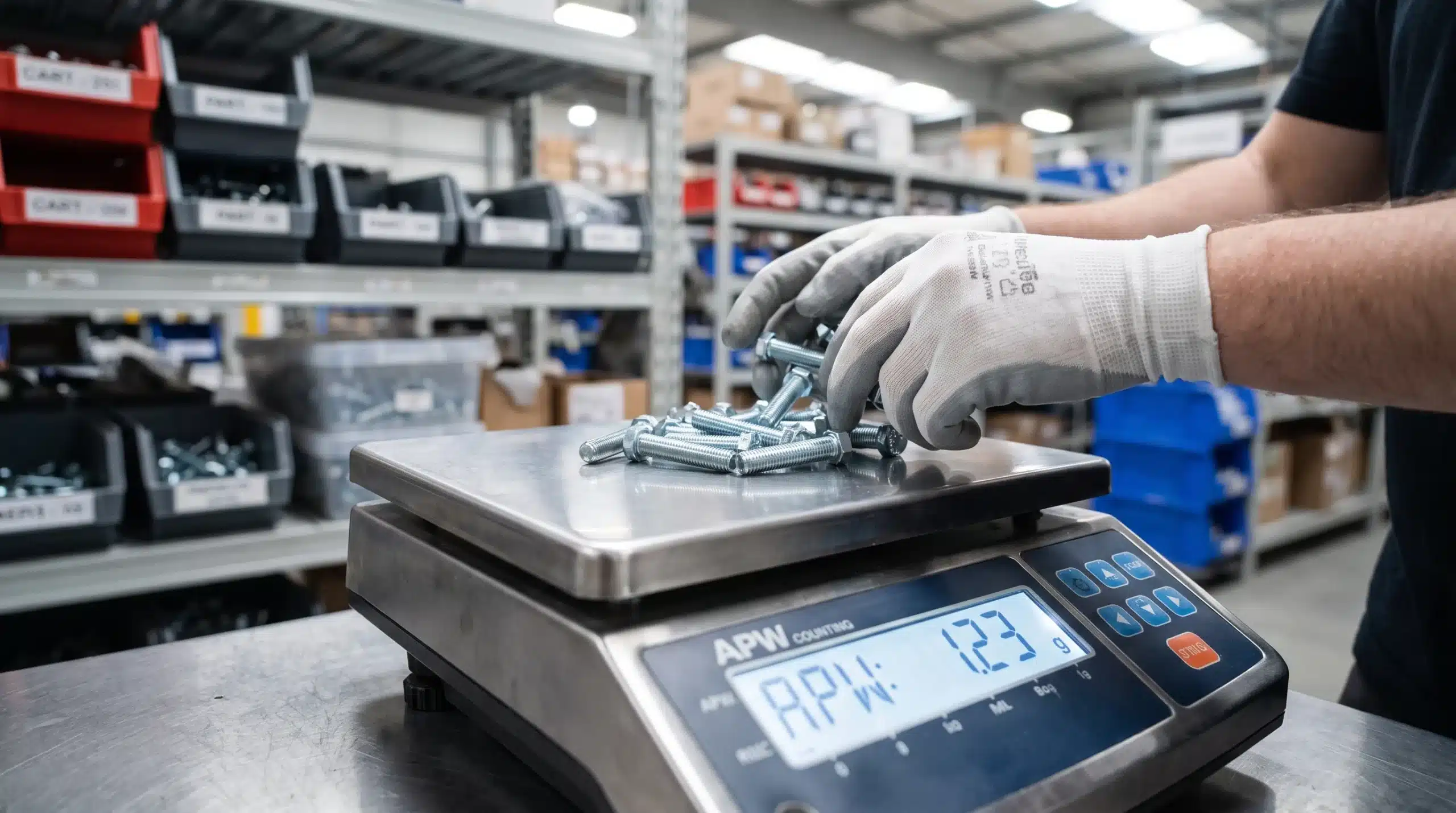
The sample step is the entire foundation of a counting scale's accuracy — everything counted afterward inherits whatever error was baked into this first weighing.
Sample Size and Why It Matters More Than Most People Think
The minimum recommended sample size for establishing an APW is 10 pieces, but many operations use 100-piece samples specifically because larger samples average out minor part-to-part weight variation and produce a meaningfully more reliable APW. A 10-piece sample from a batch with real manufacturing variance can skew the APW enough to throw off a count on a large batch; a 100-piece sample smooths that variance out considerably.
The practical rule: the more consistent the parts are by weight, the smaller a sample can safely be. The more variable they are — cast or molded parts often vary more than machined ones — the larger a sample needs to be before trusting the resulting count on a large batch.
It's worth actually testing this rather than assuming. A quick way to validate a sample size on counting scales handling a new part: weigh a 10-piece sample, note the resulting APW, then weigh a second, independent 10-piece sample and compare the two APW figures. If they're close, a 10-piece sample is probably adequate for that part. If they diverge meaningfully, that's a direct signal the parts carry enough weight variation to justify a larger sample — 50 or 100 pieces — before trusting a count on the full batch. This two-sample check costs almost nothing in time and catches exactly the kind of part-to-part variance that produces confidently wrong counts later.
Resolution: The Number That Actually Determines Accuracy
Every counting scale's resolution has to be fine enough relative to the actual piece weight being counted, or the count becomes unreliable regardless of how good the scale otherwise is. The general rule: internal resolution shouldn't exceed the weight of one part, and total sample capacity shouldn't exceed roughly 10,000 times the piece weight.
This is exactly why the Ohaus EC15's spec sheet lists a minimum recommended APW of 0.05g rather than just a blanket capacity number — below that threshold, this and most other counting scales can no longer reliably distinguish one part's weight from measurement noise, and the count starts drifting from reality even though the hardware itself is functioning correctly.
How to Size Counting Scales Correctly
Sizing counting scales means starting with the lightest individual part likely to be counted, not the heaviest total batch. A scale rated for a large total capacity can still be the wrong choice if its resolution is too coarse for a genuinely small, light part — capacity and resolution solve two different problems, and a spec sheet needs to satisfy both.
For counting scales handling a wide range of part sizes across different jobs, look for a model with multiple APW memory locations (like the EC15's 10 slots) so switching between commonly-counted parts doesn't mean re-establishing a sample every time.
Capacity headroom matters too, in the opposite direction from most other scale categories. Where an industrial floor scale benefits from extra capacity margin for safety, counting scales actually lose some resolution precision as a batch approaches the scale's rated maximum — splitting an unusually large count across two smaller batches, rather than pushing a single scale to its absolute limit, often produces a more reliable final number than a single maxed-out weighing.
Common Counting Scale Mistakes
A handful of mistakes account for most of the bad counts businesses trace back to a counting scale after the fact:
- Using too small a sample on inconsistent parts. A 10-piece sample on parts with real weight variance produces an APW that doesn't hold up across a full batch.
- Ignoring the minimum APW threshold. Counting parts lighter than the scale's rated minimum APW produces results that look precise but aren't reliable.
- Mixing part lots without re-sampling. A new production lot can carry a slightly different average weight than the last one — reusing an old APW across lots quietly introduces error.
- Skipping the tare weight for containers. Weighing parts in a bin without taring the bin's own weight first throws off both the sample and every subsequent count.
- Treating the displayed count as exact rather than estimated. A counting scale gives a very good estimate, not a literal item-by-item count — for genuinely critical quantities, a physical spot-check remains worthwhile.
Calibration and Why It Still Matters Here
Counting scales are still fundamentally weighing instruments, and everything about their counting accuracy depends on the underlying weight reading being correct in the first place. Regular calibration against certified weights keeps that foundation solid — a counting scale that's drifted out of tolerance on raw weight will produce confidently wrong piece counts, since the APW math has no way to detect that the scale itself is off.
This is a genuinely easy failure mode to miss, because a drifted counting scale doesn't necessarily produce an obviously wrong-looking number. If the underlying weight reading has shifted by even a small percentage, every APW calculation and every subsequent count built on it inherits that same percentage of error, silently, across every batch counted until the scale is recalibrated. A business relying on counting scales for inventory reconciliation or shipment verification can carry that quiet error for months before a physical audit catches the discrepancy — by which point tracing it back to a single uncalibrated scale is far harder than it would have been to simply prevent.
Most counting scales used in regular production or inventory settings benefit from the same preventive maintenance schedule as any other precision instrument — see our scale calibration services guide for real cost tiers if outsourcing that work rather than handling it in-house, since bench-scale-class equipment like this typically falls at the lower end of that pricing range.
Where Counting Scales Get Used
Counting scales show up anywhere a business needs an accurate quantity of identical small items without physically counting each one: parts rooms and manufacturing inventory tracking fasteners, electronic components, and hardware; distribution centers verifying shipment quantities before they go out the door; pharmaceutical and nutraceutical operations counting capsules or tablets; and retail or wholesale operations counting small packaged goods. The common thread across all of these is the same APW math running underneath — what changes is the capacity, resolution, and environmental protection the specific application demands.
Annual inventory counts are one of the most common single use cases for counting scales in businesses that don't otherwise use one day to day — a once-a-year rental or purchase that pays for itself many times over compared to a team physically counting a warehouse's worth of small parts by hand. Even a modest inventory of a few thousand small components can take a team hours to count manually, with the accuracy of that manual count depending entirely on human attention holding up across the last box as well as the first — a problem counting scales simply don't have.
What to Check Before You Buy
A few things worth confirming beyond the headline capacity and price when comparing counting scales:
- Minimum recommended APW. This number, not the total capacity, determines whether a scale can reliably count the specific parts you actually have — check it against your lightest item before assuming any given model will work.
- Number of APW memory locations. Operations counting several different parts regularly benefit from more memory slots, since it avoids re-sampling every time the job changes.
- Auto-optimization features. Scales that continuously refine the APW as more of a batch is weighed produce meaningfully better accuracy on large counts than ones that lock the APW after the initial sample alone.
- Platform size relative to the parts. A platform too small for the container holding a batch forces awkward workarounds that can introduce handling error.
- Data output and connectivity. For counting scales tied into inventory or ERP software, confirm the model supports the data format and connection type the rest of the system actually needs.
- Battery life and charging. For scales used across long shifts or multiple locations, the EC15's roughly 80-hour runtime is a useful real-world benchmark to compare against.
None of these factors show up in a simple capacity-and-price comparison, but any one of them can be the actual reason a specific counting scale does or doesn't work for a given job. Reading the full spec sheet, not just the headline numbers on a product listing, is worth the extra few minutes before ordering — the difference between a scale that quietly handles a job well and one that produces subtly wrong counts often comes down to exactly these details rather than anything visible on the price tag.
Conclusion
Counting scales aren't magic — they're precision weighing instruments doing a specific calculation, and understanding that calculation is what separates a business that trusts its counting scale's numbers from one that gets burned by them. A real example like the Ohaus EC15 ($544.44, 15,000g capacity, 1:600,000 internal counting resolution) shows what genuine spec-sheet numbers look like for this category. Size counting scales for the lightest part being counted, sample generously on inconsistent parts, respect the manufacturer's minimum APW threshold, and keep the scale itself on a real calibration schedule — the math only works if the underlying weight reading is actually correct, and no amount of clever software fixes a scale that's already drifted out of tolerance.
Frequently Asked Questions
How does a counting scale actually work?
A counting scale weighs a small sample of identical parts, divides that weight by the number of pieces in the sample to calculate an Average Piece Weight (APW), then divides any subsequent total weight by that APW to estimate a piece count.
How accurate are counting scales?
Accuracy depends on sample size, part-to-part weight consistency, and scale resolution. A minimum sample of 10 pieces is standard, though 100-piece samples produce meaningfully better accuracy for parts with any weight variation.
How much does a counting scale cost?
A real example: Ohaus's EC15 counting scale lists at $544.44, with a 15,000g (30 lb) capacity, 0.5g readability, and 1:600,000 internal counting resolution — a genuine, currently available price point for this category.
What is Average Piece Weight (APW)?
APW is the calculated weight of one individual piece, derived by weighing a known sample quantity and dividing by the piece count. It's the reference figure the scale uses to convert any subsequent total weight into an estimated piece count.
Why does resolution matter for a counting scale?
A scale's resolution must be fine enough to detect the weight of a single piece reliably — if a part's weight is close to or below the scale's readability, small measurement noise gets misread as extra or missing pieces.
More Related Guides
- Industrial Scales — scalecalibration.net/industrial-scales/ — types, capacities, and what to actually buy across the broader category.
- Scale Calibration Services — scalecalibration.net/scale-calibration-services/ — real cost tiers and what a certified technician checks.
- Calibration Weights — scalecalibration.net/calibration-weights/ — the certified references behind an accurate baseline reading.
- Preventive Maintenance for Scales — scalecalibration.net/preventive-maintenance-for-scales/ — the real financial cost of skipping scheduled calibration.
- Pallet Scales vs. Pallet Jack Scales — scalecalibration.net/pallet-scales/ — real specs and prices for a different weighing category entirely.