
By Jayson · Updated July 2026 · 8-minute read
Quick answer: What weighs 1 kilogram? About the weight of a liter of water, or roughly 6 to 8 medium bananas. It equals 1,000 grams, 2.20462 pounds, or 35.274 ounces. Below are 25 everyday things that weigh close to a kilogram, exact conversions, and the surprising story of how a "kilogram" is actually defined.
A kilogram is the everyday unit most of the world reaches for — heavier than a gram, lighter than most people can lift as a single mass. It's also, strangely, the one SI base unit that until 2019 was defined by a single physical object locked in a vault outside Paris. That story alone makes the kilogram more interesting than most units get credit for.
Here's what it actually weighs, in terms you can picture, plus how scientists redefined it without changing a single gram of what you own, why it still trips up anyone doing mental math between pounds and kilos, and the scale accuracy checks worth running before it matters.
In this guide
- What weighs 1 kilogram?
- The surprising history of the kilogram
- 25 things that weigh about 1 kilogram
- What weighs exactly 1 kilogram
- Where kilograms actually matter
- Kilograms vs. pounds: why the US is the outlier
- The right scale for weighing 1 kilogram
- Common mistakes people make estimating weight
- FAQ
What Weighs 1 Kilogram?
So what weighs 1 kilogram, technically speaking? A kilogram (kg) is the base unit of mass in the International System of Units (SI) — the only base SI unit that still carries a metric prefix ("kilo-") in its own name, a quirk left over from its 18th-century origins.
Kilogram conversions at a glance
| A kilogram equals | Value |
|---|---|
| Grams | 1,000 g |
| Pounds | 2.20462 lb (≈2.2 lb) |
| Ounces | 35.274 oz |
| Milligrams | 1,000,000 mg |
| Metric tonnes | 0.001 t |
The exact conversion factor between pounds and kilograms is fixed by international agreement: 1 pound = 0.45359237 kg exactly. Flip that around and 1 kilogram comes out to 2.2046226218 lb — almost always rounded to 2.2 lb in everyday use.
For a smaller reference point, 1 kilogram is 200 times heavier than a US nickel (which weighs exactly 5 grams) — see how much a nickel weighs for that comparison in more depth.
The surprising history of the kilogram
For over a century, the kilogram wasn't defined by a formula. It was defined by an object.
In 1889, metrologists cast a small cylinder of platinum-iridium alloy — about the size of a golf ball — and declared its mass to be exactly one kilogram, by definition. It was nicknamed "Le Grand K" (the Big K) and locked in a vault at the International Bureau of Weights and Measures (BIPM) outside Paris, under three nested glass domes. Every kilogram on Earth, in theory, traced its accuracy back to that single object.
The problem: Le Grand K was drifting. When scientists compared it against its official copies (kept in national labs around the world, including one at NIST in the US) over the 20th century, the masses had diverged by tens of micrograms — a tiny amount, but unacceptable for a unit the entire world's science and commerce depends on. You can't fix a physical artifact that's slowly changing mass; you can only replace what defines "correct" in the first place.
So in November 2018, delegates from about 60 nations voted to redefine the kilogram — not around another object, but around a fundamental constant of nature that can never drift: the Planck constant (h). Since May 20, 2019, the kilogram has been defined by fixing the numerical value of h at exactly 6.62607015 × 10⁻³⁴ joule-seconds. National labs now realize this definition using devices called Kibble balances, which measure mass by balancing it against a precisely known electromagnetic force.
Nothing about your kitchen scale changed on that day. A kilogram of flour is still a kilogram of flour. What changed is that the definition itself is now permanent, reproducible in any well-equipped lab on Earth, and no longer dependent on a single metal cylinder in a French vault that anyone could theoretically damage, lose, or watch slowly drift away from "correct."
What Weighs 1 Kilogram? 25 Everyday Examples
All approximate — real objects vary by size, ripeness, or manufacturer.
| Object | Approx. weight |
|---|---|
| 1 liter of water | ~1 kilogram |
| 6–8 medium bananas | ~1 kilogram |
| A standard bag of sugar or flour | ~1 kilogram |
| A hardcover novel | ~0.9–1.1 kg |
| A pair of running shoes | ~0.8–1 kg |
| A liter carton of milk | ~1.03 kg |
| A men's dress shoe (single) | ~0.5 kg (pair ≈1 kg) |
| A standard house brick | ~2–2.5 kg (half-brick ≈1 kg) |
| A small laptop | ~1–1.3 kg |
| A bag of rice (1 kilogram packaging) | ~1 kilogram |
| A liter bottle of soda | ~1.05 kg (with cap and liquid) |
| A large grapefruit x3 | ~1 kilogram |
| A men's dress shirt x4 | ~1 kilogram |
| A box of pasta (1 kilogram packaging) | ~1 kilogram |
| A small houseplant in its pot | ~1 kg (varies widely) |
| A adult guinea pig | ~0.9–1.2 kg |
| A men's size 10 sneaker (pair) | ~0.9 kg |
| A 32 oz gym water bottle, full | ~1 kg |
| A small chihuahua | ~1.5–3 kg (small ones near 1–2 kg) |
| A stack of 5 smartphone boxes | ~1 kg |
| A liter of vegetable oil | ~0.92 kg |
| A standard can of paint (1 liter) | ~1.2–1.4 kg |
| A bag of 200 US nickels | exactly 1 kilogram |
| A men's leather belt x6 | ~1 kg |
| A standard dictionary (large) | ~1–1.5 kg |
A few worth flagging for accuracy:
- A liter of water is the gold-standard everyday reference — it's the reason the kilogram was originally defined the way it was (see the history section above), and it stays close to exactly 1 kilogram at room temperature.
- Bananas are the most commonly cited produce reference online, but ripeness and size swing the number meaningfully — a bunch of small bananas might only hit 800 g for the same "6 to 8" count.
- 200 US nickels is the most mathematically exact entry on this list, since a nickel is manufactured to a legally exact 5.000 g. See our nickel weight guide for the math.
What weighs exactly 1 kilogram?
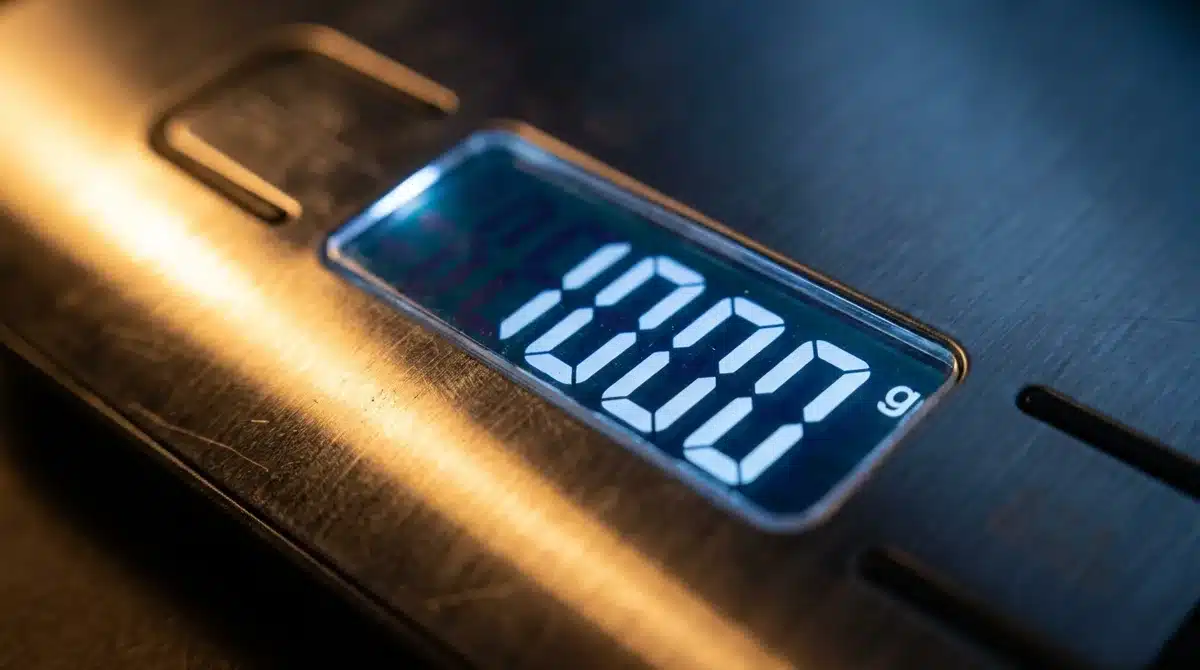 A scale reading exactly 1,000 grams — the practical way to confirm 1 kilogram at home.
The closest real-world reference to a genuinely exact kilogram is 1 liter of pure water at 4°C (39.2°F) — the temperature at which water reaches its maximum density. This isn't a coincidence: the original 18th-century definition of the kilogram was based on exactly this relationship, before metrologists moved to a physical artifact (and later, the Planck constant) for practical reproducibility.
In everyday conditions — room-temperature tap water, not laboratory-controlled — a liter will weigh very close to 1 kilogram but not perfectly exact, since water density shifts slightly with temperature. For anything that needs to be truly precise, you'd want a certified 1 kilogram calibration weight rather than a bottle of water.
Where kilograms actually matter
It shows up anywhere mass needs to be tracked precisely:
- Shipping and postage. International parcel rates are almost universally priced by the kg. A package listed as "under 1 kilogram" often crosses into a cheaper shipping tier — which is exactly why postal scale accuracy matters. See our postal scale calibration guide.
- Air travel baggage limits. Airlines set carry-on and checked-bag limits in kilograms outside the US (commonly 7 kg, 10 kg, 20 kg, or 23 kg thresholds), and even a few hundred grams over triggers a fee — sometimes a surprisingly steep one, since overweight-bag charges are rarely prorated.
- Cooking and baking at scale. Bulk recipes, bakeries, and professional kitchens measure flour, sugar, and other ingredients by the kg rather than by volume, since mass doesn't compress or settle the way flour in a cup does. A baker's percentage — the backbone of professional bread recipes — only works in mass units for exactly this reason.
- Gym equipment. Most of the world outside the US labels barbell plates and dumbbells in kilograms, not pounds — a "20 kg bar" is the Olympic standard.
- Precious metals in bulk. While individual gold or silver items are weighed in grams or troy ounces, bulk bullion and industrial quantities are often quoted by the kg.
- Body weight, medicine, and dosing. Medical dosing worldwide is calculated per kilogram of body weight — a critical reason why accurate scales matter far beyond the kitchen, and why hospital scales are calibrated on a stricter schedule than a bathroom scale ever needs to be.
Kilograms vs. pounds: why the US is the outlier
If you grew up using pounds, kilograms can feel foreign. That's not an accident of exposure — it reflects one of the more unusual holdouts in global measurement.
Only three countries have never officially adopted the metric system as their primary measurement standard: the United States, Liberia, and Myanmar. Nearly every other nation on Earth — including the UK, which still uses pounds informally for body weight — runs on kilograms for trade, science, medicine, shipping, and everyday commerce. Even US federal science agencies, NASA included, work primarily in metric units internally.
This matters practically: if you're shipping internationally, buying a scale from an overseas retailer, following a recipe from a non-US site, or reading a nutrition label from an imported product, kilograms and grams are what you'll encounter. A kitchen scale with a kg/g and lb/oz toggle — most digital scales have one — solves this instantly, and it's worth checking that switch works correctly as part of a routine accuracy check.
The Scale You Need to Weigh 1 Kilogram
A standard digital kitchen scale — the kind that reads in 1–2 gram increments up to 5 kg or so — is accurate enough for measuring a kilogram in almost any home or hobby context. You don't need lab-grade precision to know you're close to 1,000 g.
Where it gets trickier is at the edges: if you're weighing something near a shipping or baggage threshold (say, "must be under 1 kilogram"), a cheap scale's rounding error can cost you money at the post office or airport counter. In those cases, a scale that reads to 0.1 g and is freshly calibrated matters more than the sticker price suggests.
Either way, the fix is the same: check your scale against a known reference before it matters. A full 1-liter water bottle, weighed empty first and then full, gives you a rough field check. For something more exact, use a certified calibration weight or follow our full guide on how to calibrate a digital scale — scale calibration in general is the difference between a scale you can trust and one that's quietly lying to you by a percent or two.
A quick reference: standard gym plate weights
If you train with metric plates, here's the standard set most gyms stock:
| Plate color/size | Weight |
|---|---|
| Small technique plates | 0.5–1.25 kg |
| Standard bumper plates | 5 kg, 10 kg, 15 kg, 20 kg, 25 kg |
| Olympic barbell (men's) | 20 kg |
| Olympic barbell (women's) | 15 kg |
A bare men's Olympic bar already weighs 20 kg before you add a single plate — worth knowing before you load one for the first time.
Common mistakes people make estimating weight
- Confusing mass with volume. "A liter weighs a kilogram" only holds for water. A liter of vegetable oil weighs about 920 g; a liter of honey weighs closer to 1.4 kg. Density changes everything.
- Trusting produce estimates too literally. "6–8 bananas" varies by 20% or more depending on size and ripeness — fine for a mental picture, not for a recipe or a shipping label.
- Assuming packaging weight is included (or isn't). A "1 kilogram bag" of rice is usually net weight — the rice alone, not the bag. Small, but it adds up if you're trying to hit an exact shipping weight.
- Skipping calibration on scales used for anything that matters. A scale that's been bumped, dropped, or just used for months without checking can drift by several percent — invisible until you compare it to a known weight.
Frequently asked questions
What weighs exactly 1 kilogram? One liter of water at its temperature of maximum density (about 4°C) weighs almost exactly 1 kilogram. It's the closest everyday reference to a true 1 kg mass.
How many pounds is 1 kilogram? One kilogram equals 2.20462 pounds, commonly rounded to 2.2 lb. The exact conversion factor is 1 lb = 0.45359237 kg.
What weighs 1 kilogram in everyday terms? A liter of water, 6–8 medium bananas, a standard bag of sugar, a hardcover book, or a pair of running shoes all land close to 1 kilogram — see the full 25-item list above for more on what weighs 1 kilogram around the house.
How is the kilogram defined today? Since May 2019, the kilogram is defined by fixing the value of the Planck constant, replacing the old physical platinum-iridium cylinder ("Le Grand K") that had defined it since 1889.
What scale do I need to weigh 1 kilogram accurately? A standard digital kitchen scale reading in 1–2 gram increments is accurate enough for most 1 kilogram measurements. For anything requiring finer precision, use a scale that reads to 0.1 g.
How many ounces are in 1 kilogram? One kilogram equals 35.274 ounces. That's about 2.2 pounds, since there are 16 ounces in a pound.
Is a kilogram heavier than a pound? Yes — significantly. One kilogram (2.2 lb) weighs more than twice as much as one pound. It takes only 0.45 kg to equal a single pound.
Why is the kilogram the only SI base unit with a prefix in its name? Historically, the original 1795 definition used the "grave" (later renamed gram) as the base, with the kilogram as 1,000 grams. When the modern SI system formalized mass as the base quantity, the kilogram — not the gram — was kept as the base unit, prefix and all, for practical reasons tied to the original platinum artifact.
More weight references
- How Much Does a Nickel Weigh — scalecalibration.net/how-much-does-a-nickel-weigh/ — the exact 5 g coin reference.
- What Weighs 1 Gram — scalecalibration.net/what-weighs-1-gram/ — one-thousandth of a kilogram.
- What Weighs 1 Pound — scalecalibration.net/what-weighs-1-pound/ — the imperial cousin, 454 grams.
- Calibration Weights: Which Class & Size — scalecalibration.net/calibration-weights/ — certified 1 kilogram weights and up.