By Jayson · Updated July 2026 · 7-minute read
How to calibrate a jewelry scale- Quck Answer: Clean the pan with an anti-static brush, power on and wait for the sensor to stabilize, press Tare to zero, then hold CAL or MODE until the display shows your required calibration weight. Place the exact weight on the center of the pan using tweezers, wait for PASS, then verify with a known object. No calibration weight? Use clean US nickels — each weighs exactly 5.000g.
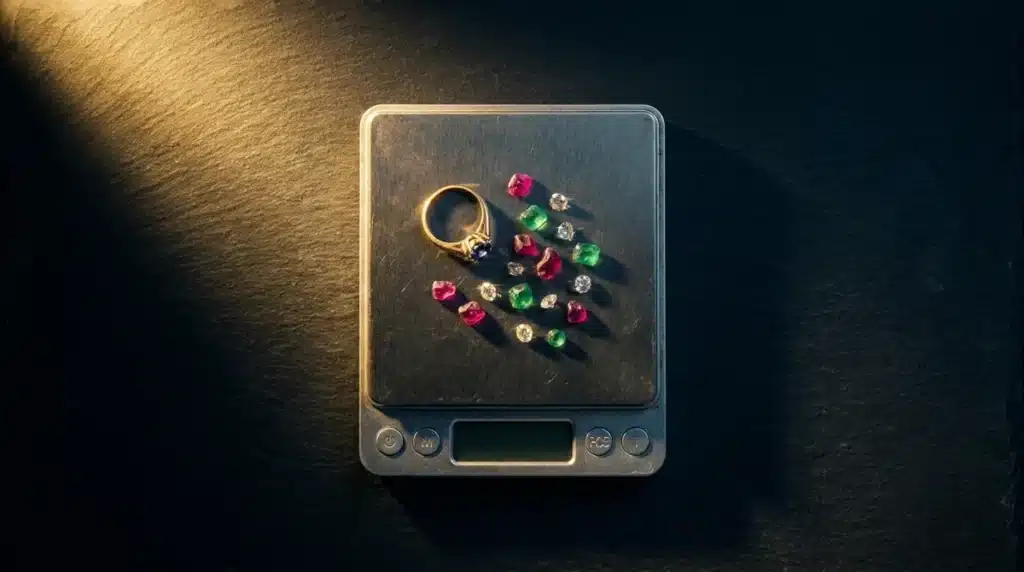
How to calibrate a jewelry scale matters more than most people assume: a jewelry scale weighs gold, diamonds, gemstones, and precious metals, and the stakes scale with the precision. At current gold prices around $130 per gram, a reading error of just 0.1g misprices a transaction by roughly $13. Diamond weighing is even less forgiving: since 1 carat equals exactly 0.2 grams, a 0.002g error is 0.01 carat — enough, near a threshold like 0.99 versus 1.00 carat, to shift a stone into a different price bracket entirely.
Learning how to calibrate a jewelry scale properly protects that precision. Here's the real 6-step process, why drafts and vibration matter more here than on almost any other scale, and what to do about the button sequence when your particular model doesn't match a generic guide.
In this guide
- Why jewelry scales lose calibration
- What you need before you start
- How many coins do you need?
- The 6-step calibration process
- Finding your scale's calibration sequence
- Accuracy tester
- Troubleshooting
- How often to calibrate
- FAQ
How to Calibrate a Jewelry Scale: Why It Loses Precision
Jewelry scales react to things that have zero effect on a kitchen or postal scale, which is exactly why how to calibrate a jewelry scale properly looks different from calibrating anything else in this guide series — precision, not just accuracy, is the whole point.
Drafts are the biggest culprit. A 0.001g readability scale reacts to air movement you cannot feel — an open window three meters away, a ceiling fan on low, someone walking past, all create enough movement to throw readings off. This is why precision balances have draft shields, and why closing them before weighing genuinely matters, not just as a formality.
Vibration is second. Polishing machines, rolling mills, and even heavy foot traffic transmit micro-vibrations through a workbench, and the load cell registers these as weight changes. If readings jump around, vibration is usually the cause before calibration drift is.
Temperature shift throws precision off fast, which is exactly the kind of environmental influence NIST's guidance on weighing instruments treats as a standard accuracy concern. Moving a jewelry scale from a cool stock room to a warm counter makes the sensor expand or contract. High-precision balances (0.001g) generally need 5 to 15 minutes to reach thermal equilibrium after being moved or turned on, and a shift of just a few degrees in room temperature can produce measurable drift at that resolution.
Skin oils and metal dust accumulate on the pan too, which is why knowing how to calibrate a jewelry scale properly always starts with a clean pan, not the button sequence. Gold dust, gem powder, and natural oils from fingers are invisible but measurable — a scale used daily without cleaning accumulates enough residue within weeks to bias every reading afterward.
How to Calibrate a Jewelry Scale: What You Need First
Gather these before you start learning how to calibrate a jewelry scale, so you're not hunting for something mid-process:
- A flat, vibration-free surface. A dedicated workbench away from polishing or grinding equipment. If your bench vibrates, place the scale on a thick anti-vibration mat.
- No drafts. Close windows, turn off fans, and close the draft shield if your scale has one.
- Fresh batteries. Low battery causes erratic readings that look like calibration drift but aren't — replace them if in doubt.
- The correct calibration weight. Check the bottom of the scale or the manual. Most pocket jewelry scales need 100g or 200g; milligram scales often need 20g or 50g. See our calibration weights guide if you're unsure which class to buy.
- An anti-static brush or soft cloth. To clean the pan before starting.
- Tweezers. Never touch the calibration weight or the items being weighed with bare hands — skin oils affect readings.
How to Calibrate a Jewelry Scale Without Weights: How Many Coins?
No calibration weight? US nickels weigh exactly 5.000g each per US Mint specification, and they work well for general-purpose gold-by-gram work. For milligram scales (0.001g readability), stick to certified weights — coin variation introduces too much error at that precision level.
Coin calibration weight calculator
Enter your scale's required calibration weight in grams (gram-level work only — use certified weights for milligram/diamond precision).
20 US nickels
Important: use only clean, undamaged coins. Wipe each one with a dry cloth and handle by the edges — never touch the face with bare fingers. See [how much does a nickel weigh](https://scalecalibration.net/how-much-does-a-nickel-weigh/) for more on using coins as calibration references.
| Coin | Weight | Good for calibration? | Notes |
|---|---|---|---|
| Nickel (5¢) | 5.000g | Best choice | Consistent since 1938. Clean multiples of 5g. |
| Penny (post-1983) | 2.500g | Good | Useful for non-multiple-of-5 targets. Pre-1983 pennies weigh 3.11g — never mix them in. |
| Quarter (25¢) | 5.670g | Awkward | Odd weight makes round totals hard to hit. |
The coin myth, corrected: nickels work — when clean and undamaged. Worn, circulated nickels can deviate by up to 0.1g each; for a 100g calibration using 20 nickels, that's a potential 2g error stacked into the one check meant to catch drift. Always inspect and wipe your coins. For diamond or milligram work, buy certified weights instead — decent sets start around $8.
How to Calibrate a Jewelry Scale, Step by Step
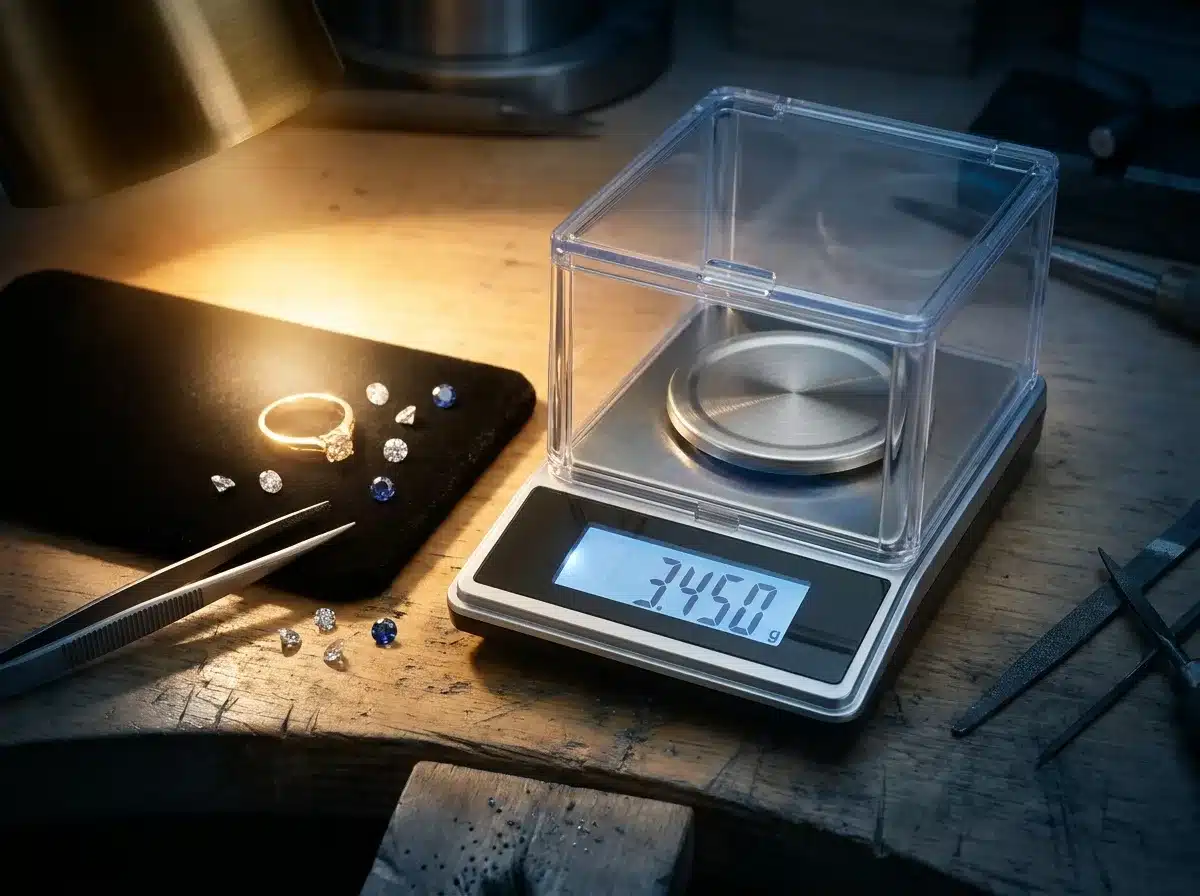 Tweezers, always — skin oils from bare fingers are enough to bias a precision reading.
This is exactly how to calibrate a jewelry scale in practice — the general process most jewelry scales that support calibration follow. Exact button names vary by model, so check the next section if a step doesn't match your display.
- Clean the pan. Use a soft anti-static brush to clear it — brush out the grooves and edges where gold dust and debris settle. Never use water or cleaning fluid; moisture damages the sensor. Visible residue means the scale has been reading heavy for longer than you'd think.
- Install fresh batteries and power on. Replace batteries if there's any doubt. A basic pocket scale needs 60 seconds to stabilize; a high-precision balance (0.001g) needs 5-15 minutes. Skipping warm-up is one of the most common reasons a calibration doesn't hold.
- Zero the scale. Nothing on the pan, draft shield closed. Press Tare or Zero and wait for a completely stable 0.000g reading. A scale that won't hold zero is telling you something — check for air movement and debris before continuing.
- Enter calibration mode. Hold CAL or MODE for a few seconds until the display shows CAL or starts flashing the required weight — this is what goes on the pan next.
- Place the calibration weight. Pick it up with tweezers, never bare hands, and set it gently in the center of the pan. Off-center placement creates a lever-arm error that shows up as consistent reading bias. Don't touch the scale, bench, or draft shield while the reading settles.
- Confirm and verify. Wait for PASS, END, or an automatic return to weighing mode. Remove the weight with tweezers, re-zero, then verify against a known-weight reference — a 5g nickel or another confirmed-weight item. If the reading is off by more than your scale's stated tolerance, repeat from step 2.
Pro tip for how to calibrate a jewelry scale on a busy bench: place the scale on a mousepad before calibrating. It levels minor surface irregularities and dampens micro-vibrations from the bench — particularly useful if you work near a polishing machine or rolling mill.
How to Calibrate a Jewelry Scale When the Manual Is Missing
Part of learning how to calibrate a jewelry scale is accepting that button sequences genuinely vary model to model, even within the same brand, and manufacturers change internals between hardware revisions without renaming the product — so rather than hand you a confident brand-by-brand table that's likely wrong for your specific unit, here's how to actually find yours: most pocket jewelry scales use some combination of holding MODE or a dedicated CAL key for a few seconds until the display shows CAL, often after pressing ON first. Higher-end scales sometimes have a dedicated CAL button rather than a hold-combo. The manufacturer's manual or a printed marking near the display is always more reliable than a generic sequence — search [your brand] [model number] calibration PDF if you don't have the manual to hand.
This is genuinely useful to know before you spend ten minutes hunting for a CAL button: some precision analytical balances, including higher-end Mettler Toledo models, use Fully Automatic Calibration Technology (FACT) — the balance calibrates itself internally based on elapsed time or a temperature shift, with no button sequence at all. If your balance never seems to need manual calibration and has internal weights you can hear moving, this is likely why.
Accuracy tester
A PASS message means the scale accepted the calibration — it doesn't mean the calibration weight you used was accurate. Always verify the result with a second known-weight object.
Scale accuracy test
Use a known object: a US nickel (5.000g), a sealed calibration weight, or a confirmed-weight gem.
For a more detailed pass/fail breakdown, use the full accuracy tester on our digital pocket scale guide.
Troubleshooting How to Calibrate a Jewelry Scale
| Symptom | Most likely cause | Fix |
|---|---|---|
| Reading drifts while a gem sits on the pan | Air draft through the pan | Close the draft shield, close windows, turn off fans. |
| Readings jump between weighings of the same item | Vibration from workbench equipment | Move the scale away from polishing or rolling equipment; use an anti-vibration mat. |
| Scale reads consistently high after calibration | Residue or gold dust on the pan | Clean the pan with an anti-static brush, re-zero, recalibrate. |
| Shows ERR or O-Ld | Overloaded — weight exceeds capacity | Remove the weight immediately; check max capacity before weighing. |
| Shows Lo or a battery symbol | Low battery | Replace the batteries before any further troubleshooting. |
| PASS displayed but the scale still reads wrong | Calibration weight was inaccurate (worn coins, uncertified weights) | Repeat with certified weights, or clean coins with a dry cloth. |
| Reading varies each time the same ring is placed on the pan | Off-center placement | Always center the item; use the same orientation each time. |
| Scale won't reach stable zero, keeps drifting | Static electricity on the pan | Wipe the pan with an anti-static cloth; ground yourself before handling the scale. |
How to Calibrate a Jewelry Scale: How Often
Knowing how to calibrate a jewelry scale is only half the job — knowing how often matters just as much. For professional use — buying or selling gold, grading gemstones, manufacturing — calibrate before every session. The stakes are too high to assume yesterday's calibration is still valid. For hobbyist or occasional use, monthly is enough.
Always calibrate after: - Moving the scale to a new location or surface - A knock, drop, or accidental bump - Battery replacement - Any reading that seems inconsistent or off - A significant temperature change in the room - Any session after the scale has sat unused for more than a month
High-precision balances (0.001g readability) are sensitive enough that a shift of a few degrees in room temperature can cause measurable drift. If you work in a variable-temperature environment, calibrate at the start of every working day.
Frequently asked questions
How do I calibrate a jewelry scale without weights? Use clean US nickels — each weighs exactly 5.000g per the US Mint. Divide your required calibration weight by 5 to get the number of nickels needed; for a 100g target, use 20 nickels. Wipe them clean, handle by the edges, and place them in the center of the pan. This works for gold-by-gram work. For milligram-level diamond weighing, use certified calibration weights instead — coin variation at 0.001g resolution is too large to ignore.
How often should I calibrate my jewelry scale? Before every professional session involving high-value items. Monthly for occasional use. Always after a drop, battery change, or moving the scale. A calibration accurate yesterday may not be accurate today if room temperature has shifted.
Why does my jewelry scale keep reading differently each time? This is the question behind most searches for how to calibrate a jewelry scale in the first place — and almost always the answer is the environment, not the scale. Check in order: air drafts, vibration from nearby equipment, battery level, debris on the pan, and off-center placement. If none of those fix it, recalibrate; if that doesn't fix it either, the load cell may be damaged.
What calibration weight does a jewelry scale need? Most pocket jewelry scales (100g-500g max) calibrate with 100g or 200g. Milligram scales (20g-50g max) often need 20g or 50g. The required weight is almost always printed on the base of the scale or shown when you enter calibration mode. For commercial or trade use, OIML F1 or F2 class certified weights are the right choice — see our OIML weight classes guide for the full breakdown.
Can I use my jewelry scale for gold and diamonds after calibrating with nickels? For gold, yes — nickel calibration is accurate enough for most gram-level transactions. For diamonds, no. Since 1 carat equals exactly 0.2 grams, diamond grading needs 0.001g accuracy, and a calibration error of even 0.002g is 0.01 carat — enough, near a threshold like 0.99 versus 1.00 carat, to shift a stone into a different price bracket. Always use certified calibration weights for milligram-level work.
More Related Guides
Now that you know how to calibrate a jewelry scale, here are related guides worth bookmarking:
- Calibration Weights: Which Class & Size — scalecalibration.net/calibration-weights/ — choosing the right weight class for jewelry and precious metal work, from OIML F2 to M1.
- How to Calibrate a Digital Pocket Scale — scalecalibration.net/how-to-calibrate-digital-pocket-scale/ — the interactive coin calculator and full accuracy tester.
- OIML Weight Classes Explained — scalecalibration.net/oiml-weight-classes/ — the certified-weight classes trade and diamond work actually require.
- How Much Does a Nickel Weigh — scalecalibration.net/how-much-does-a-nickel-weigh/ — the exact 5.000g coin reference used throughout this guide.