By Jayson · Updated August 2026 · 9-minute read
Quick answer — Stainless steel calibration weights: stainless steel calibration weights outperform chrome-plated brass because chromium is built into the entire alloy, not applied as a coating. A minimum chromium content of 10.5% forms a self-healing passive oxide film across the whole surface, so even a scratch reseals itself — while chrome plating is only a thin surface layer that, once worn through, exposes the softer brass underneath to corrosion and drift.
If you've ever wondered why a lab technician or calibration inspector reaches for a stainless steel test weight instead of a chrome-plated brass one, the answer comes down to metallurgy, not marketing. Precipitation-hardening stainless alloys like Custom 465 can reach a tensile strength in excess of 250,000 psi — a figure chrome-plated brass simply can't approach. This isn't a small margin; it's the difference between a weight that holds its certified mass for decades and one that slowly, quietly drifts out of tolerance.
In this guide
- What is a calibration weight, and why does material matter?
- Brass calibration weights: affordable, but vulnerable
- Stainless steel: the real reason it outperforms chrome-plated brass
- How to spot a compromised weight before it skews results
- Calibration weight classes: choosing the right material for your class
- Why professional calibration services rely on stainless steel calibration weights
- On-site and truck scale calibration: material under real conditions
- Calibrating without industrial weights: household alternatives
- What to check before you buy stainless steel calibration weights
- FAQ
What Is a Calibration Weight, and Why Does Material Matter?
A calibration weight is a known mass used to verify that a scale reads correctly. Scale calibration depends entirely on the assumption that the reference weight itself hasn't changed — if a weight gains rust, absorbs moisture, or gets nicked over years of handling, it no longer represents the mass it claims to.
Calibration weights come in several physical styles — cylindrical weights, grip-handle weights, pipe-handle weights, knob weights, and slotted sets — and each can be made from brass or stainless steel. The material choice affects how long that weight stays trustworthy far more than the physical style does. See our calibration weights guide for the full breakdown of types and classes.
Brass Calibration Weights: Affordable, but Vulnerable
Brass calibration weights, typically available from small gram sizes up to 10 kg, remain common in general testing environments because of their lower cost. Brass is a softer, more malleable metal — easier to machine and easier to lift for routine daily checks.
But softness is also a liability. Brass dents, scratches, and oxidizes more readily than stainless steel, and once the surface is compromised, inaccurate results are almost guaranteed. Chrome plating was introduced specifically to protect brass from this problem — but plating is only a thin veneer, and constant handling, humidity, and routine wear all work against it over time. Once it chips or wears through in even one spot, the exposed brass underneath starts corroding immediately.
An inaccurate calibration weight is a genuinely dangerous kind of failure, precisely because it doesn't announce itself. A dropped scale or a cracked housing is obvious; a brass weight that has quietly lost a few milligrams under its plating looks identical to a good one on the shelf. Nobody notices the drift until an audit, a customer complaint, or a failed inspection traces the problem back to the reference itself — by which point every measurement taken against that weight is now in question.
When Brass Still Makes Sense
None of this means brass calibration weights are obsolete. For light, infrequent testing — a hobbyist checking a kitchen scale, a classroom demonstration, a low-stakes internal spot-check — brass remains a perfectly reasonable, lower-cost choice. The tradeoff only becomes a real problem when the weight is used often, handled by multiple people, stored in variable humidity, or relied on for any result that actually matters to a business or a regulator. Matching the weight's durability to the actual stakes of the measurement is the real decision, not simply picking the more expensive material by default.
Stainless Steel: The Real Reason It Outperforms Chrome-Plated Brass
Stainless steel calibration weights resist water, wear, and contaminants for a specific, non-accidental reason: a minimum chromium content of 10.5% forms a passive, self-healing oxide film across the entire surface of the metal — not just a thin plated shell on top of a different metal.
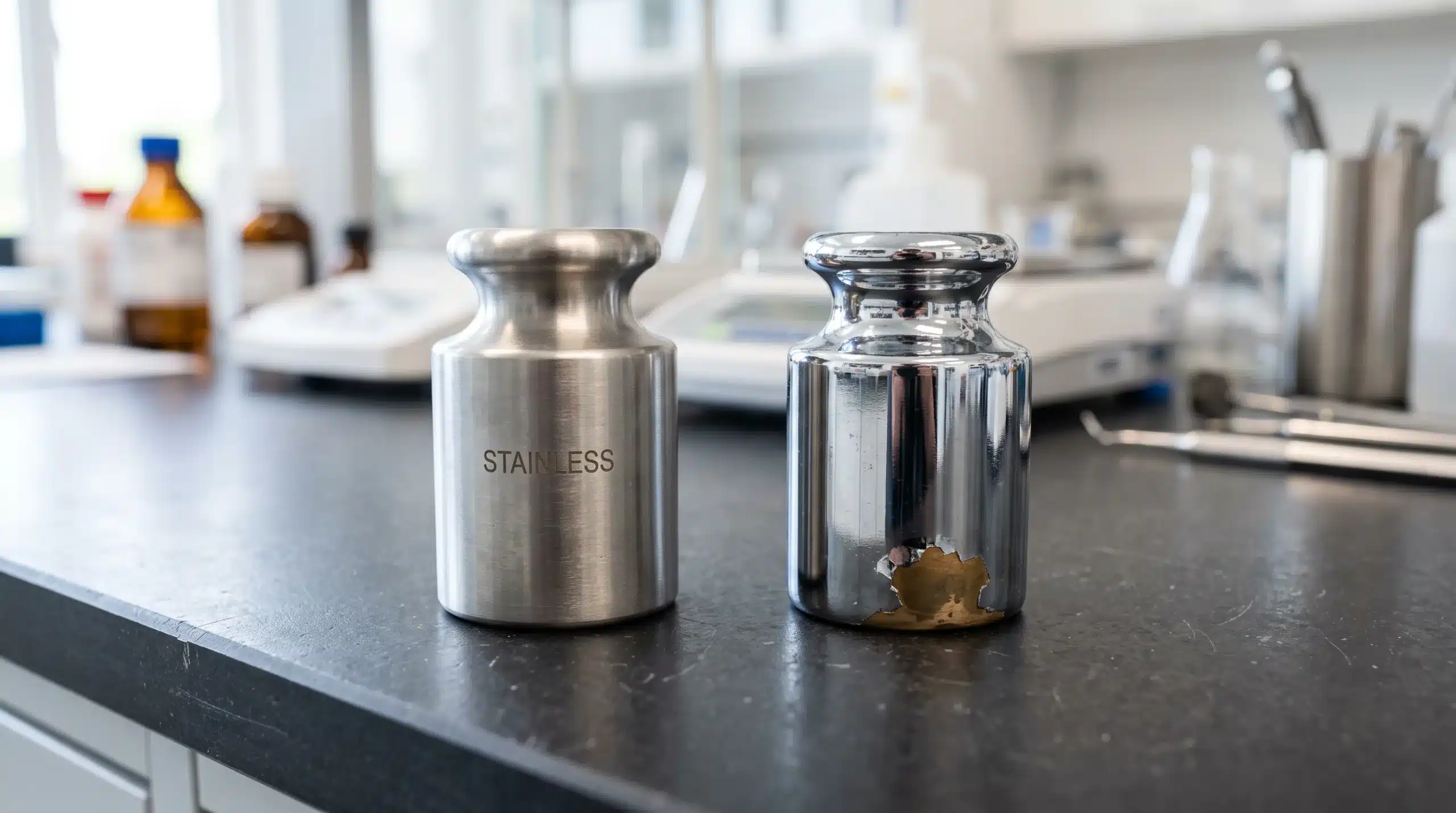 The chip in a chrome-plated weight isn't just cosmetic — it's the exact point where corrosion of the softer brass underneath begins.
This self-healing quality means that even if a stainless steel weight is scratched, the exposed chromium reacts with oxygen in the air and reforms the protective film almost immediately (Wikipedia). Chrome-plated brass has no equivalent self-repair mechanism — which is the real, material-science reason stainless steel calibration weights outperform chrome-plated brass across nearly every long-term testing scenario.
The strength difference is real too. Precipitation-hardening alloys like Custom 465 — a genuine, commercially available stainless alloy — reach tensile strengths in excess of 250,000 psi depending on aging treatment, according to Carpenter Technology's own published specifications. That kind of strength resists the deformation and surface damage that gradually throws off a weight's certified mass.
Corrosion resistance holds up even in harsh environments: according to Wikipedia's stainless steel reference, multi-layer protected stainless steel can withstand saltwater electrolysis up to 1,700 mV — a level of resilience that explains why it dominates in marine, industrial, and outdoor calibration settings where chrome-plated brass simply can't keep up.
How to Spot a Compromised Weight Before It Skews Your Results
Since a failing brass weight rarely announces itself, it's worth knowing the physical warning signs before they cost you an audit finding:
- Discoloration or green/black tarnish on brass, even under intact-looking plating, signals moisture has already reached the base metal.
- Any visible chip or scratch through the plating — even a pinhead-sized one — is a point where corrosion begins immediately, not eventually.
- A weight that feels lighter or heavier than its labeled mass on a known-good scale is the most direct evidence of drift, and worth checking periodically rather than assuming the certificate is permanent.
- Pitting or a rough, matte patch on a chrome surface where it used to be smooth indicates the plating has already failed structurally, even if no brass is visible yet.
Stainless steel calibration weights can still show physical wear from impacts or heavy use, but because the corrosion-resistant chromium runs through the entire alloy rather than sitting on the surface, a scratch on stainless steel stays cosmetic — it doesn't become a corrosion starting point the way a chip in chrome plating does.
Stainless Steel vs. Chrome-Plated Brass at a Glance
| Factor | Stainless Steel Calibration Weights | Chrome-Plated Brass |
|---|---|---|
| Corrosion protection | Chromium runs through the entire alloy — self-healing | Thin plated shell only — no self-repair |
| Behavior when scratched | Reforms passive oxide film, stays accurate | Exposes brass underneath, corrosion begins |
| Typical service life | Years to decades with proper care | Shorter — degrades once plating fails |
| Best for | Legal-for-trade, lab, field/outdoor, high-precision classes | Light, infrequent, low-stakes testing |
| Relative cost | Higher upfront | Lower upfront |
This table is the practical summary of everything above: stainless steel calibration weights cost more to buy but far less to own over time, once you factor in how much sooner a brass set needs replacing or re-certifying.
Calibration Weight Classes: Choosing the Right Material for Your Class
Calibration weight class standards — defined by NIST, ASTM, and OIML — exist so a laboratory in one city and a laboratory in another can trust the same numbers. See our OIML weight classes explained and ASTM weight classes explained guides for which class fits which application.
Higher-precision classes — the ones used in pharmaceutical or metrology settings — almost always specify stainless steel calibration weights, because certified weights at this level can't tolerate even microscopic corrosion. Certified weights used in legal-for-trade contexts lean heavily on stainless steel for the same reason. If you're unsure which class your equipment actually requires, review the tolerance ranges in the guides above before buying a set.
Why Professional Calibration Services Rely on Stainless Steel Calibration Weights
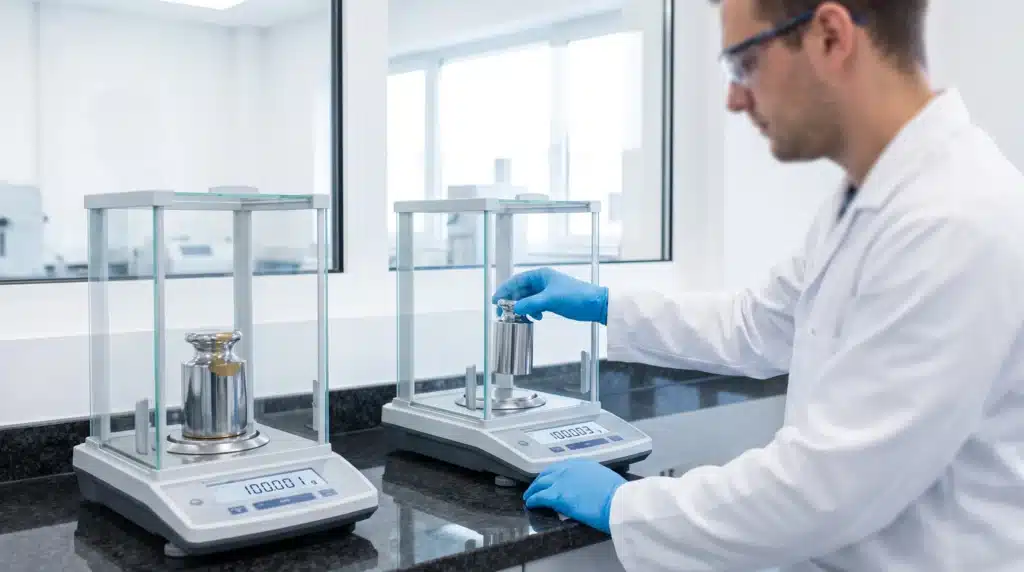
A reputable calibration provider doesn't choose reference weights casually. Weight calibration services depend on certified weights that hold their mass through repeated use, transport, and storage — sometimes for years at a stretch. Stainless steel is preferred here for the same reason it's used in surgical instruments and marine hardware: it withstands harsh conditions without degrading.
This is why calibration work done in humid warehouses, coastal facilities, or outdoor truck yards almost always specifies stainless steel calibration weights in the service protocol. When comparing providers, it's worth asking directly which material they use — a technician using an old, worn brass set on high-precision equipment is quietly compromising the very check they're being paid to perform.
On-Site and Truck Scale Calibration: Material Under Real Conditions
On-site calibration presents its own challenge, because the weights travel with the technician instead of staying in a climate-controlled lab. Truck scale calibration in particular often happens outdoors, exposed to rain, road grit, and temperature swings that would quickly compromise a chrome-plated brass set.
Stainless steel calibration weights hold up to this kind of travel and exposure far better — again, the real reason stainless steel calibration weights outperform chrome-plated brass whenever calibration happens outside a controlled environment. Certified weights used for truck scales are typically large, heavy, and expected to remain accurate through years of field use; a softer, plated material simply isn't built for that level of punishment.
Calibrating Without Industrial Weights: Household Alternatives
Not every calibration task requires an industrial weight set. For casual home use, a US nickel weighs exactly 5.000 grams and works as a genuine rough reference — see how much does a nickel weigh and our how to calibrate a digital scale guide for the full process.
Determine your scale's maximum capacity first, since calibrating beyond that limit can produce inaccurate results or damage the sensor. This household method is fine for a kitchen scale check; it's not a substitute for certified stainless steel weights once real precision or compliance is on the line.
What to Check Before You Buy Stainless Steel Calibration Weights
Not every listing labeled "stainless" delivers the same protection. A few things worth confirming before you order stainless steel calibration weights for real calibration work:
- Alloy grade, not just the word "stainless." Ask the supplier which stainless alloy the weights are made from. A reputable seller of stainless steel calibration weights will name the grade rather than just printing "stainless steel" on the listing.
- A traceable certificate of calibration. Certified stainless steel calibration weights should ship with documentation tracing the mass back to a national standard — without it, you're paying a premium for the material without the paperwork that actually makes the weight legally or scientifically useful.
- Class rating that matches your equipment. Buying stainless steel calibration weights at a class finer than your scale can resolve is wasted money; buying below your scale's resolution defeats the purpose. Match the class to the instrument, not the other way around.
- Surface finish and handling accessories. Look for weights sold with a fitted case, gloves, or a lifting fork — stainless steel calibration weights are still susceptible to oils and fingerprints affecting mass readings at the milligram level, even though they resist corrosion far better than brass.
Buying on price alone is how facilities end up with uncertified "stainless-looking" weights that offer none of the real metallurgical advantage described above. A slightly higher upfront cost for genuine, certified stainless steel calibration weights is almost always cheaper than a failed audit traced back to an unverifiable reference.
Conclusion
The real reason stainless steel calibration weights outperform chrome-plated brass isn't a matter of preference or price alone — it comes down to chromium content, a self-healing oxide film, and a resistance to corrosion, moisture, and wear that plated brass simply cannot replicate over the long term. A chrome-plated weight can look identical to a stainless one right up until the plating chips, at which point the drift it introduces is invisible until someone catches it.
Whether you run a calibration business, manage weight calibration services for a warehouse, or are just trying to calibrate a kitchen scale at home with a nickel, understanding this material difference protects you from inaccurate results down the line. An inaccurate scale can damage a business, and choosing stainless steel calibration weights over chrome-plated brass — for anything beyond casual, low-stakes use — is one of the simplest ways to protect that accuracy for years to come.
Frequently Asked Questions
Why do stainless steel calibration weights outperform chrome-plated brass?
Stainless steel contains chromium (a minimum of 10.5%) throughout the entire alloy, forming a self-healing passive oxide film across the whole surface. Chrome-plated brass only has a thin surface coating — once it wears through, the softer brass underneath corrodes and drifts out of tolerance.
Are stainless steel calibration weights worth the extra cost?
For most calibration work, yes — stainless steel calibration weights hold their certified mass far longer than brass, reducing how often they need re-certification. Facilities doing on-site or truck scale calibration, where weights face real environmental exposure, benefit most from the added durability.
Can I use brass calibration weights instead of stainless steel?
Brass weights remain acceptable for light, infrequent testing where cost matters more than long-term precision. For any calibration weight class requiring strict tolerance, stainless steel is the more reliable choice.
What makes stainless steel calibration weights corrosion-resistant?
A minimum chromium content of 10.5% forms a passive, self-healing oxide film across the entire surface of the metal. If the surface is scratched, exposed chromium reacts with oxygen and reforms the protective film almost immediately — a property chrome plating, which is only a thin surface layer, cannot replicate.
Do calibration weight class standards require stainless steel?
Higher-precision classes under NIST, OIML, and ASTM standards typically specify stainless steel because certified weights at this level can't tolerate even microscopic corrosion. Lower commercial classes often allow brass for less demanding use.
How can I tell if a chrome-plated brass weight has started to fail?
Look for any visible chip or scratch through the plating, discoloration or tarnish, a rough or pitted patch where the surface used to be smooth, or a reading that no longer matches the weight's labeled mass on a known-good scale. Any of these signs means the weight should be replaced or re-certified, not trusted as-is.
Do stainless steel calibration weights ever need replacing?
Eventually, yes — heavy impacts, extreme wear, or loss of surface finish can still affect stainless steel calibration weights over enough years of use. The difference is that a scratch on stainless steel stays cosmetic and self-heals against corrosion, while the same scratch on chrome-plated brass immediately becomes a point of failure.
More Related Guides
- Calibration Weights: Which Class & Size — scalecalibration.net/calibration-weights/ — the full range of types, materials, and classes.
- OIML Weight Classes Explained — scalecalibration.net/oiml-weight-classes/ — how the class system defines required precision.
- ASTM Weight Classes Explained — scalecalibration.net/astm-weight-classes-explained/ — the US standard equivalent.
- ISO 17025 Accreditation: A Buyer's Guide — scalecalibration.net/iso-17025-accreditation-a-buyers-guide/ — what accreditation verifies about a provider's reference weights.
- How to Calibrate a Digital Scale — scalecalibration.net/how-to-calibrate-a-digital-scale/ — the everyday process for scales that don't need industrial weights.