By Jayson · Updated August 2026 · 8-minute read
Quick answer: Legal for trade scales UK requirements mean a scale must be passed fit for trade by a Weights and Measures Inspector or approved verifier, carrying an M mark and a CE or UKCA mark. If your scale's reading sets what a customer pays, you need one — using an uncertified scale for trade is a criminal offence under the Weights and Measures Act 1985, with penalties that can include an unlimited fine and up to 2 years in prison.
Plenty of businesses run a scale for years without ever checking whether it actually meets the legal for trade scales UK requirement — right up until a Trading Standards inspector asks to see the marking on the nameplate. Getting this right isn't complicated once you know what to look for, but getting it wrong carries real legal weight, not just an awkward conversation.
This guide covers what legal for trade scales UK rules actually require, which businesses genuinely need one, how to spot the approval on a scale you already own, and what happens if you don't have it.
In this guide
- What "legal for trade" means for UK scales
- Which businesses need a legal-for-trade scale
- Who doesn't need one
- How to spot a legal-for-trade scale
- The real penalties for non-compliance
- Buying a legal-for-trade scale
- What this looks like in practice
- Common mistakes
- Verify this yourself
- FAQ
What Legal for Trade Scales UK Rules Actually Mean
Under legal for trade scales UK rules, a compliant scale is one that has either been passed as fit for use for trade by a Weights and Measures Inspector or an approved verifier, or qualified for legal use at the point of manufacture by an approved manufacturer, an approved or notified body — and, if it's ever repaired or adjusted afterward, requalified by an inspector or approved verifier at that point too.
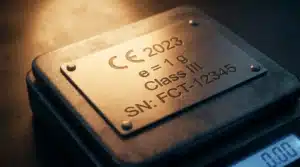
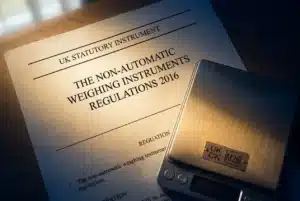
In practice, that status shows up as two things on the scale itself: an M mark (confirming manufacturing compliance, with the year of manufacture next to it) and a CE or UKCA mark (confirming the equipment was assessed against the relevant technical rules). Both need to be present and current for a scale to genuinely count as legal-for-trade — see our broader UK weighing scale regulations guide for how these markings fit into the wider legal framework.
Which Businesses Need a Legal-for-Trade Scale
The test isn't your industry — it's one specific question: does this scale's reading set the price a customer pays?
If yes, you need a legal-for-trade scale. That covers a genuinely wide range of UK businesses:
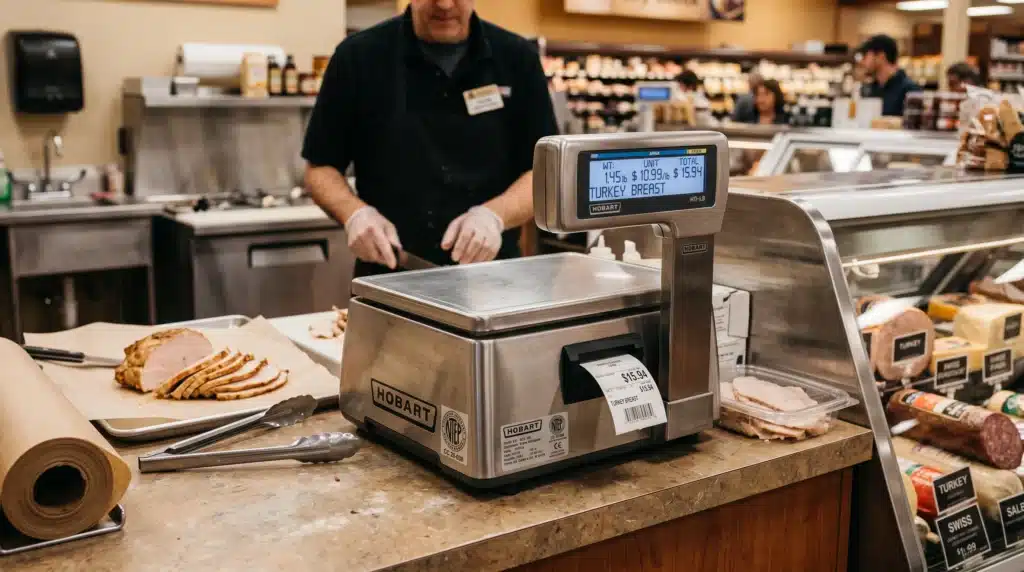
- Shop and market counters — butchers, delis, greengrocers, and market stalls selling produce by weight.
- Scrap and recycling yards — paying by the kilogram for metal is a trade transaction under the same principle as a shop counter.
- Builders' merchants and aggregate suppliers — selling sand, ballast, or similar materials by weight.
- Farm shops and direct producer sales — anywhere weight sets a price paid directly to the seller.
- Postal and parcel counters — where the customer's shipping charge is calculated from a weighed package.
If the number on the display decides what changes hands financially, the scale is subject to legal for trade scales UK requirements — full stop, regardless of how small or informal the business feels.
Who Doesn't Need One
Not every scale in a UK business needs to be legal-for-trade. The dividing line stays the same as the rule above, just in reverse:
- Internal stock control — counting inventory a business already owns, with no sale happening at the point of weighing.
- Recipe and process weighing — portioning ingredients inside production, before the finished product reaches a customer.
- Personal, educational, or laboratory use — no transaction involved at any point.
A kitchen weighing flour for a batch of bread doesn't need a legal-for-trade scale. The counter scale that then sells the finished loaf by weight does — even in the same building, sometimes the same room.
How to Spot a Legal-for-Trade Scale
The proof is physically on the equipment, not something you have to take on trust from a seller.
Check the nameplate or serial plate for:
- An M mark with a year next to it, confirming manufacturing compliance.
- A CE mark or UKCA mark, confirming technical assessment.
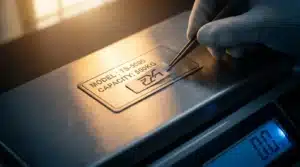
- Any requalification sticker, if the scale has been repaired or adjusted since manufacture — this should carry its own date and an identifying stamp from whoever did the work.
A scale printed "Not for trade use" gives you a direct, unambiguous answer: it cannot legally be used where weight sets a price, no matter how accurate it happens to read in practice. Consumer-grade scales bought from general retailers very rarely carry proper M and CE/UKCA marking for trade purposes — that absence is usually the fastest tell.
The Real Penalties for Non-Compliance
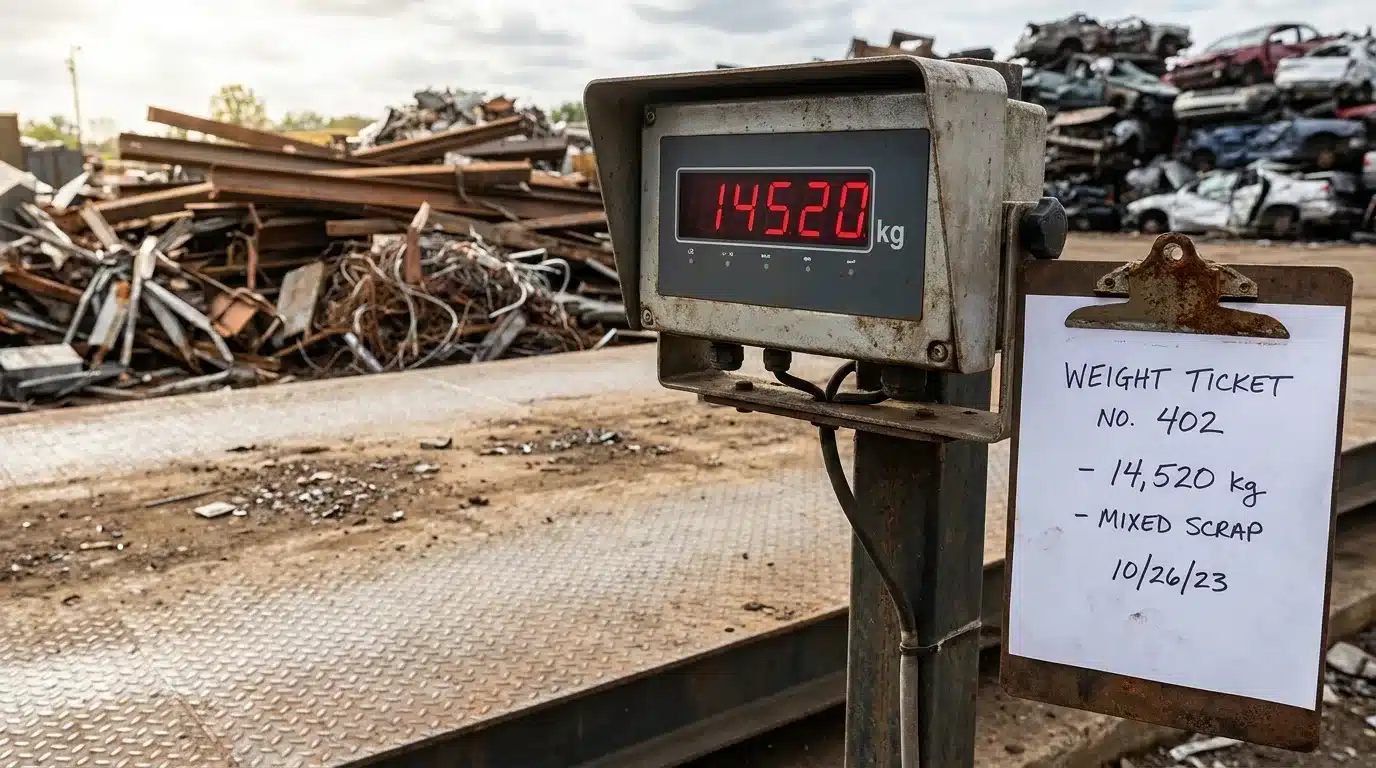 A weighbridge that sets a price per tonne is subject to exactly the same legal-for-trade requirement as a shop counter scale.
Using a non-approved scale for trade in the UK is a criminal offence under the Weights and Measures Act 1985, and Trading Standards genuinely do prosecute — this isn't a theoretical risk.
Trading Standards Officers have real enforcement powers: they can enter premises to inspect goods and test weighing equipment, make test purchases, and seize goods or documents where a breach is suspected. Following a successful prosecution, the consequences can include:
- A criminal record for the trader.
- Unlimited fines for many Trading Standards offences.
- Imprisonment — up to 2 years for standard offences, and up to 14 years where fraud, theft, or money laundering is involved.
- Forfeiture of the non-compliant equipment itself.
- Compensation orders to affected customers, plus the investigation and prosecution costs.
Short of full prosecution, Trading Standards can also issue Simple Cautions, Compliance Notices, Stop Notices requiring immediate cessation, or direct Financial Penalty Notices without going to court at all. The overall pattern is consistent: using the wrong scale for trade is treated as a genuine consumer-protection matter, not a paperwork technicality, and the range of tools available to enforce it reflects that.
It's also worth understanding that these powers aren't limited to catching a scale mid-transaction. Trading Standards Officers can enter a premises specifically to observe how a business is being carried on, inspect goods or documents, test weighing equipment directly, and make test purchases to see how a scale actually performs under normal use — not just check paperwork after the fact. That gives inspectors a genuinely practical way to catch a non-compliant scale even outside a formal complaint, which is part of why "we've never been checked" isn't the same thing as "we're compliant."
Buying a Legal-for-Trade Scale
The reliable way to get a genuinely compliant legal for trade scales UK setup is buying the right scale from the start, rather than trying to retrofit approval onto equipment afterward — approval attaches to a specific manufactured model, not something a technician can add to an existing unit after purchase.
When shopping, confirm the specific listing or spec sheet explicitly states M marking and CE/UKCA marking for trade use — general marketing language like "commercial grade" or "heavy duty" isn't the same claim and doesn't guarantee legal-for-trade status. Reputable UK industrial and retail scale suppliers list this explicitly as a spec, precisely because it's a genuine legal distinction buyers need to check before purchase, not an assumed given.
Expect legal-for-trade models to cost more than otherwise-similar non-certified equipment at the same capacity — the certification process and tighter manufacturing tolerance required to reliably pass it add real cost. Buying a cheaper, non-certified scale and assuming an upgrade path exists later is a common, expensive mistake; in practice, replacement is usually the only real fix once a business needs trade approval it doesn't have.
What This Looks Like in Practice
It helps to walk through a couple of real scenarios, since the rule is simple in principle but the edge cases are where businesses actually get caught out.
A butcher's shop counter scale is the clearest case: the customer watches the weight, the price prints or is calculated directly from it, and money changes hands based on that number. This is squarely a legal-for-trade scale, no ambiguity.
A scrap metal yard's weighbridge is less obviously "retail," but the legal principle is identical — the yard pays the seller by weight, so the weight sets a price just as directly as a shop till does. Yards sometimes assume industrial-scale equipment gets treated differently from small retail scales because of its size or cost; it doesn't. The requirement tracks the transaction, not the equipment category or the price tag on the scale itself.
A farm shop selling pre-packed produce, by contrast, may not need the scale itself to be legal-for-trade if the weight was already fixed and verified at the packing stage rather than being weighed live at the point of sale — though the packing process itself then falls under separate average-weight and pre-packaged-goods rules rather than being exempt from oversight entirely. This is a genuinely common point of confusion: "the scale isn't legal-for-trade" and "this product doesn't need to be weighed by a legal-for-trade scale" are two different claims, and conflating them is an easy way to end up non-compliant without realizing it.
Common Mistakes
- Assuming accuracy and legal approval are the same thing. A scale can weigh correctly in a spot check and still be non-compliant if it's missing the right marking or a current requalification.
- Ignoring the CE-marking question. Some buyers wrongly assume UKCA is now mandatory — CE-marked equipment remains valid in Great Britain following the 2024 legislation.
- Treating a small or informal sale as exempt. There's no minimum transaction-size exemption; if weight sets a price, the requirement applies regardless of how small the sale is.
- Buying based on marketing language alone. "Commercial grade" and "heavy duty" aren't legal-for-trade claims — confirm the actual M and CE/UKCA marking is specified.
- Letting an approved scale drift without recalibration. Legal-for-trade status at purchase doesn't mean a scale stays accurate forever — see our guide on UKAS scale calibration for how ongoing accuracy is maintained and certified.
Verify This Yourself
Penalty figures, marking rules, and enforcement practice can change, and this guide reflects research current as of August 2026. Before making a compliance decision, check directly with:
- Business Companion — Weighing equipment for legal use — official UK guidance on marking and approval.
- Business Companion — Trading Standards: powers, enforcement and penalties — the source for the enforcement detail in this guide.
- GOV.UK — National regulation: weights and measures — for enforcement contacts and reporting non-compliant equipment.
- Your local Trading Standards office, for questions specific to your business.
See our site disclaimer for how we handle regulatory content generally.
Frequently Asked Questions
What is a legal for trade scales UK scale? One passed as fit for use for trade by a Weights and Measures Inspector or approved verifier, or qualified for legal use by an approved manufacturer or notified body, carrying an M mark and a CE or UKCA mark.
Which UK businesses need trade-approved scales? Any business where a scale's reading sets a customer's price — shop counters, market stalls, scrap and recycling yards, and anywhere goods are sold by weight directly to a buyer.
What happens if I use a non-approved scale for trade in the UK? It's a criminal offence under the Weights and Measures Act 1985. Trading Standards can prosecute, with penalties including an unlimited fine, up to 2 years imprisonment for standard offences, forfeiture of the equipment, and a criminal record.
Can I use CE-marked scales for trade in Great Britain? Yes. Since legislation introduced in October 2024, CE marking can be used indefinitely for most products in Great Britain, so a CE-marked, otherwise-compliant scale remains legal for trade use.
How do I buy a legal-for-trade scale in the UK? Buy from a reputable supplier and confirm the listing explicitly states M marking and CE/UKCA marking for trade use, not just general "commercial grade" language.
Does Northern Ireland follow the same legal-for-trade rules as Great Britain? The underlying technical requirements are consistent, since both trace back to the same NAWI framework, but enforcement in Northern Ireland sits with the Department for the Economy rather than local Trading Standards — worth confirming with the correct authority if your business operates across the border.
Do second-hand scales need re-verification before being used for trade? Not automatically, if the existing M mark and CE/UKCA marking are current and the scale hasn't been repaired or adjusted since. But it's worth confirming the equipment's history directly with the seller, since a scale that's been quietly adjusted without proper requalification would no longer be genuinely legal-for-trade despite the original marking still being physically present.
More Scale Calibration Guides
- UK Weighing Scale Regulations — scalecalibration.net/uk-weighing-scale-regulations/ — the full legal framework this guide sits inside.
- UKAS Scale Calibration — scalecalibration.net/ukas-scale-calibration/ — keeping an approved scale accurate and certified.
- Legal for Trade Scales (US) — scalecalibration.net/legal-for-trade-scales/ — the equivalent US framework, for comparison.
- Calibration Weights: Which Class & Size — scalecalibration.net/calibration-weights/ — certified weights for servicing any class of scale.
- Best Scales — scalecalibration.net/category/best-scales/ — buying guides across scale types.