By Jayson · Updated August 2026 · 9-minute read
Quick answer: UK weighing scale regulations are built on three laws: the Non-automatic Weighing Instruments Regulations 2016, the Measuring Instruments Regulations 2016, and the Weights and Measures Act 1985. Together they require any scale used to set a customer's price to carry an M mark and a CE or UKCA mark, be verified by an inspector or approved verifier, and meet one of four accuracy classes. Trading Standards and the Office for Product Safety and Standards enforce compliance.
If a scale's reading decides what a customer pays anywhere in the UK, that scale is subject to law — not just good practice. UK weighing scale regulations exist specifically to make sure the number on the display is one both sides of a transaction can trust, and the framework behind that guarantee is more layered than most business owners realize until an inspector actually shows up.
This guide covers what UK weighing scale regulations actually require, in plain terms: which laws apply, what the markings on a scale's nameplate mean, the four accuracy classes, who checks compliance, and where to verify anything here directly with the official source.
In this guide
- The three laws behind UK weighing scale regulations
- Who enforces UK weighing scale regulations
- What "legal for trade" means under UK weighing scale regulations
- CE marking vs. UKCA marking
- The M mark, explained
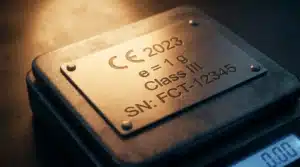
- The four accuracy classes
- Verification and requalification
- Verify this yourself: official sources
- Common mistakes
- FAQ
The Three Laws Behind UK Weighing Scale Regulations
UK weighing scale regulations aren't one single act — they're three overlapping pieces of law, each covering a different layer of the same system.
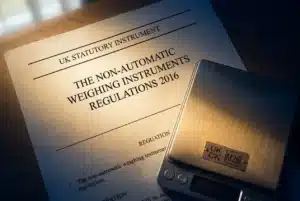
- The Non-automatic Weighing Instruments Regulations 2016 (SI 2016/1152) — usually shortened to NAWI — govern scales that require a person to load and read them, which covers the overwhelming majority of commercial scales in shops, warehouses, and yards. NAWI 2016 originally implemented EU Directive 2014/31/EU into UK law and remains the technical backbone of UK weighing scale regulations for this equipment class.
- The Measuring Instruments Regulations 2016 (SI 2016/1153) — cover measuring instruments more broadly (flow meters, fuel dispensers, and similar devices), and sit alongside NAWI as a parallel framework under the same general approach.
- The Weights and Measures Act 1985 — the older, foundational UK statute that establishes the basic legal concept of verified, trade-approved equipment and gives Trading Standards its underlying enforcement authority.
These were updated by the Product Safety and Metrology etc. (Amendment) Regulations 2021, which adjusted enforcement procedures for NAWI and the Measuring Instruments Regulations after the UK left the EU, without rewriting the underlying technical requirements from scratch. In practice, that means the accuracy and construction rules a scale must meet have stayed largely consistent — what changed is mostly the marking and administrative detail covered later in this guide.
Who Enforces UK Weighing Scale Regulations
Three different bodies share enforcement of UK weighing scale regulations, depending on where you are and what's being checked:
- Local Authority Trading Standards — the primary, day-to-day enforcer across England, Scotland, and Wales. A Trading Standards inspector is who actually turns up to check a shop, market stall, or yard.
- The Department for the Economy — the equivalent enforcement authority in Northern Ireland.
- The Office for Product Safety and Standards (OPSS) — responsible for market surveillance of weighing and measuring instruments at a national level, including investigating non-compliant products before they reach a Trading Standards inspection at all.
If you think a specific weighing instrument on the market doesn't meet UK weighing scale regulations, OPSS accepts reports directly at opss.enquiries@businessandtrade.gov.uk — a genuinely useful contact if you've bought equipment that looks non-compliant rather than just suspect it.
What "Legal for Trade" Means Under UK Weighing Scale Regulations
A scale meets UK weighing scale regulations for trade use when it is either "passed as fit for use for trade" by a Weights and Measures Inspector or an approved verifier, or "qualified" for legal use at manufacture by an approved manufacturer, an approved or notified body, or subsequently by an inspector or approved verifier following any adjustment or repair.
In everyday terms: the scale needs to be a model that was built and certified to the standard in the first place, and it needs to stay in that certified state for as long as it's used commercially. The full detail — which businesses actually need one, how to buy correctly, and what happens if you don't — gets its own dedicated breakdown in legal-for-trade scales in the UK, since it's a big enough topic to deserve its own guide rather than a section here.
CE Marking vs. UKCA Marking
This is the part of UK weighing scale regulations that trips up the most buyers, largely because the rule changed after most people had already learned the old one.
The CE mark indicates a product was assessed against EU rules by an EU notified body — it signals compliance with the underlying EU legislation the equipment was originally built to (including relevant electromagnetic compatibility and hazardous-substance restrictions, not just the weighing-specific rules). The UKCA mark is the post-Brexit equivalent: it indicates assessment against UK-specific rules by a UK-approved body, for products placed on the Great Britain market.
Here's the genuinely useful, current fact: as of 1 October 2024, the UK government introduced legislation permitting the CE mark to be used indefinitely for most products — reversing what had been a hard 31 December 2024 deadline requiring a full switch to UKCA marking. In practice, this means a CE-marked weighing scale can still be legally sold and used in Great Britain, and buyers do not need to reject CE-marked equipment as automatically non-compliant just because it lacks a UKCA mark. This is exactly the kind of detail worth re-checking directly with GOV.UK before making a purchasing decision, since it's a live policy area that has already changed once.
The M Mark, Explained
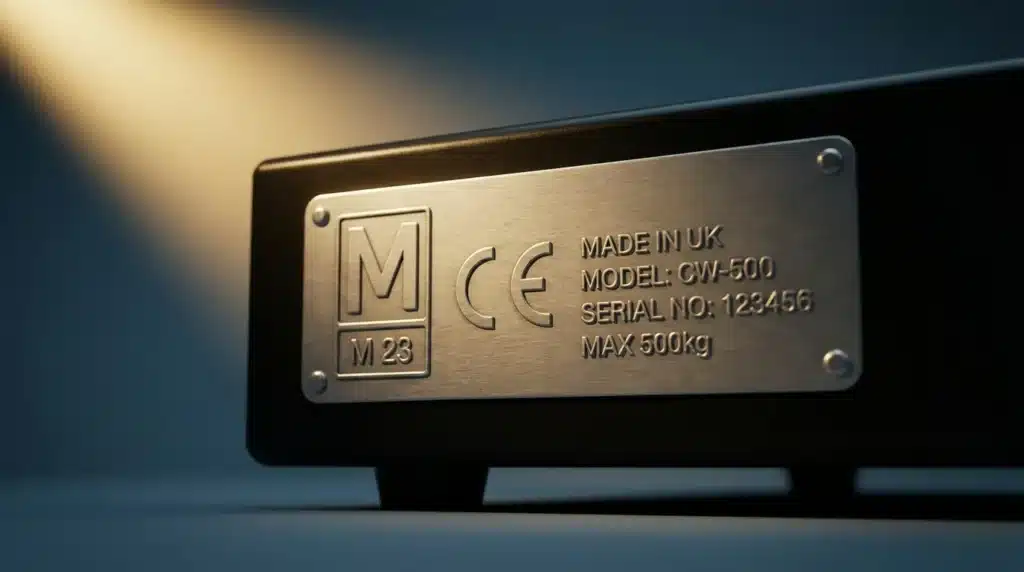
Separate from CE/UKCA, every scale that meets UK weighing scale regulations for trade carries an M mark — a sticker or stamp indicating the equipment was manufactured in accordance with legal metrology requirements. The year of manufacture appears directly next to the M, so the mark also tells you, at a glance, roughly how old the scale's original certification is.
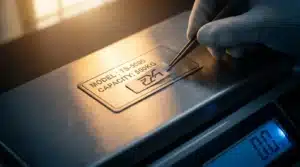
If a scale is later repaired or adjusted, that work generates a separate requalification sticker, confirming the equipment was re-tested and still meets the manufacturing and accuracy requirements after the intervention. Different bodies — inspectors, approved verifiers, manufacturers — issue their own distinct requalification stickers, so two legitimately compliant scales serviced by different verifiers can carry visibly different-looking stickers while both being perfectly valid.
The Four Accuracy Classes
UK weighing scale regulations sort weighing instruments into four accuracy classes, and matching the right class to the right use is a real, practical decision — not just a technical footnote.
| Class | Precision level | Typical use |
|---|---|---|
| Class I (Special) | Highest | Precious metals, gemstones, pharmaceuticals |
| Class II (High) | High | Fine chemical and laboratory work, precision retail |
| Class III (Medium) | Medium | General retail and commercial weighing |
| Class IIII (Ordinary) | Lowest | Ballast, building materials, waste disposal |
Most everyday retail and commercial scales — shop counters, market stalls, general trade use — fall under Class III. Higher classes exist specifically for use cases where a small absolute error carries a disproportionate cost, which is exactly why pharmacies and jewellers are pushed toward Class I or II rather than being left on the same tolerance as a builder's merchant weighing aggregate.
Verification and Requalification
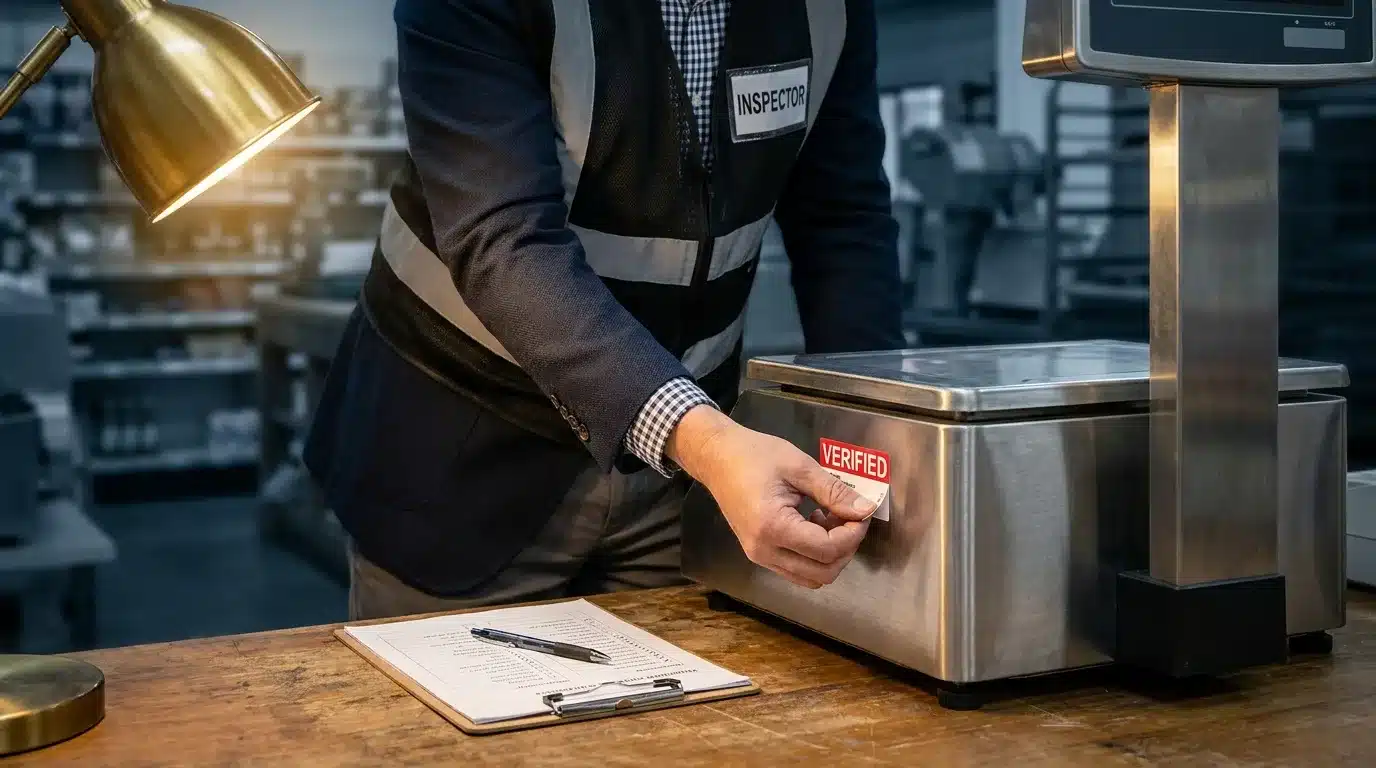 A requalification sticker like this one confirms the scale was re-tested after a repair or adjustment.
A scale doesn't just get checked once and stay compliant forever. UK weighing scale regulations expect an approved manufacturer, notified body, inspector, or approved verifier to confirm accuracy at the point of manufacture, and again any time the equipment is repaired or adjusted afterward.
There's no single universal re-verification calendar interval stated in the core regulations themselves — the practical trigger is service history (a repair or adjustment) rather than a fixed number of months. That's a meaningful difference from some other countries' systems, and it's exactly the kind of specific, changeable detail worth double-checking against the official guidance for your own equipment and sector before assuming a particular schedule applies.
In practice, this means the responsibility sits with the business owner as much as with any inspector. A scale that's never been touched since its original M mark was applied can, in principle, stay in service indefinitely without a fresh requalification — but the moment it's opened up, adjusted, or repaired, that intervention itself is what triggers the requirement for a new check. This is one of the more common points of confusion under UK weighing scale regulations: businesses sometimes assume a periodic inspection schedule exists (the way an MOT works for a vehicle), when the actual trigger is event-based rather than calendar-based. If a scale is behaving oddly — reading inconsistently, failing to hold zero, or simply "feeling" less accurate than it used to — that's the moment to get it checked and requalified, not just when a fixed interval happens to come around.
Verify This Yourself: Official Sources
Regulations and their enforcement can change, and this guide reflects our research as of August 2026 — not necessarily the current state of the law when you're reading it. Before making a compliance or purchasing decision based on UK weighing scale regulations, check directly with:
- GOV.UK — National regulation: weights and measures — the official government guidance page, covering enforcement bodies, approved verifier status, and how to report non-compliant equipment.
- Business Companion — Weighing equipment for legal use — the UK's official business-facing guidance service, with the fullest detail on CE/UKCA marking, M marking, and accuracy classes.
- Your local Trading Standards office, for enforcement questions specific to your business and location.
See our full site disclaimer for how we handle regulatory content generally — the short version is that we research carefully, but law changes, and the official source always wins.
Common Mistakes
- Assuming a scale that reads accurately is automatically compliant. Accuracy and legal approval are related but separate — a scale can weigh correctly in a spot check and still fail UK weighing scale regulations if it lacks the right marking or a current verification.
- Rejecting CE-marked equipment as non-compliant. As covered above, CE marking remains valid in Great Britain following the 2024 legislation — don't assume UKCA is now mandatory.
- Confusing the M mark with a verification stamp. The M mark shows manufacturing compliance and the year built; it isn't the same as a requalification sticker confirming a later repair passed re-testing.
- Using an uncertified scale for a "small" trade transaction. UK weighing scale regulations don't have a minimum transaction size exemption — if the reading sets a price, the scale needs to be compliant regardless of how small the sale is.
- Treating one region's enforcement as universal. Northern Ireland's Department for the Economy and Great Britain's Trading Standards system aren't identical in every procedural detail — confirm locally rather than assuming.
- Assuming a fixed re-verification calendar exists. As covered above, the trigger for requalification under UK weighing scale regulations is a repair or adjustment, not a set number of months — don't wait for a date that isn't actually specified anywhere in the law.
- Buying second-hand equipment without checking its marking history. A used scale might carry an M mark from years ago with no record of any repairs since — that's not automatically a problem, but it's worth confirming the equipment hasn't been quietly adjusted by someone unqualified in the meantime.
Frequently Asked Questions
What are the main UK weighing scale regulations? The core laws are the Non-automatic Weighing Instruments Regulations 2016 (SI 2016/1152), the Measuring Instruments Regulations 2016 (SI 2016/1153), and the Weights and Measures Act 1985, updated by the Product Safety and Metrology etc. (Amendment) Regulations 2021.
How do I identify a trade-approved scale in the UK? Check the nameplate for an M mark with the year of manufacture, and a CE or UKCA mark. A scale printed "Not for trade use" cannot legally be used where the weight sets a customer's price.
What does the UK weighing scale verification sticker mean? A requalification sticker shows the scale was repaired or adjusted after manufacture and re-tested to confirm it still meets accuracy requirements. It's issued by an inspector, an approved verifier, or the manufacturer, and carries a date and identifying mark.
Does a weighing scale need to be trade approved in the UK? Only if its reading sets what a customer pays — a shop counter, a scrap yard, a market stall. A scale used only for internal stock checks, recipe portioning, or personal use does not need trade approval.
Can CE-marked weighing scales be used in Great Britain? Yes. Following legislation introduced in 2024, the UK government permits the CE mark to be used indefinitely for most products, including weighing instruments, alongside or instead of the UKCA mark.
Who enforces weighing scale regulations in the UK? Local Authority Trading Standards enforce weights and measures law across most of Great Britain, the Department for the Economy does so in Northern Ireland, and OPSS carries out national market surveillance of weighing and measuring instruments.
More Scale Calibration Guides
- Legal-for-Trade Scales in the UK — scalecalibration.net/legal-for-trade-scales-uk/ — which businesses actually need one, and how to buy correctly.
- UKAS Scale Calibration — scalecalibration.net/ukas-scale-calibration/ — certificates, traceability, and when you need an accredited lab.
- Legal for Trade Scales (US) — scalecalibration.net/legal-for-trade-scales/ — the equivalent US framework, for comparison.
- Scale Calibration Services — scalecalibration.net/scale-calibration-services/ — what professional calibration actually costs.
- Calibration Weights: Which Class & Size — scalecalibration.net/calibration-weights/ — certified weights for servicing any class of scale.
- Best Scales — scalecalibration.net/category/best-scales/ — buying guides across scale types.