By Jayson · Updated July 2026 · 9-minute read
Best calibration management software: the strongest calibration management software in 2026 is QT9 QMS for multi-standard reporting (ISO 13485, IATF 16949, AS9100, 21 CFR Part 820), GageFX for on-site and field calibration, Beamex CMX and Fluke MET/CAL for 21 CFR Part 11 electronic records, and GAGEtrak for straightforward ISO/IEC 17025 gage tracking. Which one fits depends on which regulator you answer to and whether your equipment travels or stays on a bench.
Calibration management software earns its keep the moment a reading falls outside tolerance and the system flags it automatically, generates the corrective-action paperwork, and timestamps the whole event — without a technician having to remember to do any of it by hand. That's the real bar for 2026: not "does it store certificates," but does calibration management software actually interpret a failed reading and act on it.
For decades, calibration reporting meant a technician filling out a certificate, filing it, and hoping nobody asked for it during an audit three years later. That doesn't hold up anymore — auditors expect electronic records they can pull up in minutes, not a filing cabinet. Below are five real calibration management software platforms worth evaluating in 2026, what each one is actually built for, and where a business is better off skipping enterprise software entirely.
In this guide
- Why calibration management software matters for 2026 reporting
- What to look for before you buy
- QT9 QMS — best for multi-standard compliance
- GageFX — best for on-site and field calibration
- Beamex CMX — best for 21 CFR Part 11
- Fluke MET/CAL — best for instrument-heavy labs
- GAGEtrak — best for straightforward gage tracking
- Comparing the 5 platforms
- What actually slows a rollout down
- The certified weights every report depends on
- Do you actually need calibration management software?
- FAQ
Why Calibration Management Software Matters for 2026 Reporting
An inaccurate scale or gage can damage a business quietly — but an inaccurate report about that instrument can damage it worse, because it hides the problem from an auditor until it's a recall or a failed inspection instead of a routine fix. That's the gap calibration management software is built to close: it doesn't just log that a calibration happened, it checks the result against tolerance and reacts.
Real automation in calibration management software means the platform recognizes an out-of-tolerance reading and generates the corrective-action record before a person opens the file. It means a report that maps directly to the standard an auditor actually asks about — ISO/IEC 17025 for testing and calibration labs, IATF 16949 for automotive suppliers, ISO 13485 for medical device makers, AS9100 for aerospace, or 21 CFR Part 820 for FDA-regulated manufacturers — without a human reformatting anything by hand. If a platform can't do that, it's digitizing a paper form, not automating the reporting.
What to Look For in Calibration Management Software
Before comparing specific platforms, here's the checklist that separates genuine calibration management software from a glorified spreadsheet:
- Automatic tolerance checking — the system flags a failed reading itself, rather than relying on a technician to notice.
- Standards mapping — one-click reports formatted for the specific framework your auditor uses (ISO 9001, ISO 13485, IATF 16949, AS9100, 21 CFR Part 11/820).
- Audit trail — every edit to a record shows who changed what, when, and why, with the original value preserved.
- Traceability to a national standard — certificates that trace back to NIST or an equivalent national metrology institute, not just an internal reference.
- Field/mobile support — if any of your equipment is calibrated on site rather than in a lab, the software needs to capture that data offline and sync it later.
- Interval automation — calculated due dates and alerts by gage type or usage, not a shared spreadsheet someone has to remember to check.
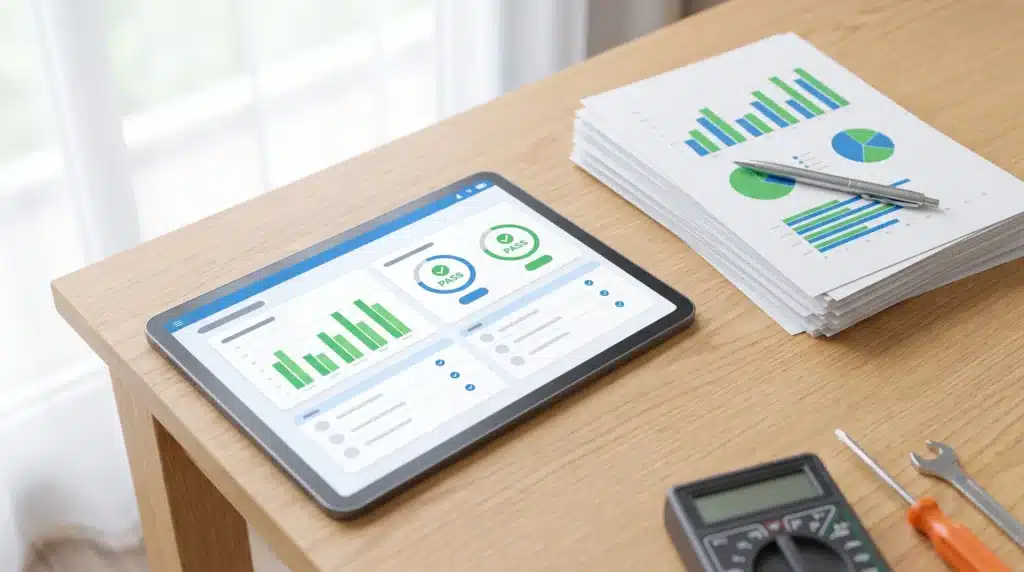
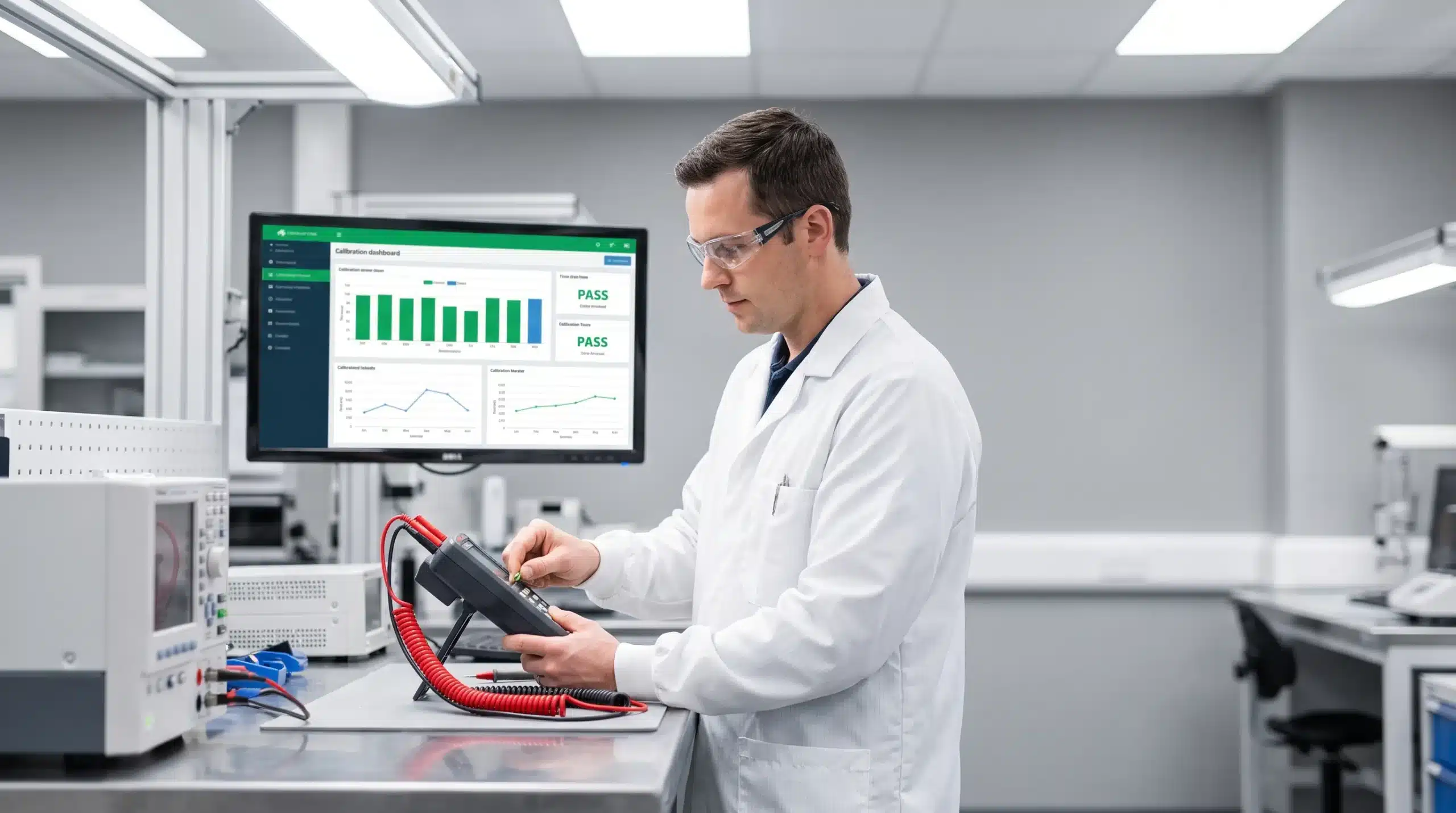 Modern calibration management software flags a pass or fail the moment a reading is captured — no separate review step needed.
QT9 QMS — Best for Multi-Standard Compliance
QT9 QMS is cloud-based calibration management software built inside a full quality management system, which matters most to manufacturers who answer to more than one regulator at once — say, a supplier shipping to automotive, medical, and aerospace customers from the same plant. It supports FDA 21 CFR Parts 11, 210, 211, and 820, ISO 9001, ISO 13485, AS9100, IATF 16949, and EU MDR/GMP frameworks from a single system, and ships pre-validated with Installation, Operational, and Performance Qualification (IQ/OQ/PQ) protocols already completed — which shortens the internal validation work most enterprise calibration management software otherwise demands.
The calibration module ties directly into corrective-action workflows, so a failed gage automatically opens a non-conformance record instead of waiting for a quality manager to notice it during a monthly review. Businesses already running document control, supplier audits, and training records inside QT9's broader QMS tend to prefer keeping calibration in the same place rather than bolting on a separate tool. See the platform directly at QT9 QMS.
GageFX — Best for On-Site and Field Calibration
GageFX is cloud-native gage management software built with a heavier industrial floor in mind — equipment that can't simply be unplugged and carried to a bench. Truck scales are the clearest example: the unit is massive, the calibration happens entirely on location, and the software has to generate a certificate from a tablet in the field rather than a desk three states away.
GageFX stores calibration certificates traceable to NABL/NPL-equivalent standards, generates one-click reports for IATF 16949, ISO 9001, and AS9100, and auto-calculates due dates by gage type or usage so intervals aren't tracked on a shared spreadsheet. Bulk gage-register upload via Excel or ERP integration keeps a single source of truth when a plant is managing hundreds of instruments at once. Explore the platform at GageFX.
Beamex CMX — Best for 21 CFR Part 11 Electronic Records
Beamex CMX is calibration management software built specifically to satisfy 21 CFR Part 11, the FDA requirement governing electronic records and electronic signatures — which makes it a strong fit for pharmaceutical and life-sciences environments where a missed audit trail entry is a compliance finding, not just an inconvenience. Change management stores full record history (timestamp, author, status, a unique audit-trail key), and every added, modified, or deleted field is logged with who made the change and when.
Its Mobile Security Plus feature extends that same data integrity to offline field calibration, syncing securely once a connection is available — useful for teams running Beamex's own documenting calibrators away from the lab. Review the software at Beamex CMX.
Fluke MET/CAL — Best for Instrument-Heavy Labs
Fluke has built decades of credibility on precision test instruments, and its calibration software, MET/CAL, extends that same discipline into reporting. It automates the calibration procedures for a large library of instruments, timestamps every reading against the certified reference used in the test, and supports 21 CFR Part 11 electronic records and signatures alongside ISO 9000, ISO/IEC 17025, ANSI Z540.3, and NRC 10 CFR.
That combination — a huge procedure library plus multi-standard compliance — makes MET/CAL a natural fit for labs juggling many instrument types rather than one narrow category of gage. See the full suite at Fluke MET/CAL.
GAGEtrak — Best for Straightforward Gage Tracking
Not every business needs a full quality management system attached to its calibration records. GAGEtrak is calibration management software built around a narrower job done well: tracking gage inventory, scheduling calibrations, and generating audit-ready reports mapped to ISO/IEC 17025, without the overhead of a broader QMS platform. For a shop that just needs due-date alerts and a clean certificate trail — not corrective-action workflows tied into supplier audits — that focus is the appeal. Details at GAGEtrak.
Comparing the 5 Calibration Management Software Platforms
| Software | Best For | Standards Supported | Field/On-Site Strength |
|---|---|---|---|
| QT9 QMS | Multi-standard reporting inside a full QMS | ISO 9001, ISO 13485, AS9100, IATF 16949, 21 CFR Part 820 | Moderate |
| GageFX | On-site and truck-scale field calibration | ISO 9001, IATF 16949, AS9100 | Strong |
| Beamex CMX | 21 CFR Part 11 electronic records | 21 CFR Part 11, pharma/life-sciences frameworks | Strong (Mobile Security Plus) |
| Fluke MET/CAL | Large instrument libraries, multi-standard labs | 21 CFR Part 11, ISO 9000, ISO/IEC 17025, ANSI Z540.3 | Moderate |
| GAGEtrak | Straightforward gage tracking, no full QMS needed | ISO/IEC 17025 | Light |
None of these platforms publish one-size-fits-all pricing — calibration management software is typically quoted per seat, per gage count, or per module, so get a scoped quote against your actual instrument count before comparing cost.
Calibration Management Software: What Actually Slows a Rollout Down
Every vendor above will tell you setup takes a matter of weeks. In practice, the calibration management software itself is rarely the bottleneck — the surrounding work is. Three things consistently stretch a rollout longer than the sales pitch suggests:
- Data migration. Moving years of paper certificates and spreadsheet logs into a structured gage register takes real hours, especially if instrument IDs, calibration intervals, and certificate numbers were never standardized in the first place. Budget time to clean the data before it goes in, not after.
- Validation overhead. Regulated environments (pharma, medical device, aerospace) typically require the calibration management software itself to be validated — Installation, Operational, and Performance Qualification (IQ/OQ/PQ) — before it can generate records an auditor will accept. Pre-validated platforms like QT9 QMS cut this down; others require the business to run the validation protocol itself, which can add weeks.
- Technician adoption. A platform that automates reporting perfectly is still only as good as whether technicians actually log readings into it instead of falling back to a paper habit. Rollouts that succeed tend to start with the highest-risk equipment first — the gages tied directly to a regulatory deadline — rather than trying to migrate every instrument on day one.
None of this is a reason to skip calibration management software — it's a reason to scope the rollout honestly. A five-instrument pilot on your most audited equipment, run for one full calibration cycle, tells you more about whether a given platform fits your workflow than any vendor demo does.
The Certified Weights Every Report Actually Depends On
Calibration management software is only as trustworthy as the physical reference feeding it data. None of the automation above means anything if the weight or gage used to generate the reading isn't itself certified and traceable. A Class F weight isn't interchangeable with a Class M weight, and the software needs to know which class was used to determine whether a scale genuinely passed or failed — see our OIML weight classes explained guide for how that grading works.
Certified calibration weights typically ship with documentation tracing them back to a national standard, and businesses that skip this step and calibrate against uncertified weights are generating a report that looks official but proves nothing. If you're sourcing the physical weights that feed into any of the platforms above, our calibration weights guide covers which class and size to buy for your equipment.
Do You Actually Need Calibration Management Software?
If your business owns a handful of kitchen or shipping scales and nobody's auditing you against ISO or FDA frameworks, dedicated calibration management software is more than you need right now — the cost and setup time won't pay for themselves. In that case, the fundamentals in our how to calibrate a digital scale guide, plus a simple paper or spreadsheet log, cover the job. A US nickel, for what it's worth, weighs exactly 5.000 grams and works as a genuine rough home-calibration check — see how much does a nickel weigh — though it's a coin, not a substitute for certified weights once real compliance is on the line.
Once you're managing certified weights across multiple instruments, tracking calibration weight class documentation, and coordinating more than one technician, calibration management software starts paying for itself fast in avoided audit findings. The tipping point is usually the first time someone has to reconstruct three years of paper certificates for an auditor by hand.
This is also where scale calibration as a discipline connects back to the bigger picture: software automates the reporting, but it never replaces the physical calibration event itself, or the certified reference weight that makes the reading meaningful in the first place.
Frequently Asked Questions
What is the best calibration management software for 2026?
It depends on which regulator you answer to. QT9 QMS is the strongest pick for businesses juggling multiple standards (ISO 13485, IATF 16949, AS9100) inside one system. GageFX leads for field and on-site calibration, Beamex CMX and Fluke MET/CAL for 21 CFR Part 11 electronic records, and GAGEtrak for simple gage tracking without a full QMS.
Is calibration management software worth it for a small business?
If you own a handful of scales and aren't being audited against a formal standard, a paper log or spreadsheet is enough for now. Once you're tracking certified weights, calibration weight class documentation, and multiple technicians across many instruments, calibration management software quickly pays for itself in avoided audit findings.
Does calibration management software replace certified calibration weights?
No. The software automates scheduling, tolerance checking, and reporting — it doesn't replace the physical certified weight or gage used to actually perform the calibration. A report generated against an uncertified weight looks official but proves nothing to an auditor.
Which calibration management software supports 21 CFR Part 11?
Beamex CMX and Fluke MET/CAL both explicitly support 21 CFR Part 11 electronic records and signatures. QT9 QMS also supports Part 11 alongside Parts 210, 211, and 820 for FDA-regulated manufacturers.
Can I calibrate a scale with coins instead of certified weights?
For a rough home check, yes — a US nickel weighs exactly 5.000 grams and a quarter weighs 5.670 grams. For any calibration that feeds into calibration management software or a regulated report, certified traceable weights are the only acceptable reference.
How often should calibration management software trigger a recalibration?
Most platforms let you set intervals by gage type, usage, or the applicable standard rather than a fixed calendar date. Follow the manufacturer's recommended interval as the default, and shorten it for equipment that sees heavy use or has a history of drifting out of tolerance.
What does calibration management software typically cost?
None of the five platforms above publish flat public pricing — cost is quoted per seat, per gage count, or per module, and varies with how many instruments and users are involved. A useful way to evaluate cost isn't the sticker price of the software itself, but what a single missed calibration finding costs during an audit: a corrective-action investigation, a possible recall, or a suspended certification often dwarfs a year of calibration management software licensing. Get a scoped quote against your actual instrument count rather than comparing list prices in the abstract.
More Related Guides
- Calibration Weights: Which Class & Size — scalecalibration.net/calibration-weights/ — the certified references every calibration report depends on.
- OIML Weight Classes Explained — scalecalibration.net/oiml-weight-classes/ — how weight-class grading works.
- How to Calibrate a Digital Scale — scalecalibration.net/how-to-calibrate-a-digital-scale/ — the manual process behind every automated report.
- How Much Does a Nickel Weigh — scalecalibration.net/how-much-does-a-nickel-weigh/ — the exact 5.000g coin reference for a quick home check.