By Jayson · Updated July 2026 · 9-minute read
ISO 17025 accreditation: ISO/IEC 17025 accreditation is the international standard that verifies a calibration or testing laboratory's technical competence — audited staff qualifications, equipment, environmental controls, and documented procedures — so a balance's accuracy claim is traceable and provable, not just the seller's word. Before buying a balance or signing a calibration contract, ask to see the provider's current ISO 17025 accreditation certificate and its specific scope.
Accuracy is never assumed in a regulated setting — it's proven, documented, and repeated. ISO/IEC 17025 accreditation exists precisely for that purpose: a global standard for the technical competence of testing and calibration laboratories, maintained by ISO. Whether you're outfitting a school lab, a pharmacy counter, or a production floor, understanding ISO 17025 accreditation before you buy gives you a real basis for comparing vendors — instead of taking an accuracy claim on faith.
This guide covers what ISO 17025 accreditation actually verifies, what it costs against running calibration in-house, how weight classes tie into an accreditation claim, and exactly how to check a provider's certificate before you sign anything.
In this guide
- Why ISO 17025 accreditation matters when buying a balance
- What ISO 17025 accreditation actually verifies
- ISO 17025 accreditation vs. ISO 9001
- Certified weights and calibration weight class
- In-house vs. accredited third-party calibration: cost and risk
- On-site and truck scale calibration under the same standard
- Comparing calibration weight classes at a glance
- Do you need ISO 17025 accreditation for a home or kitchen scale?
- How to verify a provider's ISO 17025 accreditation
- FAQ
Why ISO 17025 Accreditation Matters When Buying a Balance
When you're shopping for a new balance, the question of why ISO 17025 accreditation matters comes down to one word: proof. An accredited provider doesn't just say the balance is accurate — it shows the chain of evidence behind that claim, from the reference weight used down to the technician who performed the check.
Buyers curious about an instrument's history should always ask to see the accreditation certificate before signing a purchase order. It's not an unusual request, and any reputable seller hands it over without hesitation. If a vendor can't produce one, or gets vague about which instruments it actually covers, that's the moment to ask more questions, not sign.
Traceability is the thread connecting a balance reading on your bench to a national reference standard housed somewhere else entirely — see our NIST Handbook 44 explained guide for how that chain works in the US. Without it, a balance reading is just a number floating in isolation, with nothing a regulator, auditor, or customer could verify against.
What ISO 17025 Accreditation Actually Verifies
"Technical competence" sounds abstract until you break it into its parts. ISO 17025 accreditation audits:
- Staff qualifications — the training and demonstrated competence of the people actually performing the calibration.
- Equipment suitability — whether the lab's own reference instruments are themselves traceable and within tolerance.
- Environmental controls — temperature, humidity, and vibration conditions appropriate to the precision being claimed.
- Documented procedures — a written, repeatable method for every test, not an informal routine that varies technician to technician.
A laboratory earning accreditation has been audited on all four fronts, not just one. As of March 2025, over 114,600 laboratories worldwide had been accredited under the ILAC Mutual Recognition Arrangement — the framework that lets an accreditation earned in one country be recognized internationally — which shows how widespread and expected this standard has become in serious measurement work.
If you're purchasing a balance for scientific or industrial use, ask your vendor whether their balance calibration services are performed in-house by accredited technicians or outsourced to a third party. Either can be acceptable — you just deserve to know which applies before committing funds.
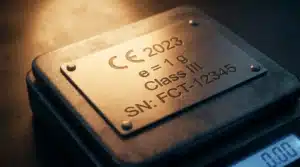
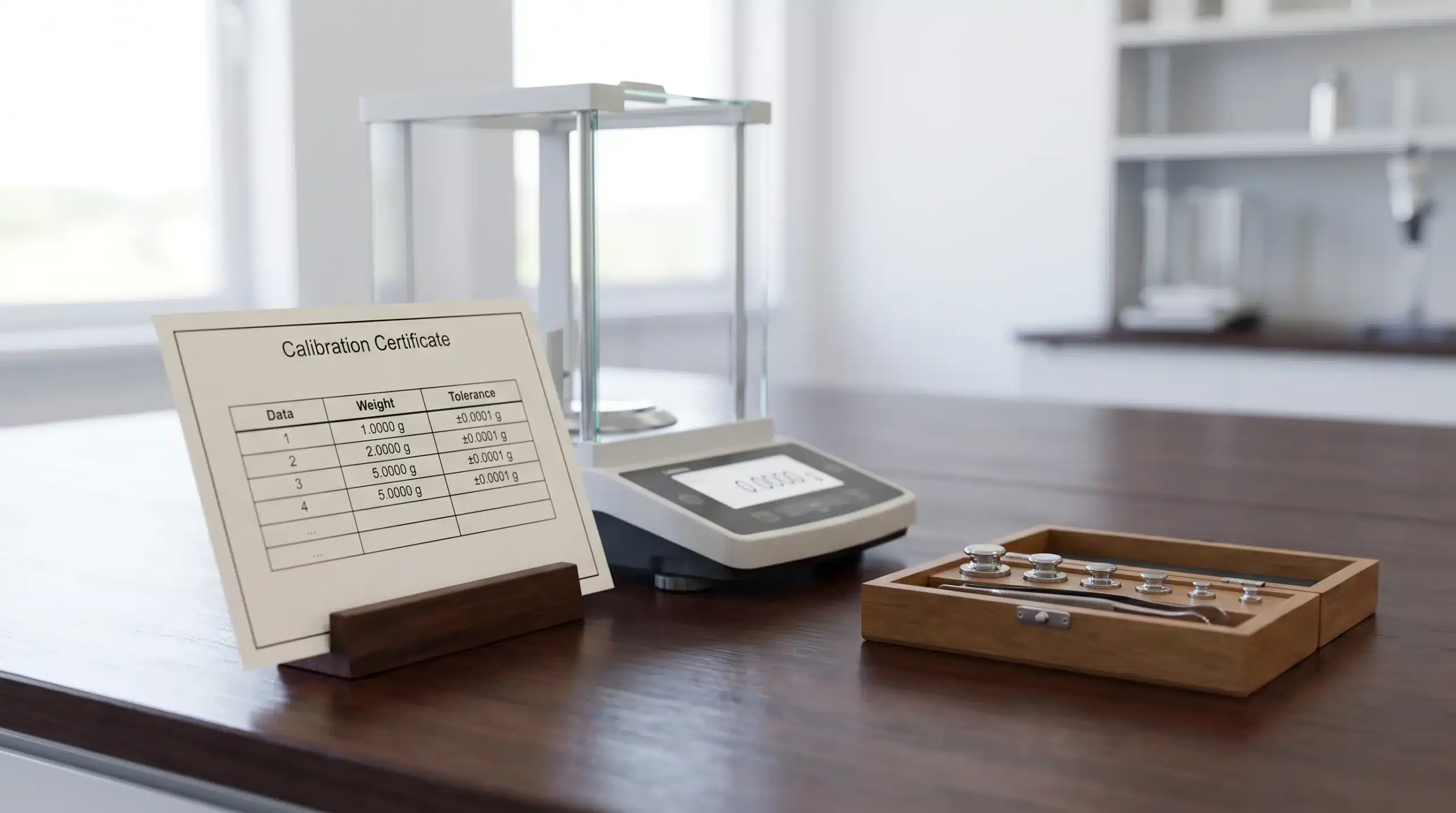 A calibration certificate is the paper trail behind every ISO 17025 accreditation claim — without it, an accuracy claim is just an assertion.
ISO 17025 Accreditation vs. ISO 9001: What's the Difference
Buyers often assume ISO 9001 certification and ISO 17025 accreditation are interchangeable proof of quality. They aren't, and confusing the two is one of the most common mistakes in a balance purchase.
ISO 9001 certifies a management system. It confirms a company has documented processes, a quality policy, and a framework for continuous improvement — it says nothing specific about whether a given measurement is technically accurate. A vendor can be ISO 9001 certified and still have no accredited capability to verify a balance's calibration.
ISO 17025 accreditation certifies technical competence to produce a specific, traceable measurement result. It's granted for defined scopes — particular instrument types, ranges, and methods — audited by an independent accreditation body, not self-declared. This is the distinction that actually matters when you're buying or servicing a precision balance: ISO 9001 tells you the company runs an organized business; ISO 17025 accreditation tells you a specific calibration result can be trusted and traced.
Some vendors hold both, which is a genuinely strong signal — an organized business and audited technical competence. But if a seller only mentions "ISO certified" without specifying which standard, ask directly whether they mean ISO 9001 or ISO 17025 accreditation. The two words "certified" and "accredited" get used loosely in sales material, and the difference is exactly the kind of detail that matters the day an auditor asks for proof.
Certified Weights and Calibration Weight Class
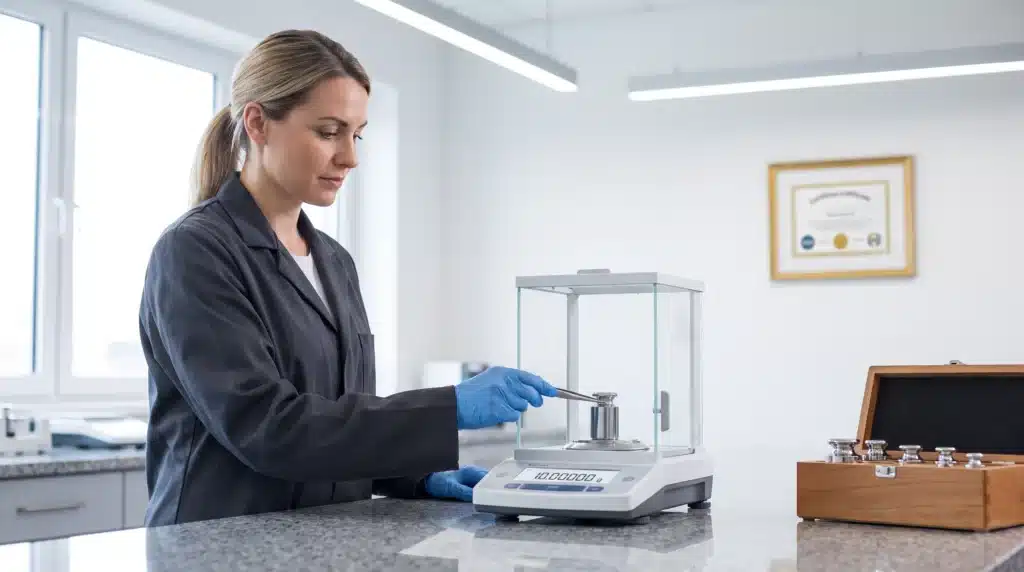
Calibration weights are used to check and calibrate balances and scales, and they come in materials including stainless steel, brass, and cast iron. Each weight is manufactured to a specific tolerance, and that tolerance is what determines its calibration weight class — see our OIML weight classes explained and ASTM weight classes explained guides for the full breakdown.
NIST, OIML, and ASTM are the three frameworks most often referenced alongside certified weights. Higher classes — Class 1 or ASTM Class 1 — are reserved for the most sensitive laboratory balances, while lower classes suit commercial or industrial scales with more tolerance for drift. Our calibration weights guide walks through the full range from milligrams to kilograms.
For anyone weighing very light objects, a US nickel — a coin, not to be confused with the chemical element nickel used in its alloy — weighs exactly 5.000 grams and has served as a rough reference for generations. See how much does a nickel weigh. Coins aren't a substitute for certified weights, but they illustrate the same principle: known mass compared against unknown mass.
In-House vs. Accredited Third-Party Calibration: Cost and Risk
Cost is always part of the conversation. Multiple industry market reports on the calibration services sector consistently put the savings from outsourcing to accredited third-party labs at roughly 20 to 35 percent lower internal maintenance cost compared to running the entire program in-house — a range corroborated across several independent market analyses of the calibration services market, not just one source.
The upfront cost of accredited services can be higher, but the long-term risk reduction often justifies it: a reputable, ISO 17025-accredited scale calibration company documents every check, adjustment, and deviation, leaving a paper trail that protects your business if a regulator ever comes asking. An out-of-tolerance instrument that slips through unnoticed for months is a far more expensive problem than the accreditation premium ever was — failed audits, rejected shipments, and lost customer trust all cost more than the calibration invoice.
On-Site and Truck Scale Calibration Under the Same Standard
Not every balance can be shipped to a lab for testing, which is where on-site calibration becomes essential. Large industrial equipment, floor scales, and truck scales require technicians to bring certified reference weights directly to the equipment.
Truck scales carry outsized consequences for accuracy, since freight billing, toll compliance, and regulatory reporting all depend on the number the scale produces. An accredited technician performing on-site calibration on a truck scale follows the same documented, traceable process used for a laboratory balance — just scaled up considerably in capacity. If your facility relies on equipment that can't be moved, ask whether a prospective provider offers on-site calibration as part of its standard service menu; it's easy to overlook until an inspector asks for the certificate.
The same standard extends to medical equipment calibration services and thermometer calibration services — a thermometer drifting by even half a degree can compromise a cold chain or a sterilization cycle, and the accreditation framework doesn't change based on which instrument is being tested.
Comparing Calibration Weight Classes at a Glance
| Weight Class | Typical Use | Tolerance Level |
|---|---|---|
| ASTM Class 1 | Analytical and microbalances in laboratories | Extremely tight, research-grade instruments |
| ASTM Class 2 | High-precision industrial balances | Very tight, common in pharmaceutical settings |
| OIML M1 / M2 | Commercial and trade scales | Moderate, suitable for retail and warehouse use |
| NIST Class F | Field and truck scale calibration | Wider tolerance for large-capacity equipment |
This table is a simplified reference — higher classes cost more because the manufacturing tolerance on the weight itself is tighter, and the documentation behind it is more extensive.
Do You Need ISO 17025 Accreditation for a Home or Kitchen Scale?
Not every reader buying a balance is running a pharmaceutical plant. Plenty of people just want to know how to calibrate a kitchen scale at home, and the underlying principle is the same, just at a much smaller scale of consequence: determine the scale's capacity, place a known reference mass on it, and adjust if the reading is off. Our how to calibrate a digital scale guide walks through the process step by step.
For home and hobbyist use, a nickel or a set of quarters works fine as an improvised reference mass. ISO 17025 accreditation matters when a reading has to hold up to a regulator, a customer contract, or a lab audit — not when you're checking a kitchen scale before baking. Know which situation you're in before you pay for accreditation you don't need, or skip it where you actually do.
This is also where scale calibration as a discipline ties together: ISO 17025 accreditation is the framework that makes a professional calibration claim verifiable, while the everyday calibration habits covered elsewhere on this site keep a household scale trustworthy without needing a certificate at all.
How to Verify a Provider's ISO 17025 Accreditation
Once you understand why ISO 17025 accreditation matters, the practical step is verifying it before you buy or sign a service contract:
- Ask for the certificate directly, not just a logo on the company's website. A logo alone proves nothing.
- Check the scope. Accreditation is granted for specific measurement types and ranges — a certificate covering jewelry scales may not extend to industrial floor scales. The scope section of the certificate says exactly where competence ends.
- Verify against the accreditation body's public directory. In the US, A2LA and ANAB both publish searchable directories of currently accredited labs — confirm the certificate is real and still active, not expired or revoked.
- Confirm traceability, not just accreditation. Ask whether the reference weights used trace back to NIST or an equivalent national metrology institute.
Larger operations managing many instruments often turn to calibration management software to track due dates, store certificates, and flag equipment approaching the end of its calibration interval — see our calibration management software comparison for platforms that automate this instead of relying on a filing cabinet.
Accreditation isn't a one-time badge, either. Accreditation bodies typically require periodic surveillance visits and a full reassessment on a multi-year cycle to keep a lab's ISO 17025 accreditation current — a certificate that hasn't been checked against the issuing body's directory in a while may be expired without anyone noticing until an auditor asks. That's exactly why step 3 above (checking the public directory rather than trusting a printed certificate alone) matters more than it sounds like it should.
Conclusion
Buying a balance without asking about accreditation is a little like buying a car without checking whether the brakes have ever been inspected. Understanding ISO 17025 accreditation gives you a framework for asking the right questions, whether you're outfitting a school lab, a pharmacy, or a manufacturing floor. From certified weights and calibration weight class designations to on-site calibration for truck scales and medical equipment calibration services, the underlying principle never changes: traceable, documented, accredited measurement protects your business, your compliance record, and your reputation — and that's exactly why ISO 17025 accreditation is worth checking for before you buy, not after.
Frequently Asked Questions
What is ISO 17025 accreditation?
ISO/IEC 17025 accreditation is the international standard that verifies a testing or calibration laboratory's technical competence — its staff qualifications, equipment, environmental controls, and documented procedures — through independent third-party audit.
Why does ISO 17025 accreditation matter when buying a balance?
It proves, through documented evidence, that the balance's calibration is traceable to a recognized national or international standard rather than just the seller's word. An accredited provider can show the chain of evidence behind an accuracy claim.
Is ISO 17025 accreditation worth the extra cost?
In regulated industries, usually yes — the reduced risk of failed audits or rejected shipments typically outweighs the higher upfront cost. Outsourcing to an accredited calibration provider is also commonly reported to cut internal maintenance costs by roughly 20 to 35 percent compared to running the program entirely in-house.
How do I verify a provider's ISO 17025 accreditation?
Ask for the accreditation certificate and its specific scope, then check the issuing accreditation body's public directory (such as A2LA or ANAB in the US) to confirm the certificate is current and actually covers the instrument type you need calibrated.
What is the difference between calibration weights and certified calibration weights?
Calibration weights are simply reference masses used to check a scale. Certified calibration weights come with documentation proving their mass was verified against a traceable standard, usually NIST, OIML, or ASTM — only certified weights support an ISO 17025 accreditation claim.
Can I calibrate a scale with coins instead of certified weights?
For casual, non-regulated use, yes — a US nickel weighs exactly 5.000 grams and works as a rough reference mass. Coins are not accepted as certified weights in any regulated, audited, or ISO 17025-accredited laboratory setting.
Does ISO 17025 accreditation expire?
Yes. It isn't a one-time badge — accreditation bodies require periodic surveillance visits and a full reassessment on a recurring cycle to keep a lab's ISO 17025 accreditation current. Always check the issuing body's public directory rather than relying on a printed certificate alone, since it may have lapsed since it was issued.
More Related Guides
- Calibration Management Software — scalecalibration.net/calibration-management-software-5-best-tools/ — the platforms that automate tracking accreditation-ready calibration records.
- Calibration Weights: Which Class & Size — scalecalibration.net/calibration-weights/ — the certified references every accreditation claim depends on.
- OIML Weight Classes Explained — scalecalibration.net/oiml-weight-classes/ — how weight-class grading works.
- NIST Handbook 44 Explained — scalecalibration.net/nist-handbook-44-explained/ — the US traceability rulebook behind commercial scales.
- How to Calibrate a Digital Scale — scalecalibration.net/how-to-calibrate-a-digital-scale/ — the everyday process for scales that don't need accreditation.