By Jayson · Updated August 2026 · 9-minute read
Pallet scales: pallet scales are low-profile floor platforms you roll a loaded pallet onto; pallet jack scales are hand pallet trucks with the scale built into the frame, so lifting and weighing happen in one motion. Most warehouses handling standard 48x40 pallets need a 5,000 lb capacity either way — the real decision is whether you're weighing pallets at a fixed station or moving them around the floor as you go.
Two products both get called "pallet scales" — a low-profile floor platform and a pallet jack with a scale built in — and they solve the same weighing problem in genuinely different ways. Picking the wrong one doesn't just waste money; it slows down exactly the workflow pallet scales were supposed to speed up.
In this guide
- What is a pallet scale?
- What is a pallet jack scale?
- Pallet scale vs. pallet jack scale: side-by-side
- How much capacity do you actually need?
- Manual vs. electric pallet jack scales
- Calibration and legal-for-trade requirements
- What to check before you buy
- Where pallet scales get used
- Real cost comparison: floor scale vs. jack scale over time
- Common pallet scale buying mistakes
- FAQ
What Is a Pallet Scale?
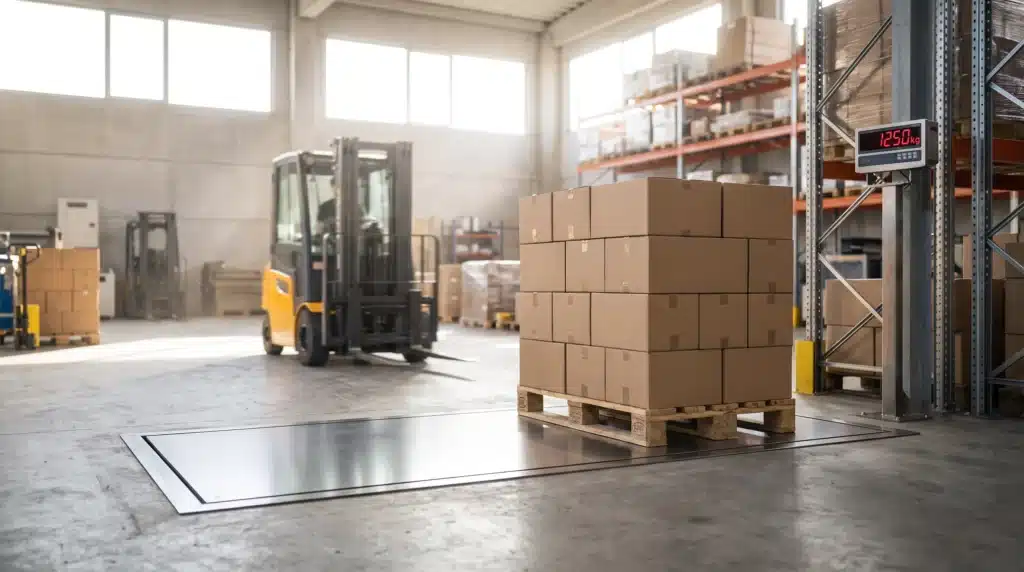
A pallet scale is a low-profile, heavy-duty platform built specifically for weighing a fully loaded pallet — the deck sits close to the floor, typically 3.5 to 5.5 inches high, so a pallet can be rolled or forked directly onto it without a ramp. The load distributes across four corner load cells, which is why platform size and load-cell placement matter more on pallet scales than on a general-purpose floor scale.
This low-profile design is the entire point. A standard floor scale built for drums or general freight can sit taller off the ground without causing problems, but pallet scales specifically need that low deck height so a loaded pallet jack or forklift can approach and set the load down without needing a ramp on either side.
A real example: Global Industrial's NTEP pallet scale is a 36" x 36" platform, 4 inches tall, rated for 2,500 lb capacity at 0.5 lb resolution, NTEP-approved for legal-for-trade use at 5,000 divisions, with 200% overload protection built into the load cells. Real price: $1,285. That's a fixed weighing station — the pallet comes to the scale, not the other way around.
What Is a Pallet Jack Scale?
A pallet jack scale combines a standard hand pallet truck with a digital scale built into the frame, so a worker lifts, moves, and weighs a load in one motion instead of transporting a pallet to a separate weighing station.
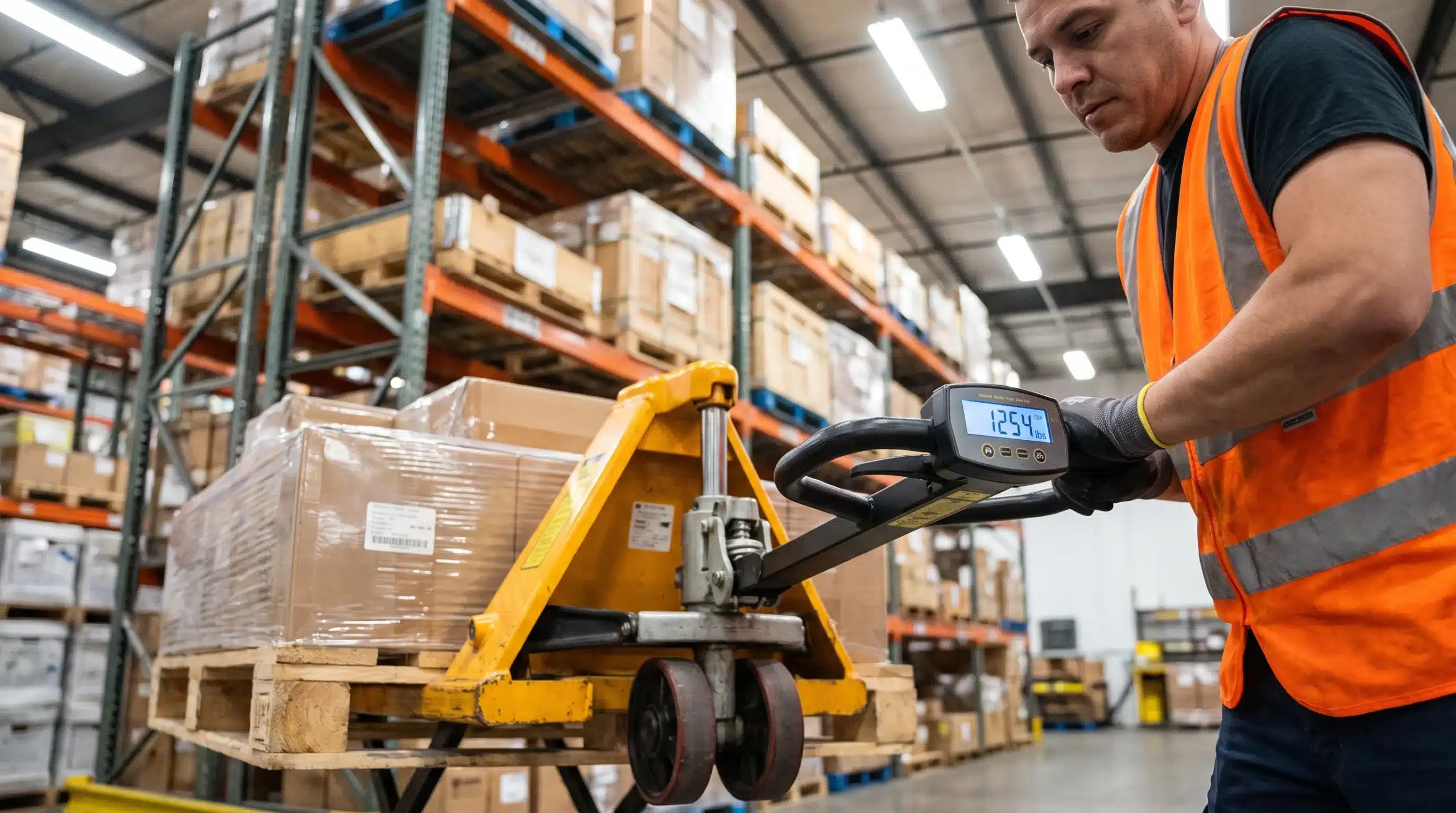
A pallet jack scale trades a fixed weighing station for mobility — the scale goes wherever the pallet does.
A real example: Rice Lake's RL-HPJ hand pallet jack scale uses four stainless steel IP68 load cells and an IP65 water-resistant indicator, rated for 5,000 lb capacity at 1 lb readability with a stated accuracy of ±0.1% of maximum capacity. The forks measure 48.75" x 26.75" and sit just 3.125" off the ground — standard pallet-jack profile. A rechargeable battery runs roughly 80 hours of continuous use or about a month of light daily use. Real price: $2,370.25 (MSRP $2,495). That's a mobile weighing tool — it goes to wherever the pallet already is.
Pallet Scale vs. Pallet Jack Scale: Side-by-Side
| Factor | Pallet Scale (Floor) | Pallet Jack Scale |
|---|---|---|
| Real example | Global Industrial NTEP Pallet Scale | Rice Lake RL-HPJ |
| Real price | $1,285 | $2,370.25 |
| Capacity | 2,500 lb (this model) | 5,000 lb |
| Platform/fork size | 36" x 36" | 48.75" x 26.75" |
| Height off floor | 4" | 3.125" (fork height) |
| Mobility | Fixed weighing station | Moves with the load |
| Best for | High-volume single-point weighing, shipping docks | Scattered weighing across a warehouse floor |
| Legal-for-trade capable | Yes (NTEP-approved) | Yes (model-dependent) |
Neither product is objectively "better" — a shipping dock weighing every outbound pallet at one chokepoint wants the fixed floor scale; a warehouse team weighing pallets scattered across different aisles wants the mobility a jack-style pallet scale provides. The honest answer to "which pallet scale should I buy" almost always comes down to where the pallets physically sit when they need weighing, not which product has the more impressive spec sheet.
How Much Capacity Do You Actually Need?
Sizing a pallet scale starts with the pallet, not the scale. A standard 48" x 40" GMA pallet — the dominant pallet size in North America, accounting for roughly a third of all pallets produced — supports 5,000 to 7,500 lb static load while sitting still, but only about 2,000 to 2,500 lb dynamic load while actually being moved or lifted. That dynamic figure is the one that matters for scale capacity, since a pallet jack scale weighs the load while lifting it.
Most standalone pallet floor scales and pallet jack scales on the market cluster around 2,500 lb or 5,000 lb capacity for exactly this reason — it comfortably covers a fully loaded standard pallet with headroom to spare. If your operation regularly handles oversized or double-stacked pallets, size up rather than running pallet scales near their rated maximum, which is where accuracy and load-cell lifespan both suffer.
Manual vs. Electric Pallet Jack Scales
Pallet jack scales come in both manual and electric drive versions, and the choice affects more than just price. Manual models cost less upfront and suit lower-volume operations where a worker isn't weighing and moving pallets constantly through a shift. Electric models cost more but reduce physical fatigue and speed up high-volume environments — genuinely useful when the same operator is running dozens of loads a day rather than a handful.
The scale mechanism itself — load cells, indicator, calibration requirements — works identically on both; the difference is purely in how the jack itself moves the load once it's been weighed. Whichever drive type you pick, both are still genuinely pallet scales at their core, just with a different transport mechanism attached.
Calibration and Legal-for-Trade Requirements
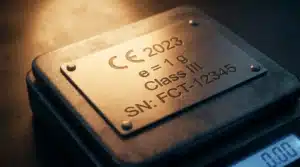
A pallet scale used to bill a customer or supplier by weight is a legal-for-trade scale, which means it needs NTEP approval and periodic weights and measures inspection — the Global Industrial example above is NTEP-approved at 5,000 divisions specifically to meet this requirement. Internal-use scales (inventory control, shipping-weight verification without customer billing) don't carry the same legal requirement, though the same accuracy principles still apply.
Either way, a pallet scale still needs regular preventive maintenance and calibration against certified weights — most warehouses schedule this at least annually, with more frequent checks for scales in harsh environments (temperature swings, forklift traffic, washdown areas) or handling legal-for-trade transactions. For scales that can't easily be moved off the floor, on-site calibration is the practical option, and it's worth asking any provider directly what calibration weight class and NIST-traceable documentation they use before signing a service contract.
What to Check Before You Buy
A few things worth confirming beyond the headline capacity number:
- NTEP certification, if you need legal-for-trade use. Confirm the specific model is NTEP-approved, not just "accurate" — those are different claims, and only one satisfies an inspector.
- Load cell IP rating. Washdown environments, outdoor use, and dusty warehouses all call for a higher IP rating than a clean, climate-controlled facility needs.
- Overload protection. A scale rated for 200% overload protection (like the Global Industrial example) survives an accidental overload far better than one without it — a real consideration in a busy warehouse.
- Battery life, for jack scales specifically. 80 hours of continuous use sounds like a lot until a scale is running two full shifts a day without a charging window built into the schedule.
- Printer and data-output options. If shipping documentation or inventory software needs the weight recorded automatically, confirm the model supports a printer attachment or data output before buying, not after.
Where Pallet Scales Get Used
Pallet scales show up anywhere goods move on pallets and someone needs to know the weight: warehouse receiving and shipping docks, manufacturing floors tracking material by weight, distribution centers billing freight by weight, and recycling or scrap operations weighing incoming and outgoing loads. The same core equipment — a load-cell platform or an integrated jack — adapts to all of these; what changes is capacity, certification requirements, and how mobile the pallet scales need to be for that specific environment.
Real Cost Comparison: Floor Scale vs. Jack Scale Over Time
The purchase price is only part of the real cost of owning pallet scales. The $1,285 Global Industrial floor scale and the $2,370 Rice Lake jack scale look like a straightforward price gap on paper, but the total cost of ownership depends heavily on how the equipment gets used day to day.
A fixed floor scale has almost no moving parts beyond the load cells themselves — no battery, no drive mechanism, nothing that wears from being pushed around a warehouse floor all shift. That translates into lower long-term maintenance costs for pallet scales used at a single chokepoint like a shipping dock. A pallet jack scale, by contrast, has to survive the same wear a regular pallet jack does — wheels, hydraulics or motor, battery cycles — on top of the scale mechanism itself, which is real additional maintenance overhead that pure floor-mounted pallet scales don't carry.
Where the jack scale earns back that overhead is labor time: eliminating a second trip to a stationary scale saves real minutes per pallet, which adds up fast in a high-volume operation. For a facility moving dozens of pallets a shift, that labor savings can outweigh the higher upfront cost and added maintenance of pallet scales built into a jack. For a facility with one or two weighing points and steady, moderate volume, the simpler floor-mounted pallet scales are usually the better long-term value.
Either way, the real total cost of ownership for pallet scales includes the calibration and maintenance visits discussed above, not just the sticker price and any repair bills — a cheaper scale that drifts out of tolerance and fails an inspection costs far more in downtime than the price difference between the two options ever would.
Common Pallet Scale Buying Mistakes
A few recurring mistakes show up whenever businesses shop for pallet scales without a clear sense of their actual workflow first:
- Buying capacity for the static load, not the dynamic load. A pallet rated for 7,500 lb sitting still can still exceed 2,500 lb while being lifted and weighed in motion — size pallet scales to the dynamic figure, not the higher static number on a pallet spec sheet.
- Skipping NTEP certification, then needing it later. Retrofitting a non-certified scale for legal-for-trade use often means replacing it outright rather than certifying it after the fact — decide this before buying, not after an inspector asks.
- Choosing a jack scale for a fixed weighing point. If pallets already funnel through one location, the mobility a jack scale offers goes unused while its higher price and added maintenance don't.
- Ignoring platform or fork size relative to pallet footprint. A pallet scale platform smaller than the pallet it's weighing risks an unbalanced load and an inaccurate reading, even when the capacity rating is technically sufficient.
- Treating "accurate out of the box" as "accurate forever." Every one of these pallet scales still needs a real calibration schedule — the factory-certified accuracy on delivery day isn't a permanent guarantee, and load cells drift with use regardless of how well-built the equipment was on day one.
Conclusion
Pallet scales and pallet jack scales solve the same problem — knowing what a loaded pallet weighs — from two different directions. A fixed floor scale like the Global Industrial NTEP model suits a chokepoint where pallets already funnel through, at real capacities from 2,500 lb and real prices starting around $1,285. A pallet jack scale like the Rice Lake RL-HPJ brings the weighing station to the load instead, at 5,000 lb capacity and a real price around $2,370. Match the choice to how your pallets actually move through the facility, size for the dynamic load a standard 48x40 pallet puts on the equipment while it's being lifted, and keep whichever one you choose on a real calibration schedule — the specs on the box only matter if the scale still reads true a year later. A quick gut check before you buy: picture where the pallet physically sits when it needs weighing. If it's already funneling through one point, buy the floor scale. If it's scattered across a warehouse floor, buy the jack. That single question resolves most of the decision before price ever enters the conversation.
Frequently Asked Questions
What's the difference between a pallet scale and a pallet jack scale?
A pallet scale is a low-profile floor platform (typically 3.5-5.5 inches tall) that a loaded pallet is rolled or forked onto for weighing. A pallet jack scale is a hand pallet truck with a digital scale built into the frame, so it lifts, transports, and weighs a pallet in one motion.
How much weight can a standard pallet scale handle?
Most pallet scales are rated between 2,500 and 5,000 lb capacity, matching the static load range of a standard 48x40 GMA pallet (roughly 5,000-7,500 lb static, 2,000-2,500 lb dynamic while in transit).
Do pallet scales need to be NTEP certified?
Only if the scale is used for legal-for-trade transactions — billing a customer or supplier by weight. For internal inventory control or shipping-weight verification, NTEP certification isn't legally required, though it's still a useful accuracy signal.
How often should a pallet scale be calibrated?
Most warehouses calibrate a pallet scale annually at minimum, with more frequent checks for scales handling legal-for-trade transactions or operating in harsh conditions. Daily spot-checks with a known weight help catch drift between formal visits.
Is a manual or electric pallet jack scale better?
Manual pallet jack scales cost less and suit lower-volume operations. Electric models cost more but reduce operator fatigue and speed up high-volume environments where the same worker is weighing and moving dozens of pallets a shift.
More Related Guides
- Best Floor Scale for Warehouse — scalecalibration.net/best-floor-scale-for-warehouse/ — extreme-temperature floor scale models compared.
- Heavy-Duty Calibration Services — scalecalibration.net/heavy-duty-calibration-services/ — real fee data for on-site industrial calibration.
- Preventive Maintenance for Scales — scalecalibration.net/preventive-maintenance-for-scales/ — the real financial cost of skipping scheduled calibration.
- Calibration Weights — scalecalibration.net/calibration-weights/ — the certified references a technician uses.
- Legal for Trade Scales — scalecalibration.net/legal-for-trade-scales/ — what NTEP approval actually requires.