By Jayson · Updated August 2026 · 9-minute read
Quick answer: EU weighing scale regulations are built around a single core law — Directive 2014/31/EU, the NAWI Directive — which requires any non-automatic weighing instrument placed on the EU market to carry a CE mark and a supplementary "M" metrology marking, meet one of four accuracy classes, and be assessed for conformity before sale. The harmonised standard EN 45501 sets the detailed technical requirements, and enforcement sits with each member state's own national market surveillance authority.
Unlike the UK's patchwork of separate acts and statutory instruments, EU weighing scale regulations run through one recast directive, applied consistently across all 27 member states. That single-law structure sounds simpler than it actually is in practice — the directive covers placing an instrument on the market, but day-to-day enforcement and in-service checks are still handled nationally, which is exactly the kind of detail that trips up businesses operating across more than one EU country.
This guide covers what EU weighing scale regulations actually require: the directive itself, what the CE and M markings mean, how conformity is assessed before a scale ever reaches a shop, the four accuracy classes, who enforces compliance, and where to verify anything here directly against the official EU source.
In this guide
- The law behind EU weighing scale regulations
- What "placing on the market" covers — and what it doesn't
- CE marking and the M mark, briefly
- Conformity assessment: how a scale gets approved before sale
- The four accuracy classes
- Manufacturers, importers, and distributors: who's responsible
- Who enforces EU weighing scale regulations
- Verify this yourself: official sources
- Common mistakes
- FAQ
The Law Behind EU Weighing Scale Regulations
The core of EU weighing scale regulations is Directive 2014/31/EU, formally "on the harmonisation of the laws of the Member States relating to the making available on the market of non-automatic weighing instruments." It's a recast of the earlier Directive 2009/23/EC, and it became applicable across the EU on 20 April 2016.
A non-automatic weighing instrument (NAWI) is a weighing instrument that requires human intervention during the weighing process — someone has to load it, or actively initiate the reading. That covers the overwhelming majority of commercial scales: shop counters, market-stall scales, warehouse platform scales, and laboratory balances used commercially. Automatic weighing instruments (like automated checkweighers on a production line) sit under a separate legal framework entirely.
Directive 2014/31/EU sets out essential requirements in Annex I that a NAWI must meet before it can legally be sold anywhere in the EU. Rather than spelling out every technical detail in the directive text itself, the EU relies on a harmonised standard — EN 45501:2015, "Metrological aspects of non-automatic weighing instruments" — published by CENELEC. A manufacturer who builds a scale to EN 45501 gets the benefit of a presumption of conformity with the directive's essential requirements, which is why EN 45501 compliance is the practical benchmark most manufacturers actually build and test against, rather than working from the directive's Annex I text directly.
What "Placing on the Market" Covers — and What It Doesn't
This is the distinction that causes the most confusion about EU weighing scale regulations, and it's worth being precise about it.
Directive 2014/31/EU governs placing an instrument on the market and putting it into service — the moment a scale is manufactured, imported, or first made available for use. Once a CE- and M-marked NAWI clears that stage, it can be sold and used anywhere in the EU without a second round of national approval, because the whole point of the directive is to let compliant equipment move freely across the single market.
What the directive does not directly govern is ongoing in-service verification — the periodic re-checking of a scale that's already in use, to confirm it hasn't drifted or been tampered with since it was first placed on the market. That responsibility sits with each member state's own national legal metrology authority, and the specific rules, intervals, and enforcement bodies genuinely differ from one EU country to the next. A business operating scales in more than one EU country should expect to deal with more than one national metrology authority for in-service checks, even though the original CE/M-marked equipment itself is recognised identically across all of them.
This is a genuinely common source of confusion for businesses new to EU weighing scale regulations: a scale bought in Germany with a valid CE and M marking doesn't need to be re-approved to be used in France, Spain, or Ireland — but once it's actually in service in any of those countries, that country's own national inspectorate is who checks it going forward, not a central EU body and not the country where it was originally purchased. For a business running the same model of scale across several EU locations, this can mean tracking several different national inspection schedules for equipment that is, on paper, identical.
CE Marking and the M Mark, Briefly
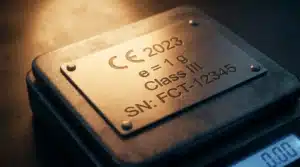
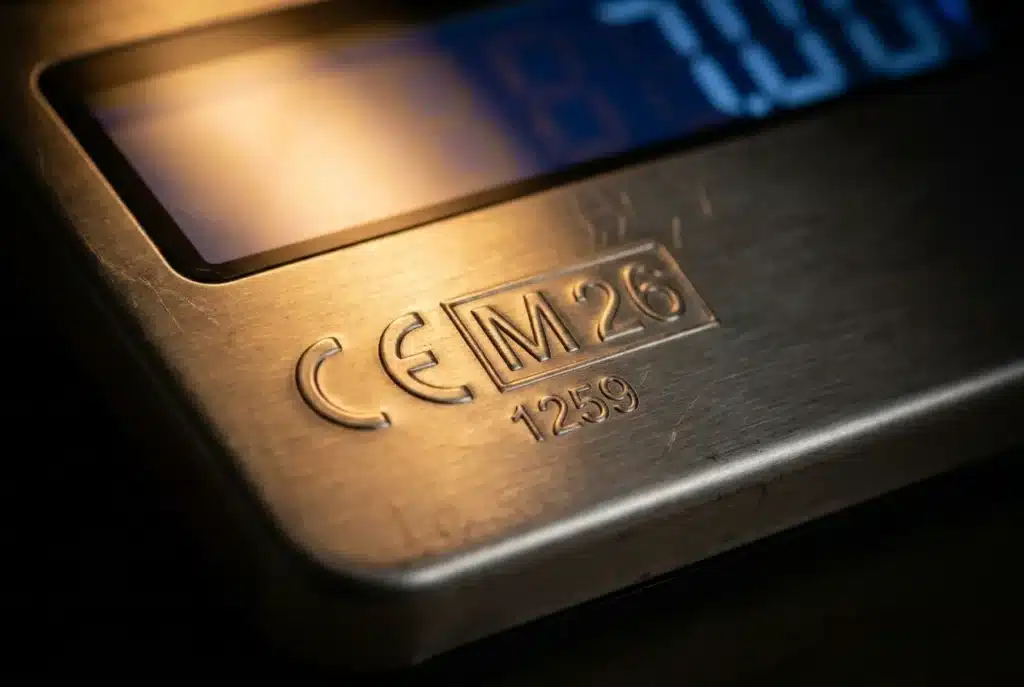
Every NAWI compliant with EU weighing scale regulations carries two markings side by side: the CE mark, and directly after it, a supplementary metrology marking — a capital M plus the last two digits of the year it was affixed, enclosed in a rectangle matching the CE mark's height. Immediately following both, the instrument carries the identification number of the notified body that was involved in production control.
The manufacturer is legally responsible for affixing all three elements, visibly, legibly, and indelibly, to the instrument itself or its data plate, before the scale is placed on the market. This guide covers the essentials; the full breakdown of exactly what each element means, how to spot a fake, and what a genuine EU Declaration of Conformity should contain gets its own dedicated guide in CE and M marking on weighing scales.
Conformity Assessment: How a Scale Gets Approved Before Sale
Before a NAWI ever reaches a shop shelf, its manufacturer has to put it through a conformity assessment procedure — proof, checked by an independent notified body, that the design and production actually meet the essential requirements in Annex I. This step is what genuinely separates EU weighing scale regulations from a simple self-certification scheme: an outside body has to actually check the work before the CE and M markings can legally go on the instrument.
For most NAWIs, this happens through EU-type examination (Module B), where a notified body examines a representative sample of the instrument's design and issues an EU-type examination certificate confirming it meets the requirements. Module B is then combined with a second module covering the actual production process: either Module D (the manufacturer operates an approved quality-assurance system, with the notified body auditing that system on an ongoing basis) or Module F (the notified body directly verifies conformity on the finished products themselves, a stricter third-party check). For one-off or very low-volume instruments, a manufacturer can instead use unit verification (Module G), where a notified body examines and verifies each individual instrument.
The specific combination a manufacturer chooses affects how much ongoing notified-body involvement continues after the initial type approval — which is exactly why the notified body number on a scale's data plate is worth checking, not just treating as a formality.
The Four Accuracy Classes
EU weighing scale regulations sort every NAWI into one of four accuracy classes, set out in Annex I of Directive 2014/31/EU:
| Class | Precision level | Typical use |
|---|---|---|
| Class I (Special) | Highest | Precious metals, gemstones, high-precision laboratory work |
| Class II (High) | High | Pharmacy dispensing, fine chemical work, precision retail |
| Class III (Medium) | Medium | General retail and commercial weighing |
| Class IIII (Ordinary) | Lowest | Bulk materials, ballast, waste and scrap weighing |
Each class carries its own defined verification scale interval and minimum capacity requirements in the directive's Annex I tables — the practical effect is that a business buying a scale for general retail use should be looking at Class III as standard, while pharmacies and precious-metal dealers need to specifically confirm Class I or II before purchase rather than assuming any CE-marked scale is automatically precise enough for their use case.
Manufacturers, Importers, and Distributors: Who's Responsible
A distinctive feature of EU weighing scale regulations, compared with older product-safety frameworks, is that legal responsibility doesn't rest with the manufacturer alone. Directive 2014/31/EU explicitly defines and assigns obligations to three separate categories of economic operator:
- Manufacturer — the person or company that manufactures the instrument, or has it designed or manufactured, and markets it under their own name or trademark. Carries the primary responsibility for conformity assessment and affixing CE/M marking.
- Importer — a person or company established within the EU who places an instrument from a non-EU country onto the EU market. Must verify the manufacturer has already carried out the correct conformity assessment before importing.
- Distributor — anyone else in the supply chain, other than the manufacturer or importer, who makes the instrument available on the market. Must check the instrument carries the required markings and documentation before selling it on.
In practice, this means a UK or non-EU manufacturer's EU-based importer can share real legal exposure if a non-compliant scale reaches the EU market — it isn't purely the original manufacturer's problem once the instrument crosses the border. This shared-responsibility structure is a deliberate feature of EU weighing scale regulations, not an oversight: it exists because it's far easier for a national market surveillance authority to act against a company physically established within the EU than to pursue a manufacturer based entirely outside it, so the law spreads accountability across the whole supply chain rather than leaving enforcement dependent on reaching an overseas manufacturer directly.
Who Enforces EU Weighing Scale Regulations
 In-service checks on scales already in use — like this market-stall scale — are carried out by each member state's own national metrology authority, not by a single EU-wide body.
Enforcement is the part of EU weighing scale regulations most likely to surprise a business used to a single national regulator. There's no single central EU enforcement body for weighing instruments. Instead, each member state designates its own national market surveillance authority, operating under the common EU-wide framework set out in Regulation (EU) 2019/1020 on market surveillance and compliance of products. That regulation gives national authorities shared powers — including investigating suspected non-compliance, requiring corrective action from economic operators, and restricting, withdrawing, or recalling non-compliant instruments from the market — while leaving the specific penalties to national law.
Directive 2014/31/EU requires member states to set penalties for non-compliance that are "effective, proportionate and dissuasive," but it deliberately doesn't fix a single EU-wide fine schedule — the actual amounts and enforcement procedures vary by country, which matters if your business operates weighing equipment across more than one EU market.
Verify This Yourself: Official Sources
EU legislation and enforcement practice can change, and this guide reflects research current as of August 2026. Before making a compliance or purchasing decision based on EU weighing scale regulations, check directly with:
- EUR-Lex — Non-automatic weighing instruments (legal summary) — the official EU legal database's plain-language summary of Directive 2014/31/EU.
- European Commission — Non-automatic weighing instruments (NAWI) — the Commission's own page covering harmonised standards, including EN 45501.
- EUR-Lex — full text of Directive 2014/31/EU — the complete legal text, including Annex I essential requirements.
See our site disclaimer for how we handle regulatory and standards content generally.
Common Mistakes
- Assuming EU weighing scale regulations mean a single EU-wide enforcer checks compliance. Enforcement is national, under the shared Regulation 2019/1020 framework — there's no single EU inspector network.
- Treating CE marking alone as sufficient proof of compliance. A genuine NAWI needs the CE mark, the M mark, and the notified body number together — CE marking by itself isn't the full picture for a weighing instrument.
- Confusing "placing on the market" approval with ongoing in-service compliance. A scale's original CE/M marking doesn't exempt it from national in-service verification requirements once it's actually in use.
- Assuming any CE-marked scale is precise enough for a pharmacy or precious-metals business. Confirm the specific accuracy class (Class I or II) rather than assuming general retail Class III equipment is adequate.
- Overlooking importer and distributor obligations. Under EU weighing scale regulations, importers and distributors carry real legal responsibility too, not just the original manufacturer.
- Assuming penalties for non-compliance are the same across every EU country. Directive 2014/31/EU sets a general standard (effective, proportionate, dissuasive) but leaves the actual fines and procedures to each member state.
Frequently Asked Questions
What are the main EU weighing scale regulations? The core law is Directive 2014/31/EU, the NAWI Directive, which governs placing non-automatic weighing instruments on the market. It's backed by the harmonised standard EN 45501 and enforced under the EU-wide market surveillance framework in Regulation (EU) 2019/1020.
How do I check if a weighing scale is NAWI Directive compliant? Look for a CE mark plus a supplementary metrology marking — a capital M with the last two digits of the year of manufacture, in a rectangle the same height as the CE mark — followed by the notified body's identification number. All three should be visible, legible, and permanently affixed.
What are the NAWI accuracy classes? Four classes under Annex I of Directive 2014/31/EU: Class I (special), Class II (high), Class III (medium), and Class IIII (ordinary), each with its own verification scale interval and capacity rules.
Does a compliant weighing scale in one EU country automatically work in every EU country? Yes, for placing it on the market — a CE- and M-marked NAWI can be sold and used anywhere in the EU without further national approval. In-service verification and periodic re-inspection, though, remain the responsibility of each member state's own national authority.
Who enforces EU weighing scale regulations? Each member state's own national market surveillance authority, operating under the common Regulation (EU) 2019/1020 framework. There's no single central EU enforcement body.
What happens if a business uses a non-compliant weighing scale in the EU? The national market surveillance authority can require corrective action, restrict or withdraw the instrument, and impose penalties on the responsible economic operator. Directive 2014/31/EU requires penalties to be effective, proportionate, and dissuasive, but the specifics vary by country.
More Scale Calibration Guides
- UK Weighing Scale Regulations — scalecalibration.net/uk-weighing-scale-regulations/ — the equivalent UK framework, for comparison.
- CE and M Marking on Weighing Scales — scalecalibration.net/ce-and-m-marking-on-weighing-scales/ — the full detail on both markings, notified body numbers, and the EU Declaration of Conformity.
- NAWI Directive 2014/31/EU: Requirements for Weighing Instruments — scalecalibration.net/nawi-directive-2014-31-eu/ — a deeper technical breakdown of the directive itself.
- Scale Calibration Services — scalecalibration.net/scale-calibration-services/ — what professional calibration actually costs.
- Calibration Weights: Which Class & Size — scalecalibration.net/calibration-weights/ — certified weights for servicing any accuracy class of scale.
- Best Scales — scalecalibration.net/category/best-scales/ — buying guides across scale types.