
By Jayson · Updated August 2026 · 9-minute read
Heavy-duty calibration services: the fees that most often surprise businesses signing an annual contract are accreditation premiums (commonly 120% of standard pricing), on-site wait-time charges (around $100/hour), rush/expedite surcharges (often 150% of the standard rate), minimum order charges ($75+), cleaning surcharges (~$95), and handling fees (~$10) — all confirmed against a real published lab fee schedule. Read the full contract, not just the quote summary, before signing.
If you've ever signed an annual contract for heavy-duty calibration services and later noticed a bill far larger than the quote promised, you're not alone. A single "wait time" clause can bill facilities real money for a technician standing idle because equipment wasn't prepped on time — and few businesses read that line before signing. This guide breaks down where hidden fees actually live in a calibration contract, using real published pricing from an accredited lab as the benchmark, not estimates.
In this guide
- Why heavy-duty calibration services need closer scrutiny
- Where hidden fees actually live in a contract
- Real fee schedule: what one accredited lab actually charges
- Truck scale calibration: a case study in contract complexity
- What to ask before signing a contract
- Certified weights, weight class, and why they affect cost
- Balance and medical equipment calibration services
- Tracking contracts with software
- Between annual visits: routine checks you can do yourself
- How to compare quotes
- FAQ
Why Heavy-Duty Calibration Services Need Closer Scrutiny
Truck scales, industrial floor scales, and large tank systems aren't small tabletop devices — they carry heavier consequences when something goes wrong. An inaccurate scale can damage a business directly, particularly when that scale determines billing weight for freight, raw materials, or finished goods.
When you sign an annual contract for heavy-duty calibration services, you're trusting a vendor to keep equipment within tolerance for twelve months. That trust deserves a contract you can actually read line by line — not one where the real costs live in an appendix or a footnote reading "standard rates apply."
Where Hidden Fees in Heavy-Duty Calibration Services Contracts Actually Live
Most heavy-duty calibration services agreements look simple on the cover page. The charges that most often escape notice during contract review:
- Accreditation premiums — ISO/IEC 17025 accredited certificates commonly cost more than standard, non-accredited ones.
- Regulatory compliance premiums — nuclear-grade or defense-related certifications (NQA-1, 10CFR50) run even higher.
- On-site wait time — technicians performing on-site calibration may bill hourly if your facility isn't ready when they arrive.
- Rush or guaranteed turnaround fees — expect a real surcharge if you need faster service than the standard window.
- Cleaning surcharges — a fee applies when equipment needs deep cleaning before calibration work can even begin.
- Minimum order values — standard minimums apply per order, and specialty work can push them higher.
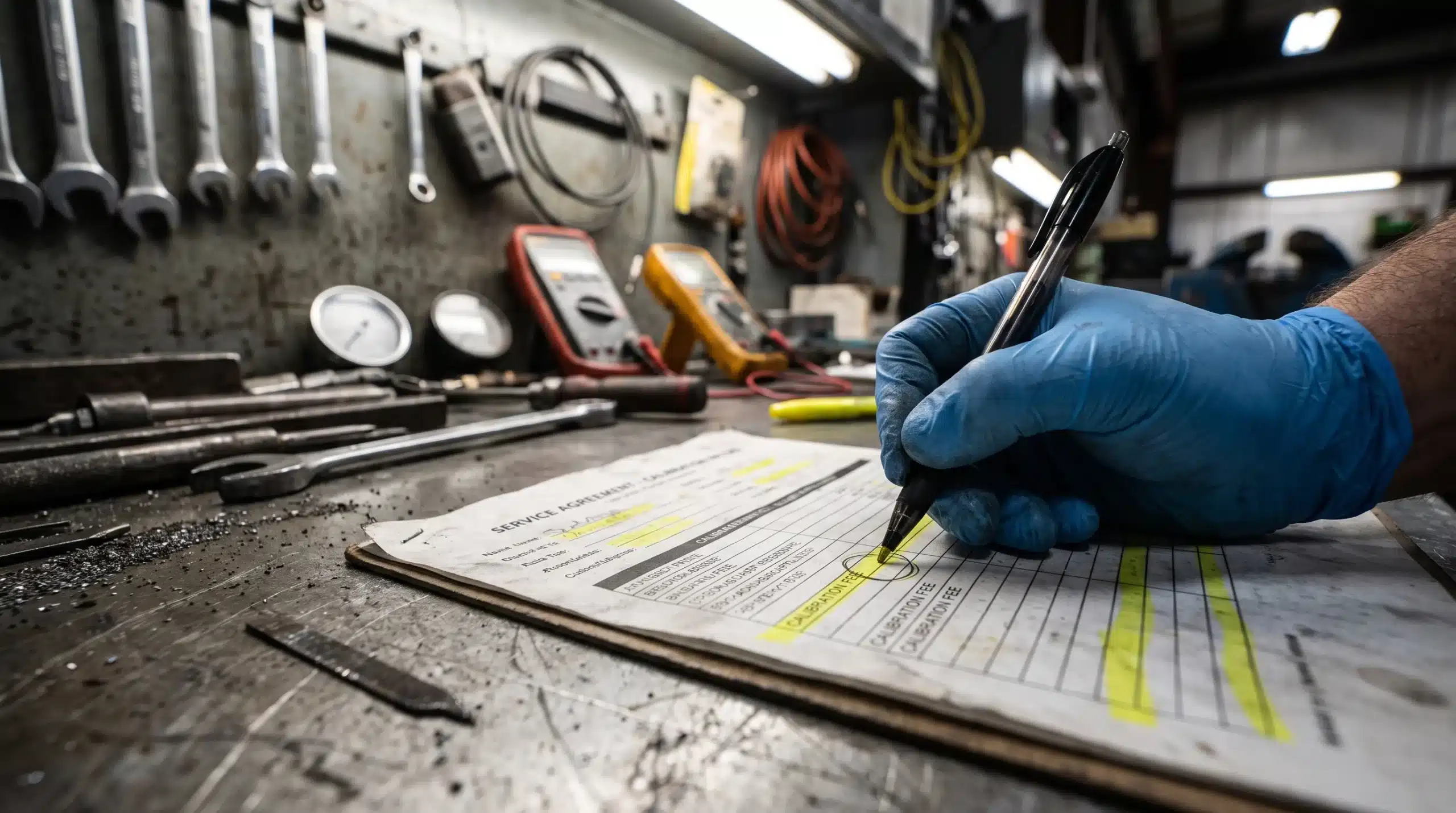 Real fee schedules exist for exactly this reason — the numbers below come from a published, verifiable lab terms-of-service document, not an estimate.
Real Fee Schedule: What One Accredited Lab Actually Charges
Rather than estimate what heavy-duty calibration services typically cost, here's a real, published fee schedule from Applied Technical Services, an accredited calibration lab (A2LA-accredited, an ILAC member) — confirmed directly against their Calibration Terms of Service:
| Fee Type | Actual Published Rate | Why It Gets Missed |
|---|---|---|
| ISO/IEC 17025 Accreditation | 120% of standard calibration price, per item | Listed as a certificate option, not framed as a cost multiplier |
| Nuclear/NQA-1 Compliance | 150% of standard price, $200 minimum order | Buried in industry-specific fine print |
| On-Site Wait Time | $100.00/hour | Assumes the facility will always be ready on arrival |
| Rush/Expedite Service | 150% of the applicable calibration charge, $25 minimum expedite fee | Only disclosed if you specifically ask about turnaround |
| Cleaning Surcharge | ~$95.00 (one hour of repair labor) | Framed as "conditional," easy to overlook |
| Minimum Order Charge | $75.00 standard | Only relevant on small or single-item orders |
| Handling/Shipping Fee | $10.00 | Applied to all shipments, even with your own shipping account |
One provider's rates aren't universal — every lab sets its own pricing for heavy-duty calibration services — but this table shows the real shape of a calibration contract's hidden costs, verified against an actual published document rather than a guess. Default recalibration interval, per the same document, is 12 months unless the customer specifies otherwise in writing.
What "Standard" Calibration Actually Includes
Before comparing add-on fees, it's worth knowing what a baseline heavy-duty calibration services quote should already cover, so you can spot when a provider is charging extra for something that ought to be included by default:
- NIST-traceable results. Reputable providers issue calibration traceable to NIST as standard, not as a paid upgrade — if a quote lists "traceability" as an optional add-on, that's worth questioning directly.
- As-found and as-left data. A real calibration record shows the instrument's reading before any adjustment and after — not just a final pass/fail stamp. Both numbers matter for your own drift tracking over time.
- Measurement uncertainty data. A proper certificate states the uncertainty of the measurement itself, not just the reading.
- A listing of the reference standards used. You should be able to see exactly which certified weights or references were used to test your equipment, not just take the result on faith.
- Basic cleaning. Routine cleaning as part of the service is standard; it's deep cleaning of a neglected instrument that triggers the surcharge discussed above.
If a heavy-duty calibration services quote doesn't include these five items by default, that's a bigger red flag than any single line-item fee — it suggests the provider is treating basic documentation as an upsell rather than a baseline expectation.
Truck Scale Calibration: A Case Study in Contract Complexity
Truck scale calibration deserves its own scrutiny because these systems are large, load-bearing, and often located outdoors where weather adds wear and tear. A truck scale that drifts out of tolerance can misreport tonnage on every load that crosses it, multiplying a small measurement error into a large financial one over a busy month.
Annual contracts for truck scale calibration frequently bundle travel charges, on-site calibration labor, and certified-weight transport as separate line items. Ask your provider directly whether certified calibration weights are transported at no additional cost — heavy test weights for truck scales aren't cheap to move, and some vendors pass that cost along quietly.
This is exactly the kind of equipment where heavy-duty calibration services contracts diverge most from a simple tabletop-instrument quote: the on-site wait-time clause matters far more when a technician has to bring a truck's worth of certified weights to your yard than when a small instrument ships to a lab in a box. If your facility can't get the scale cleared and accessible the moment the technician arrives, that hourly charge accrues fast on a job that already takes longer than a bench calibration.
What to Ask Before Signing a Heavy-Duty Calibration Services Contract
Before committing to any provider for a full year, ask direct questions rather than accepting a summary quote:
- Does the quote include ISO/IEC 17025 accreditation, or is that billed as a separate premium?
- What is the hourly wait-time charge if your team is delayed on the day of service?
- Is the default recalibration interval 12 months, and can that be adjusted in writing?
- What qualifies as "rush" service, and is the surcharge disclosed in the base contract, not just on request?
- Are certified weights and their transport included, or billed separately?
Certified Weights, Weight Class, and Why They Affect Cost
Certified calibration weights are graded by calibration weight class (Class F, Class M, and others), and the class required for your equipment directly affects price. Heavy-duty truck scales typically require larger, industrial-grade certified weights, while a lab balance may only need small Class F reference weights — see our calibration weights guide for the full breakdown.
For light home or kitchen equipment, a US nickel (5.000 grams exactly) or quarter (5.670 grams) works as a rough substitute — see how much does a nickel weigh. Heavy-duty industrial equipment demands certified weights, not pocket change, because the tolerances involved are far less forgiving.
Balance and Medical Equipment Calibration Services
Not every heavy-duty calibration services contract covers only floor scales and truck scales — the same hidden-fee logic applies across adjacent equipment categories. Laboratories rely on balance calibration for precision instruments, and hospitals depend on medical equipment calibration to keep diagnostic tools within legal tolerance — see our scale calibration accuracy requirements guide for the real published data on how often medical scales fail.
These specialized categories often carry their own higher minimum order values, because the certification standards are stricter. If your annual contract bundles industrial scales with lab balances or medical devices, request a fee breakdown for each category separately rather than accepting one combined total.
Tracking Contracts with Software
Many heavy-duty calibration services providers now use calibration management software to track intervals, certificates, and due dates across a fleet of instruments. For any business managing multiple pieces of heavy-duty calibration services equipment, this software layer should make your invoice more predictable, not less.
Ask whether your provider's software generates a transparent line-item report for every service visit. If the software exists but the invoice still arrives as a lump sum, that's a sign the fees discussed above are being folded into a single number on purpose.
Between Annual Visits: Routine Checks You Can Do Yourself
Between visits from your heavy-duty calibration services provider, it helps to know how to run a basic check on your own equipment — see our how to calibrate a digital scale guide for the full walkthrough. Determine the scale's maximum capacity, place a known certified weight (or a close substitute for lighter equipment), and check the reading against the expected value. Wait for full stability before recording any number — sensitive load cells are prone to momentary fluctuation.
This won't replace a full annual service visit for heavy-duty equipment, but it catches obvious drift early and gives you a better sense of what your provider is actually doing during a full visit.
How to Compare Quotes for Heavy-Duty Calibration Services
Once you've collected two or three quotes, the comparison isn't as simple as looking at the bottom-line number — a lower headline price with vague terms can easily end up costing more than a higher, fully itemized one. A few practical steps:
- Request the full terms of service document, not just the quote. A one-page quote summary almost never shows accreditation premiums, wait-time rates, or minimum order values — those live in the terms document, exactly like the real example in the table above.
- Normalize for accreditation. If one quote is for standard calibration and another is accredited, add roughly 20% to the standard quote before comparing, since that's the real-world gap.
- Ask each vendor the same five questions from the section above and compare answers side by side, not just prices.
- Check last year's actual invoice against last year's quote, if you're renewing with an existing provider. The gap between the two documents often reveals exactly where hidden fees crept in over the year.
- Weigh response time against price. A cheaper heavy-duty calibration services contract that leaves a truck scale out of service for two extra weeks can cost more in lost billing accuracy than the savings on the invoice.
Pay close attention to whether on-site visits historically included wait-time charges, whether rush fees applied even once during the year, and whether a minimum order value affected any single-instrument service call. Added together, these line items often explain a surprising share of total annual spend.
Conclusion
Heavy-duty calibration services protect your equipment, your compliance standing, and ultimately your bottom line — but only when the annual contract behind them is transparent. An inaccurate scale can damage a business directly; an inaccurate or vague pricing structure can damage your budget just as easily, and the two problems compound each other when a provider's fee schedule is genuinely hard to read.
Before signing your next renewal, request a full line-item breakdown, ask about accreditation premiums, wait-time charges, and minimum order values by name, and compare that document against your actual annual invoice — not just last year's quote. Spotting hidden fees in heavy-duty calibration services contracts isn't difficult once you know exactly where to look, and the real published fee schedule in this guide is a genuine starting point for what to look for, not a hypothetical. Any reputable heavy-duty calibration services provider should be able to answer every question in this guide without hesitation.
Frequently Asked Questions
Is switching heavy-duty calibration services providers worth it if my current contract has hidden fees?
Often yes. If your current provider won't produce a transparent, itemized breakdown of accreditation, wait-time, and rush fees when asked directly, that reluctance is itself useful information — a competing provider willing to show real numbers up front is usually the better long-term partner, even before comparing the final price.
What are the most common hidden fees in heavy-duty calibration services contracts?
Accreditation premiums (typically 120% of standard pricing), on-site wait-time charges billed hourly (often around $100/hour), rush service surcharges (often 150% of the standard rate), and minimum order charges that inflate small single-item requests.
How much does an ISO/IEC 17025 accredited certificate typically cost compared to standard?
Based on one published accredited lab's real fee schedule, accredited certifications are billed at 120% of the standard calibration price, per item — a 20% premium over a non-accredited certificate.
Is on-site calibration more expensive than sending equipment to a lab?
On-site calibration avoids shipping costs but can trigger hourly wait-time fees — around $100 per hour in one published real-world example — if the facility isn't fully prepared when the technician arrives.
How often should heavy-duty industrial scales be recalibrated?
Most contracts default to a 12-month recalibration cycle unless a different interval is specified in writing by the customer. Confirm your exact schedule rather than assuming a shorter or longer window.
What questions should I ask before signing an annual calibration contract?
Ask whether the quote includes accreditation or bills it separately, what the hourly wait-time charge is, whether the default interval is 12 months and adjustable in writing, what qualifies as rush service and its surcharge, and whether certified weight transport is included or billed separately.
More Related Guides
- ISO 17025 Accreditation: A Buyer's Guide — scalecalibration.net/iso-17025-accreditation-a-buyers-guide/ — what the accreditation premium actually buys you.
- NIST Calibration Certificate Cost — scalecalibration.net/nist-calibration-certificate-cost/ — real scale-specific pricing by capacity.
- Calibration Management Software — scalecalibration.net/calibration-management-software-5-best-tools/ — tracking contracts and due dates across many instruments.
- Calibration Weights: Which Class & Size — scalecalibration.net/calibration-weights/ — the certified references behind every calibration.
- How to Calibrate a Digital Scale — scalecalibration.net/how-to-calibrate-a-digital-scale/ — routine checks between professional visits.