By Jayson · Updated August 2026 · 9-minute read
Scale calibration accuracy requirements: A Complete Guide these are the standards that define how close a scale's reading must be to a certified reference weight before it's considered reliable, expressed as a tolerance in grams, pounds, or percent of capacity. Requirements tighten as the stakes rise — loosest for home use, stricter for legal-for-trade commerce, and strictest of all for laboratory and medical scales, where a study of nearly 8,000 patient scales found more than a third failed to meet them.
Scale calibration accuracy requirements determine whether the numbers your equipment displays can actually be trusted — and the data on how often scales fail them is more sobering than most people assume. This guide covers what these requirements actually mean, how often you need to check, and how the bar changes across home, commercial, legal-for-trade, and medical use.
In this guide
- What are scale calibration accuracy requirements?
- Why these requirements matter: the real data
- Understanding calibration tolerance · by use case
- How often to calibrate
- Legal-for-trade accuracy requirements
- Medical scale accuracy requirements
- Calibration weights and meeting requirements
- Calibrating without certified weights at home
- Common mistakes that violate accuracy requirements
- How to verify your scale meets requirements right now
- Signs your scale no longer meets requirements
- FAQ
What Are Scale Calibration Accuracy Requirements?
Scale calibration accuracy requirements are the specific standards a weighing device must meet to be considered dependable — usually a defined percentage of deviation, or a fixed tolerance in grams or pounds, allowed between the displayed reading and a certified reference weight. If a scale falls outside its allowed tolerance, it needs adjustment or repair before it can be trusted again.
Every context sets its own version of these requirements. A kitchen scale has looser standards than a laboratory balance, and a legal-for-trade scale used in commerce is held to the strictest standard of all, governed by NIST Handbook 44.
Why Scale Calibration Accuracy Requirements Matter: The Real Data
Inaccurate scales create real financial and safety consequences, and the published research on how often scales actually fail their accuracy requirements is worth knowing before you assume "close enough" is fine.
A study of nearly 8,000 patient scales across 200 hospitals found more than a third of all scales tested were inaccurate (Evans & Best, Nursing Times, 2014). A separate study, "Precision in Weighing," published in Public Health Reports (2005), found more than 15% of scales tested at physician offices, fitness centers, and weight loss centers showed an average inaccuracy greater than 6 pounds. That's not a rounding error; it's enough to change a clinical decision. Both figures are cited directly in a Health o Meter Professional white paper on medical scale calibration — Health o Meter has supplied scales to the healthcare industry since 1919.
The same research found scales that hadn't been calibrated in the past year were 150% more imprecise on average than scales calibrated within the last year — a mean absolute weight difference of about 9.15 lb versus 6.05 lb in the actual study data. Businesses that stay on a regular calibration schedule avoid most of these costly surprises entirely.
Understanding Calibration Tolerance
Calibration tolerance is the technical core of scale calibration accuracy requirements — the specific margin of error a scale is permitted before it's flagged as noncompliant, usually expressed in grams, ounces, pounds, or as a percentage of total capacity. Scales with tighter tolerance requirements — laboratory balances especially — need more frequent checks than general-purpose bathroom or kitchen scales, since they're more sensitive to small environmental changes.
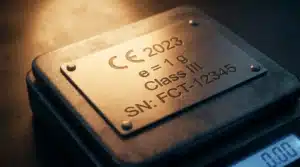
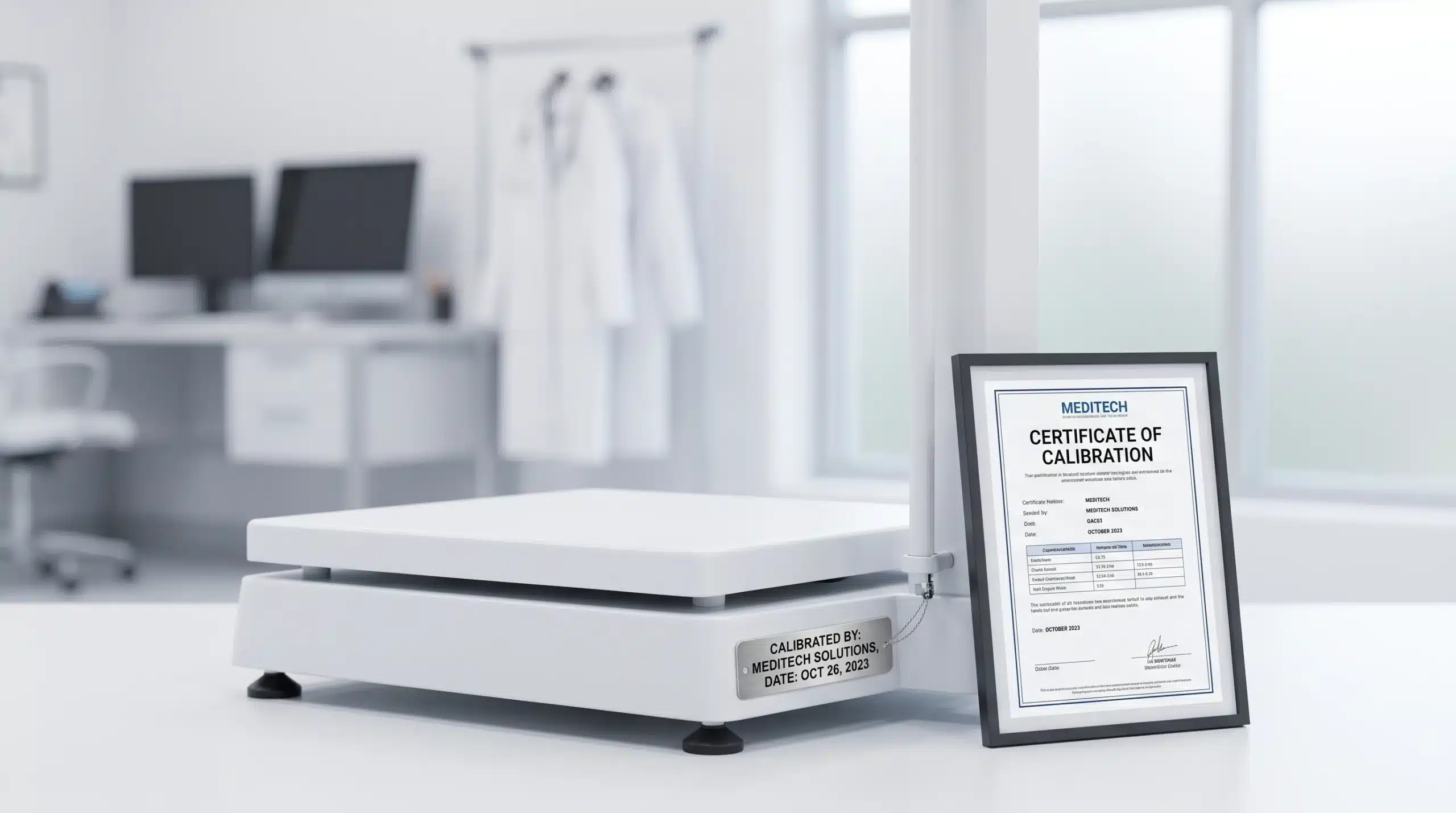 A calibration tag and certificate are the documented proof that a scale currently meets its accuracy requirements — not just a claim.
NIST Handbook 44 specifies calibration to a minimum of 25% of a scale's capacity, or 300 lb — whichever is greater. In practice, that means a scale with a capacity between 300 and 1,200 lb should be calibrated using at least 300 lb of certified test weight, while scales rated 300 lb or less should be calibrated at their full maximum capacity. We recommend checking the tolerance specifications in your own scale's manual rather than assuming any device meets industry requirements out of the box.
Scale Calibration Accuracy Requirements by Use Case
Not every scale answers to the same bar. Here's roughly how tolerance requirements tighten as the stakes rise:
| Use Case | Typical Tolerance Basis | Calibration Authority |
|---|---|---|
| Home / kitchen scale | Manufacturer spec, no external enforcement | None — self-checked |
| General commercial (non-trade) | Manufacturer spec, internal QA policy | Internal or contracted technician |
| Legal-for-trade (retail, freight, scrap) | NIST Handbook 44 tolerance classes | NTEP + state weights and measures official |
| Laboratory / analytical balance | OIML or ASTM weight class matched to instrument precision | Accredited calibration lab |
| Medical / patient scale | Manufacturer spec + facility policy (no single federal standard) | Biomedical engineering or contracted scale service |
This table is a simplified reference — the exact scale calibration accuracy requirements that apply to your equipment depend on its specific use, capacity, and any regulations tied to your industry, not just its category label.
How Often to Calibrate
How frequently you calibrate depends on how heavily the scale is used and how strict its scale calibration accuracy requirements are:
- Daily commercial use: check every 1–3 months.
- Laboratory or medical use: check monthly, or per your facility's protocol.
- Light home use: check every 6–12 months.
- After any drop, shock, or move: check immediately, regardless of schedule.
Many facilities default to annual calibration unless a discrepancy is noticed sooner — but given that uncalibrated scales in the published research ran 150% more imprecise on average, "annual and only if something seems wrong" is a real risk for anything used daily.
Legal-for-Trade Scale Calibration Accuracy Requirements
Scales used in commerce — retail checkouts, shipping departments, scrap yards — fall under legal-for-trade rules, which set stricter scale calibration accuracy requirements than personal or general business scales. These devices typically need NTEP approval and registration with a local weights and measures authority, plus calibration by a certified technician rather than a self-check.
Businesses that skip this step risk fines and, in some cases, having the scale disqualified from use in transactions entirely.
Medical Scale Calibration Accuracy Requirements
Medical settings carry the highest-stakes scale calibration accuracy requirements of any use case, because some medications — particularly for renal disease and certain cancers — are dosed by patient weight. An inaccurate weight can mean a patient receives too little or too much medication.
A four-year review of state health event reports by the Pennsylvania Patient Safety Authority found 479 medication errors resulting from inaccurate patient weights, with 67% resulting in the patient receiving the wrong dose, and more than 1% causing harm serious enough to require additional treatment. Separately, research published in the American Heart Association's Circulation journal found that a weight gain of just 2 pounds or more is associated with increased risk of heart failure hospitalization in certain patient populations — which means an inaccurate scale doesn't just misreport a number, it can mask a real early warning sign.
The FDA and The Joint Commission don't set specific calibration standards for medical scales directly; instead, they require facilities to maintain a regular, appropriate maintenance program consistent with manufacturer specifications and recognized standards from NIST, ISO, and ASTM. In practice, many hospitals and networks calibrate annually at minimum, more often for high-use equipment, and always after any incident that could have affected accuracy.
Calibration Weights and Meeting Requirements
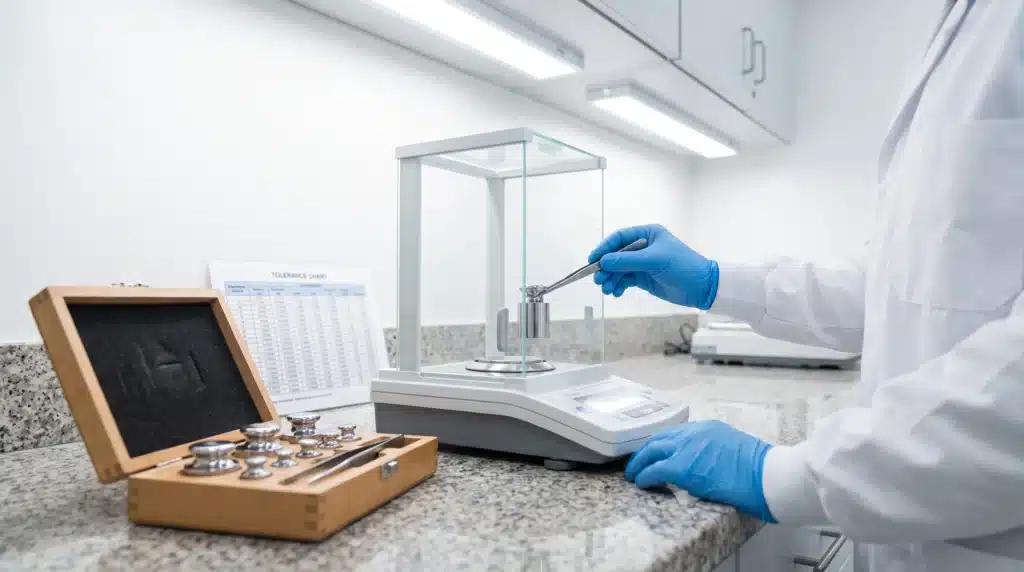
Calibration weights are the reference standards used to test whether a scale meets its scale calibration accuracy requirements, made in materials including brass, stainless steel, and cast iron, each rated to a specific tolerance class. Choosing the correct weight class matters — a scale certified to a tighter tolerance needs weights manufactured to match that same precision, or the test itself becomes unreliable. See our calibration weights guide, and OIML weight classes explained for how that grading works.
For a weight to count as "certified," it must be traceable back to the master weights maintained by NIST, with no gaps in the chain of certification — and re-certified periodically, typically annually, to stay valid.
Calibrating Without Certified Weights at Home
Not everyone needs to meet formal scale calibration accuracy requirements, and for casual home use, that's fine. A US nickel weighs exactly 5.000 grams and works well as a reference point for a pocket or kitchen scale — see how much does a nickel weigh and our how to calibrate a digital scale walkthrough for the full process.
Home substitutes like coins can verify general accuracy, but they should never replace certified weights when legal-for-trade, medical, or laboratory accuracy requirements are actually on the line.
Common Mistakes That Violate Accuracy Requirements
Most failures to meet scale calibration accuracy requirements don't come from a single dramatic event — they come from small, repeated habits that quietly push a scale out of tolerance:
- Skipping the warm-up period. Many digital scales need 15–60 seconds after power-on before a reading is stable; testing immediately can make a perfectly good scale look out of tolerance.
- Using approximate rather than certified weights for anything beyond a casual home check, then treating the result as if it satisfies formal accuracy requirements.
- Calibrating on an uneven or unstable surface. A scale can meet every other accuracy requirement on paper and still read wrong if it's not level and stationary.
- Ignoring environmental drift. Temperature swings, humidity, and vibration all shift a scale's baseline over time, even between scheduled checks.
- Treating "passed once" as "compliant forever." Scale calibration accuracy requirements assume an ongoing schedule, not a one-time certificate that never gets revisited.
Fixing these five habits closes the gap between owning a scale that's capable of meeting accuracy requirements and one that actually does, day to day.
How to Verify Your Scale Meets Requirements Right Now
Before assuming your equipment satisfies its scale calibration accuracy requirements, run this quick real-world check — it takes under five minutes and catches most scale calibration accuracy requirements failures without needing certified reference weights:
- Confirm the scale is level and on a stable surface, away from vibration, drafts, and direct sunlight or heat.
- Let it warm up per the manufacturer's recommendation before testing anything.
- Zero the scale with nothing on the platform and confirm it settles cleanly at 0.
- Apply a certified reference weight (or a US nickel for a rough home check) and compare the reading against the expected value.
- Repeat the test 2–3 times without moving the scale — inconsistent results across repeats is itself a sign of a problem, even if any single reading looks fine.
If the scale passes this quick check consistently, it's likely meeting its accuracy requirements for routine use. If it doesn't, that's the signal to move to a full calibration or professional service, not to keep testing until you get a result you like.
Signs Your Scale No Longer Meets Requirements
Scales rarely fail scale calibration accuracy requirements all at once — they drift slowly, which is exactly why routine checks matter. Watch for:
- Readings that change slightly each time you reweigh the same object.
- A display that won't return to zero after removing weight.
- Inconsistent results between two scales weighing the same item.
- Visible physical damage from drops, moisture, or debris buildup.
Any of these is a sign to run a calibration check immediately, rather than waiting for the next scheduled interval.
Conclusion
Scale calibration accuracy requirements aren't a bureaucratic formality — they're the difference between a number you can act on and one you're just guessing at. The published data is blunt about the stakes: a third of tested hospital scales inaccurate, 15% of physician-office scales off by more than 6 pounds, hundreds of documented medication errors traced directly to bad weights. Whatever tier your scale falls into — home, commercial, legal-for-trade, or medical — the fix is the same: know your actual tolerance, test against it on a real schedule, and use a reference weight that matches the precision you're claiming.
Meeting scale calibration accuracy requirements once is easy. Meeting them consistently, year after year, is the part that actually protects your business, your lab, or your patients.
Frequently Asked Questions
What are scale calibration accuracy requirements?
Standards that define how close a scale's reading must be to a certified reference weight before it's considered reliable — usually expressed as a tolerance in grams, pounds, or a percentage of capacity. Requirements get stricter moving from home use to commercial to legal-for-trade to laboratory and medical use.
How often should scales be calibrated to meet accuracy requirements?
Most facilities calibrate annually at minimum, with high-volume commercial and medical scales checked quarterly to monthly. Published research found scales not calibrated in the past year were 150% more imprecise on average than recently calibrated ones.
How many patient scales actually fail accuracy requirements?
A study of nearly 8,000 patient scales across 200 hospitals found more than a third were inaccurate. A separate study found over 15% of scales at physician offices and fitness centers showed an average inaccuracy greater than 6 pounds.
Do legal-for-trade scales have stricter accuracy requirements?
Yes. Scales used in commerce must meet NTEP-approved tolerances under NIST Handbook 44, be verified by a state weights and measures official, and are held to a stricter standard than a home or general commercial scale.
Can I calibrate a scale without certified weights?
For casual home use, yes — a US nickel weighs exactly 5.000 grams and works as a rough reference. For legal-for-trade, medical, or laboratory equipment, only certified weights traceable to NIST satisfy accuracy requirements.
Why do medical scale accuracy requirements matter so much?
Some medications are dosed by patient weight, so an inaccurate scale can lead to the wrong dose. A four-year review by the Pennsylvania Patient Safety Authority found 479 medication errors tied to inaccurate patient weights, 67% of which resulted in the wrong dose being given.
What's the single most common mistake that violates scale calibration accuracy requirements?
Skipping the scale's warm-up period before testing or use, and treating an approximate weight as if it satisfies certified reference standards. Both are easy to fix and account for a large share of "out of tolerance" results that aren't actually equipment failures.
How do I quickly check if my scale currently meets its accuracy requirements?
Level the scale, let it warm up, zero it, apply a certified (or nickel, for casual use) reference weight, and repeat the test 2–3 times without moving the scale. Consistent, correct readings across repeats are a good sign; drift or inconsistency means it's time for a full calibration.
More Related Guides
- Legal for Trade Scales — scalecalibration.net/legal-for-trade-scales/ — what commercial accuracy requirements actually demand.
- NIST Handbook 44 Explained — scalecalibration.net/nist-handbook-44-explained/ — the rulebook behind most scale tolerance standards.
- Calibration Weights: Which Class & Size — scalecalibration.net/calibration-weights/ — the certified references every accuracy check depends on.
- OIML Weight Classes Explained — scalecalibration.net/oiml-weight-classes/ — how weight-class tolerance grading works.
- How to Calibrate a Digital Scale — scalecalibration.net/how-to-calibrate-a-digital-scale/ — the everyday process for scales that don't need certified weights.